
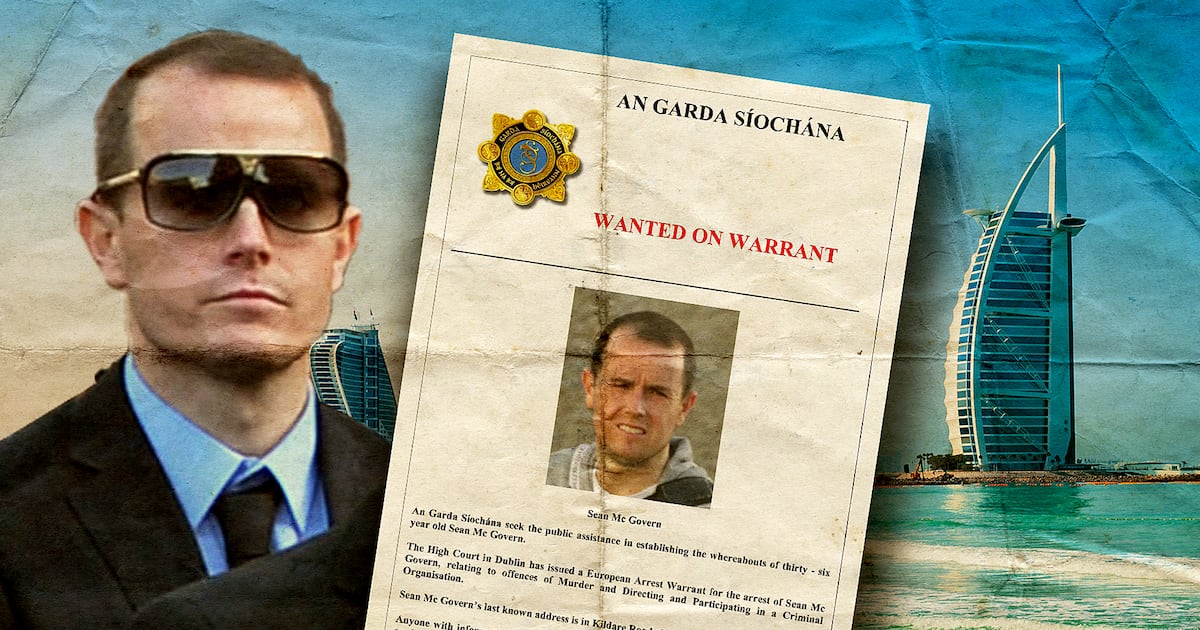
Kinahan gang member Seán McGovern swore on his baby’s life that he would not stop following the 2016 Regency hotel attack, the Special Criminal Court has been told.
McGovern was heard “discussing targets” with a man referred to as ‘Cap’ in February 2016: “They targeted us, they wanted you, this is personal”, Det Supt David Gallagher said.
McGovern also swore on his baby’s life, saying: “I’m not stopping now.”
They also discussed going after other relatives of the Hutch family while Cap described the Hutch gang as ‘scum’ and said he would not stop until they are “all gone”.
In a later exchange, when the Kinahans were targeting James Gately, McGovern described Gately as a weasel and added: “All weasels get caught out in the end.”
McGovern, dressed in black jeans and a black shirt, was brought amid tight security before the three-judge non-jury court for sentencing on Monday. He pleaded guilty to two counts of directing organised crime, linked to a murder and an attempted murder, during the Kinahan-Hutch feud.
He was arrested in Dubai in October 2024 on foot of an extradition request from Ireland. He became the first Irish criminal to be extradited from the United Arab Emirates in May 2025 and has been in custody since.
On Monday, the court heard McGovern told an individual named “Cap” in February 2016 that “this is personal”, Gallagher said.
Investigations also linked McGovern with tracker devices used by members of the Kinahan organised crime group to track Hutch associate James “Mago” Gately, Gallagher said.
The Kinahan organised crime group believed Gately was involved in the Regency attack carried out by the Hutch organised crime group, during which Kinahan gang member David Byrne was killed and McGovern was wounded, the court heard.
During a conversation between McGovern and another man in March 2017, the other man was recorded saying: “Ha ha, we get Mago this week”, the court was told on Monday.
McGovern, with a previous address at Kildare Road, Crumlin, Dublin 12, has pleaded guilty to a charge of directing the activities of a criminal organisation between October 20th and December 22nd, 2016, both dates inclusive both within and outside the State, in relation to the murder of Christopher “Noel” Kirwan.
He was initially charged with the murder of Kirwan (62) but since his extradition, and his pleading guilty to the two charges of directing organised crime, the Director of Public Prosecutions did not proceed with the murder charge.
McGovern also admitted directing the activities of a criminal organisation between October 17th, 2015, and April 6th, 2017, both dates inclusive both within and outside the State, in connection with the surveillance of Hutch associate Gately in preparation for the commission of an indictable offence.
McGovern was previously named during a separate trial at the Special Criminal Court as “a significant figure” with a “leadership role” in the Kinahan organised crime group.
In evidence on Monday, Gallagher told the court he played a lead role in the investigation in the matters before the court.
The charges against McGovern arose from the feud between the Kinahan and Hutch organised crime gangs, which began during 2014 and resulted in violence in Ireland and Spain, he said. That violence included the shooting in Spain of Gary Hutch.
The feud escalated after the murder of Gary Hutch and culminated in the “significant watershed moment” of the Regency hotel attack by the Hutch organised crime group in February 2016, during which Byrne was killed and McGovern was wounded.
The court was shown a presentation outlining six different areas of investigation that contributed to the evidence against McGovern.
The six areas were operations by An Garda Síochana, involving surveillance, information and “interventions” during 2015 and 2016; evidence recovered from a satellite navigation device; data from telephones; evidence from GPS tracking devices; CCTV evidence and evidence from encrypted devices.
Searches were also carried out at various locations, including McGovern’s home.
Gallagher said certain software used on some devices has a legitimate purpose in the business world but was taken advantage of by the criminals. It involves using a specific mail service on the network confined to a particular administrator and users and was a closed network. Multiple Blackberry devices were seized and analysed and some of those were relevant to the case against McGovern.
The evidence linked some of the devices seized to McGovern and to other Kinahan gang members who have been convicted here and in the UK, the court was told.
The hearing is continuing.