
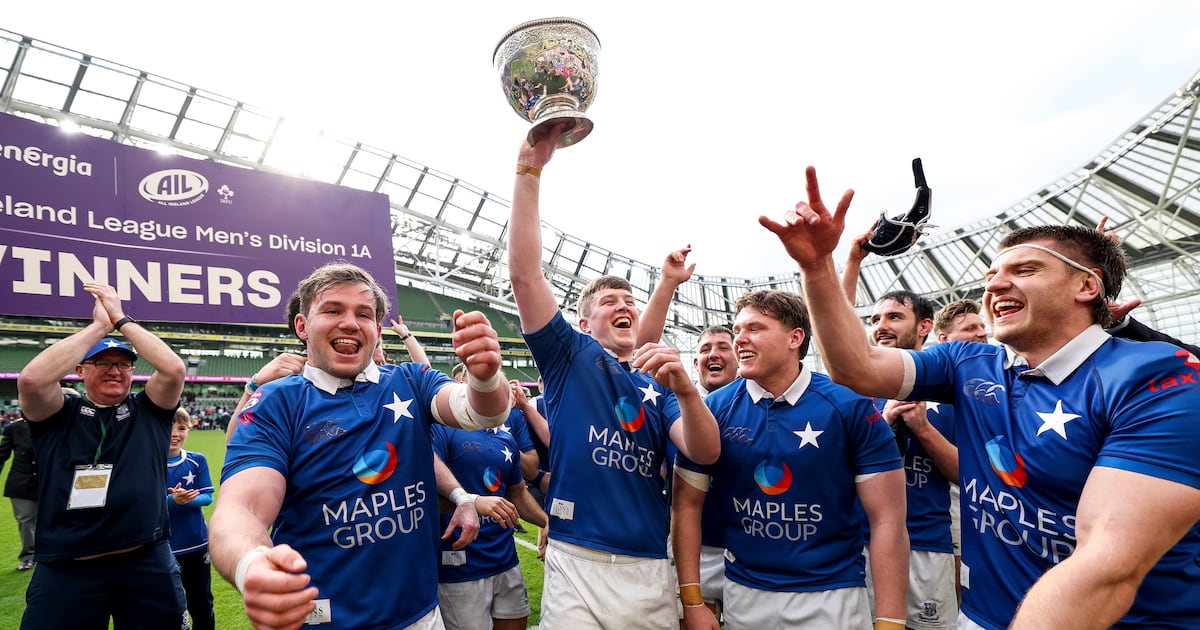
It’s not often this can be said confidently, but Irish club rugby appears to have a major new force in the game. Having ended a seven-year stay in Division 1B, when they even flirted with relegation to the third tier, St Mary’s College became the first newly promoted side to reach the 1A playoffs last season, and then last Sunday claimed their third AIL crown and first since 2012.
Perhaps all title winners deserve to be recognised as worthy champions, but some more so than others and there’s no doubting the merit of this achievement by St Mary’s.
Mark McHugh’s side topped the table over the regular 18-game season. They then rose to the occasion by beating neighbours Terenure College in a record Templeville Road 4,500 sell-out in the semi-finals, before dethroning reigning champions Clontarf by 46-31 in Sunday’s final in front of almost 7,000 supporters.
That leaves little room for argument. With Conor Dean pulling the strings in attack, they can pull a side all over the pitch, but under Jamie Cornett they also had the best defence in the top flight, as they demonstrated particularly in their semi-final win over Terenure.
This triumph, the club’s first since 2012, was also years in the making, and it seems fitting that the club’s president, Gareth Logan, and head coach McHugh were both players in the team of 1999-2000 which last played in a Lansdowne Road decider when beating Lansdowne to become the first Leinster winners of the AIL and end the Munster domination.
[ St Mary’s outclass Clontarf to complete journey back to the Promised LandOpens in new window ]
They are a very well-run club, as well as one with a rich history and a long list of Irish and Lions internationals from a very wide base. Credit must also go to Seán Cronin, the former head coach who was hired by Munster for McHugh to take over.
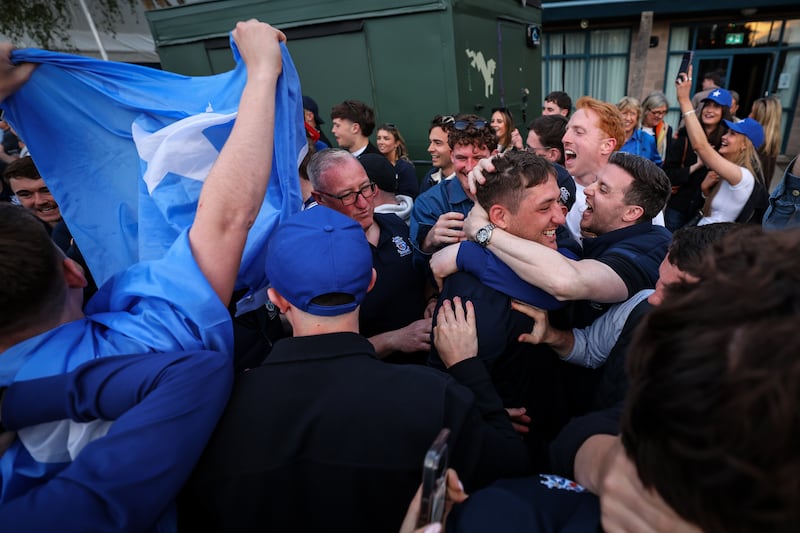 Dan Goggin is welcomed by fans at St Mary’s College RFC following their victory in the AIL final on Sunday. Photograph: Ben Brady/Inpho
The acquisitions of Greg Jones and Dan Goggin on foot of promotion were undoubtedly statement signings and proof that champions need a sprinkling of quality from the pro game, although their relative lack of players in the provincial set-ups has possibly been an advantage.
St Mary’s seem to have the most settled side and Dean, this season’s club captain, last week pointed out that a core of five players all became centurions for St Mary’s this season.
What’s more, the club’s future looks bright. Those centurions and most of the squad have a few more years in them. The St Mary’s College schools side won the Leinster Senior Cup for the first time in 24 years this season, two years on from winning the Junior Cup. The club are also working more productively with Templeogue College and have almost completed a new padel complex on site at Templeville Road which will become a source of income for years to come.
The other contenders are unlikely to go away, most obviously Clontarf, who have now reached 10 of the last 13 finals. Whether or not they still feel cursed when it comes to finals given their return has been four titles is a moot point. But the curse of the champions grows bigger.
Shannon were the last club to retain the AIL in 2006, since when eight champions have finished as runners-up the next season. Furthermore, this has now happened for four seasons running – 2022-23 Clontarf, 2023-24 Terenure, 2024-25 Cork Constitution and Clontarf 2025-26.
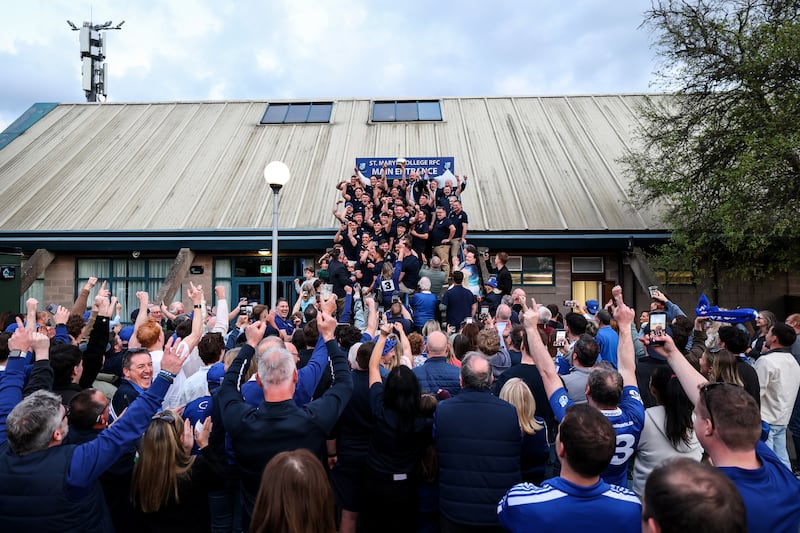 The St Mary’s College team and supporters celebrate with the trophy at the club after the game. Photograph: Ben Brady/Inpho
As well as all four semi-finalists being Leinster clubs for the first time, Dublin clubs have been champions in 10 of the last 13 AILs, with Cork Con being the exception on all three other occasions. Next season, for the first time ever, seven of the 10 1A clubs will be from the capital city. This is partially a reflection of socio-economic factors but it is not healthy.
In its recent review of the AIL, when employing the former European Rugby Cup chief executive Derek McGrath to canvass all stakeholders, the IRFU’s main resulting recommendation was to divide 2B and 2C into regional divisions – something they’d long since argued for anyway – and the fear lurks that this will make them glorified amateur clubs.
One wonders, at times, how much the IRFU – and to a lesser extent the provinces – really care about the club game, and what exactly it wants from the AIL. The league is an invaluable breeding ground for academy players and late developers, but one of the most frustrating aspects of the club/provincial game is that so many talented young players simply do not play enough rugby.
The regulations decree that contracted players must have made three starts to be eligible for the last four games plus the playoffs, regardless of how many games they have played for their province. This too often backfires and disqualifies players like Ruadhán Quinn and Cormac Foley from the end-of-season run-in. It should be related to how many games they have played for their provinces as well.
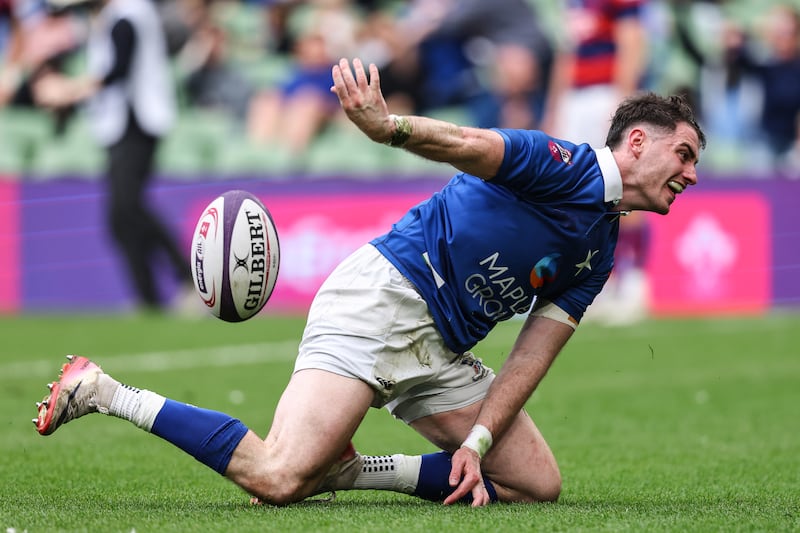 Ruairi Shields of St Mary’s College celebrates after scoring his side’s fourth try at the Aviva Stadium. Photograph: Ben Brady/Inpho
The IRFU’s review made no mention of regulation 6 regarding the payment of players. The universities are being stung on all sides, and the costs of running a club on a hand-to-mouth existence are exorbitant. Wealthy benefactors and/or sponsors are crucial. Many clubs are selling vast swathes of their Ireland international tickets to stay afloat and you can’t really blame them.
The 4,500 attendance for the UCD-Trinity 1A/1B play-off final in the UCD Bowl was in part the consequence of the semi-finals having taken place a week beforehand. Likewise, the 1A semi-finals and finals should be a fortnight apart.
The 1A final is being shortchanged by being run off with indecent haste just a week after the semi-finals, and it is not especially fair on part-time or amateur players. The final also deserves to be held on the Sunday of a bank holiday weekend.
The AIL is a brilliant product. It really is. But it could be better still.
gerry.thornley@irishtimes.com