
Main PointsUS president Donald Trump is unhappy with the latest proposal from IranIran says it needs “credible guarantees” against more US-Israeli attacks before it can ensure security in the GulfThe UAE is quitting Opec, a heavy blow to the group of oil-exporting countries amid the ongoing conflict in the regionKing Charles, in a state visit to the US, stressed the importance of Nato and other alliances in a “contested world”With the US and Iran sides seemingly far apart on a possible peace deal, oil prices continued to rise, with Brent crude up to around $111 a barrelGlobal oil prices have risen around 50 per cent since the US and Israel invaded Iran Best reads
Naomi O’Leary – 14 minutes ago
Trump threatens Iran in early morning social media post
It has just turned 5am in Washington, DC, and United States President Donald Trump has begun the day by posting a threatening message on his social media platform Truth Social.
“Iran can’t get their act together. They don’t know how to sign a nonnuclear deal. They better get smart soon!” Trump wrote.
The text was published with an image of Trump holding an assault rifle in front of a town being hit by explosions, with the text “no more Mr. Nice Guy!”
Naomi O’Leary – 19 minutes ago
Energy credits can’t ‘be ruled out’, Simon Harris says
Tánaiste and Minister for Finance Simon Harris has said that energy credits next winter cannot be ruled out.
“I think it would be a foolish and arrogant government that would rule out anything right now,” he told Newstalk’s Claire Byrne show.
The Tánaiste suggested that the crisis was unlikely to be resolved in the short term.
“If I thought this crisis was going to end today, tomorrow, next week, next month, of course we could have different conversations on what to do in the here and now,” Harris said. “But I have to be honest with people about the winter.”
He defended the government’s support package for the sectors impacted by fuel price rises in the wake of the conflict in the middle east.
“It does make sense to target in the first instance the sectors that are most dependent on fuel, not just for those sectors, but actually for the broader benefit of the Irish economy, because there’s a huge, huge, huge link between the cost of fuel and the level of inflation,” he said.
Naomi O’Leary – 43 minutes ago
The EU should use €95 billion to electrify transport, industry and heating, von der Leyen urges
Of funds allocated to energy in the current EU budget, €95 billion is still unspent and should be used to electrify the continent, European Commission President has told the European Parliament.
Let us use this to make the switch now to electricity, not just in transport but also in industry and in heating,” von der Leyen said.
“This is not only a matter of affordability and competitiveness. This is also, as we learned in this crisis, a matter of economic security.”
She warned national governments against rolling out blanket fuel subsidies, saying supports must be targeted towards “the most vulnerable households and industries” to avoid pushing up demand for oil and gas.
Some €350 billion was spent on untargeted measures during the last crisis, with only a quarter going towards the most vulnerable, she said.
“This had a huge impact on member state finances, and it also undermined the measures to protect those most in need, so let’s not make the same mistake again and let’s focus our support where it matters most,” she said.
She has urged EU countries to coordinate on purchases of diesel and jet fuel to avoid competing against each other and inadvertently driving the price up higher.
Flights resume from Tehran’s main airport
International flights have resumed from Tehran Imam Khomeini International Airport in the Iranian capital after a shutdown of 57 days due to the war.
International flight tracking data shows that flights departed this morning and yesterday to Istanbul and Beijing.
Arrival flights are scheduled today from Dubai, Iraq, Thailand, and a number of Chinese cities. Though running on a much reduced schedule, it’s a sign of how the ceasefire is allowing some measure of normality to resume.
Naomi O’Leary – 51 minutes ago
EU countries with more clean energy are less affected by the crisis, von der Leyen says
The surge in oil and gas prices has had an uneven effect across the European Union, punishing countries that have a heavy dependency on fossil fuels
“Member states with more low carbon sources in their energy mix are less impacted by the crisis,” European Commission President Ursula von der Leyen has told the European Parliament.
She gave the example of Sweden, where if the gas price increases by €1 per megawatt hour, the electricity price increases by only €0.04 per megawatt hour “because almost all of Sweden’s electricity comes from renewables and nuclear.”
“This is how we insulate ourselves from future shocks, and this is the path to independence for Europe,” she said.
Naomi O’Leary – 1 hour ago
Europe’s bill imported fossil fuel bill rose €27 billion in 60 days
European Commission President Ursula von der Leyen has presented a price tag for the United States and Israel’s decision to go to war with Iran to the European Parliament: €27 billion.
That’s how the European Union’s bill for importing fossil fuels rose in the 60 days since the war began.
“This is the second energy crisis within four years, and the message should be very clear. Our over-dependency on imported fossil fuels makes us vulnerable,” von der Leyen told MEPs.
“The way forward is obvious. We must reduce our overdependency on imported fossil fuels. We must boost our homegrown affordable clean energy supply, from renewables to nuclear.”
All EU member states want a lasting ceasefire and a return to freedom of navigation in the Strait of Hormuz, with no tolls, she said. But things may not be returning to how they were for some time.
“There’s a harsh reality we all need to face. The consequence of this conflict may echo for months or even years to come,” von der Leyen told the parliament.
European stocks rise as earnings take centre stage
European shares ticked higher on Wednesday, after three straight sessions of declines, as investors turned their focus to a busy run of corporate earnings, while US-Iran talks remained at an impasse.
The pan-European STOXX 600 rose 0.2 per cent to 607.54 points shortly after 8am Irish time. European equities remain almost 5 per cent below pre-war levels, lagging US peers and global markets, which have rebounded, partly driven by gains in AI and tech stocks.
On the earnings front, Adidas advanced 8.2 per cent after the German sportwear maker reported better-than-expected first-quarter operating profit.
UBS gained 5 per cent after the Swiss bank posted first-quarter net profit above expectations despite market turbulence due to the Middle East war.
Deutsche Bank reported its largest-ever profit under CEO Christian Sewing and upgraded its 2026 investment bank revenue outlook. However, its shares fell 2.8 per cent. – Reuters
Von der Leyen says impact of Iran war may be felt for years to come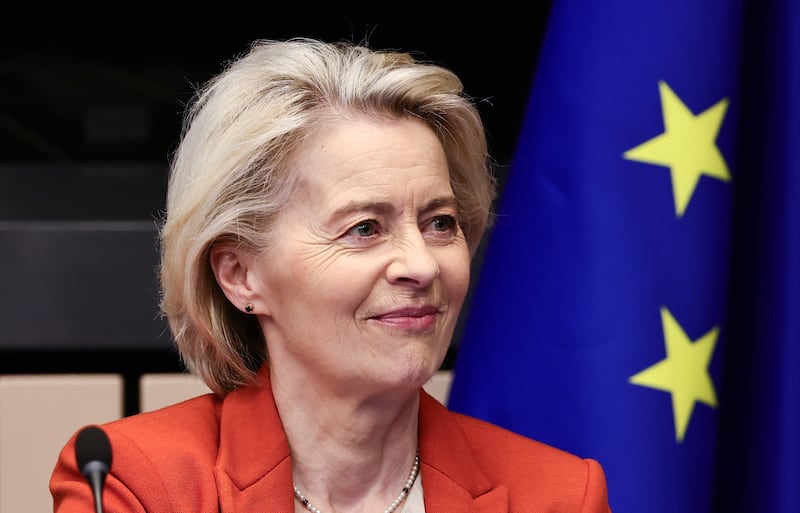 European Commission President Ursula von der Leyen, pictured yesterday, said the EU should focus on clean energy supply. Photography by Ronald Wittek/EPA
The European Union needs to reduce its overdependency on imported fossil fuels, European Commission president Ursula von der Leyen has said.
In a speech to EU lawmakers on Wednesday morning, von der Leyen said the bloc should focus on clean energy supply.
On the Middle East, she said the EU wants the ceasefires in Iran and Lebanon “to hold” with urgent need to “re-establish peace and stability through diplomatic means”.
But she warned: “The consequences of this conflict may echo for months or even years to come.”
She continued: “This is the second energy crisis within four years, and the lesson should be very clear. Our overdependency on imported fossil fuels makes us vulnerable…
“We must reduce our overdependency on imported fossil fuels and boost our home-grown, affordable, clean energy supply. From renewables to nuclear, in full respect of technology neutrality.”
Von der Leyen also said the EU needs to “protect consumers and businesses” but should target “the most vulnerable households and industries only”. – The Guardian
Government to announce details of fuel support scheme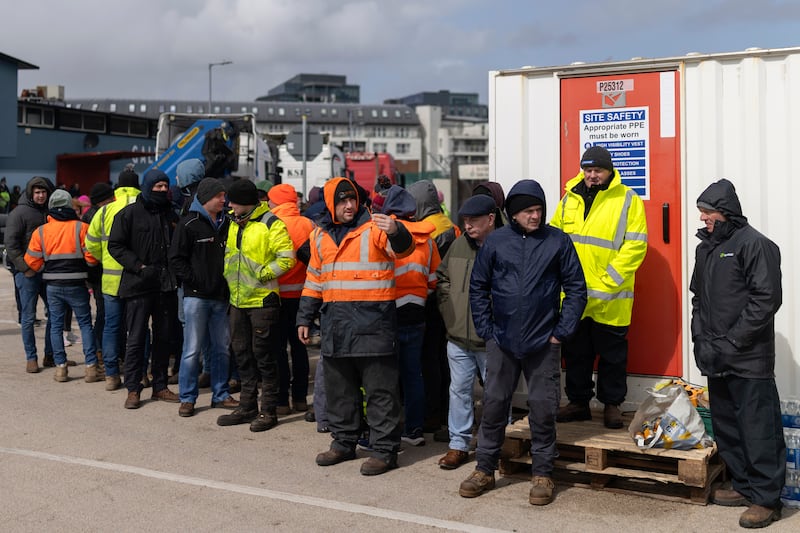 Fuel protesters blocking the oil depot at the port in Galway on April 11th. Photograph by Chris Maddaloni/The Irish Times
The Government is due to announce details of its fuel support scheme later today. The measures are aimed at supporting agriculture, transport and other sectors.
The scheme was drawn up in response to the fuel protests earlier this month. The €505 million package was larger than expected and involves an extension of and increase to excise duty cuts on petrol and diesel.
Minister for Agriculture Martin Heydon and Minister for Transport Darragh O’Brien will outline more details at a press conference at Government Buildings today.
EU agri-food groups call for critical status, priority energy access amid Middle East crisis
European farming, food and retail associations on Tuesday called for the EU agri-food chain to be formally recognised as critical infrastructure, urging policymakers to grant operators priority access to energy and key inputs at affordable and competitive rates.
Middle East instability is increasing volatility in energy, logistics and input markets vital to Europe’s food production and distribution, CEJA, Copa-Cogeca, CELCAA, FoodDrinkEurope and EuroCommerce said
The groups said costs for energy, fertilisers, freight, packaging and agricultural raw materials are already rising across the value chain, risking higher grocery prices and weaker food affordability without urgent EU action.
The associations urged EU and national authorities to guarantee farmers, processors, traders, retailers and wholesalers secure and predictable access to energy and key inputs.
They said targeted, temporary and EU-coordinated measures may be needed for the most exposed actors. – Reuters
Heathrow Airport warns Iran war will hit 2026 passenger numbers
Heathrow Airport on Wednesday said its passenger numbers for the rest of year are likely to be impacted by the Iran war, despite temporarily absorbing demand from elsewhere following airspace closures in the region.
The UK’s biggest airport reiterated an uncertain outlook for the year, but said 18.9 million passengers travelled through the west London hub in the first quarter, a 3.7 per cent increase from a year ago. – Reuters
Trump ‘rejects’ interim Hormuz deal proposed by Iran
Trump on Tuesday said Iran had asked the US to lift the naval blockade of the Strait of Hormuz.
Tehran wants the critical waterway for oil and gas shipments open “as soon as possible, as they try to figure out their leadership situation”, Trump said on Truth Social. Iran has said it’s in a “State of Collapse”, he added.
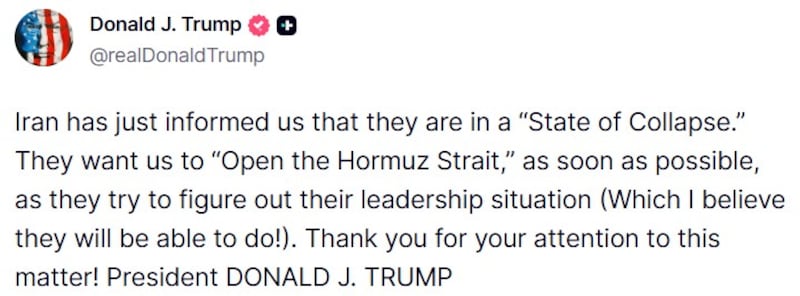 Iran has said it’s in a “State of Collapse”, Trump said on Truth Social.
Iran has signalled it may be willing to accept an interim deal to reopen the strait in exchange for Washington ending its blockade of Iranian ports, while postponing more complex negotiations over the country’s nuclear programme. It is insisting on keeping some control over shipping through the strait, which Washington is unlikely to accept.
Trump rejected that offer from Iran, according to the Wall Street Journal, and told aides it showed that Iran wasn’t negotiating in good faith. Mediators in Pakistan expect Iran will submit a revised proposal to end the war in the next few days, CNN reported on Tuesday, citing sources close to the mediation process. – Bloomberg
Oil prices rise to about $111 a barrel
Oil was steady as investors focused on the next steps for peace talks over the Iran war, with the near-closure of the crucial Strait of Hormuz prolonging disruptions that have upended global markets.
Brent traded near $111 (€94.90) a barrel after rising 2.8 per cent on Tuesday, and West Texas Intermediate was above $99 (€84.60).
US president Donald Trump said Iran has asked the US to lift a naval blockade of the strait while the two sides negotiate an end to hostilities that have choked off energy supplies from the Middle East. – Reuters
King Charles stresses importance of Nato 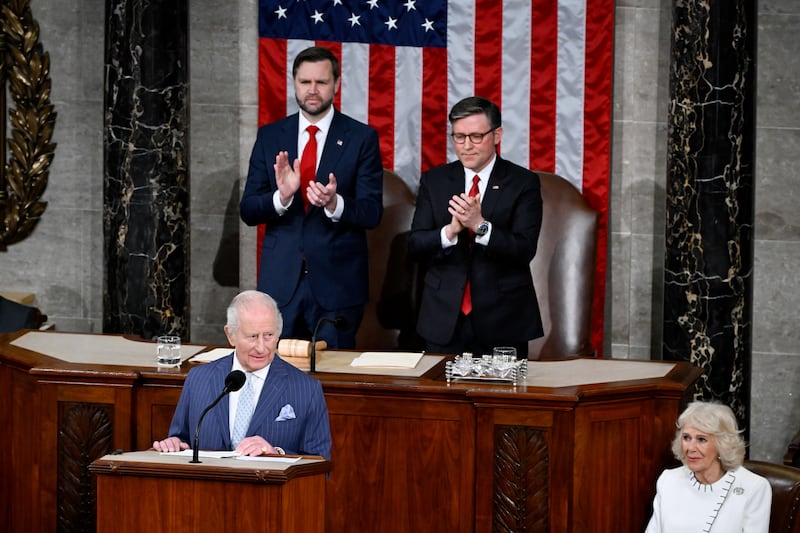 Britain’s King Charles with US vice president JD Vance, US House Speaker Mike Johnson and Queen Camilla during a joint address to Congress at the US Capitol in Washington on Tuesday. Photograph by Daniel Heuer/Bloomberg
Britain’s King Charles has extolled the importance of UK’s “special relationship” with the US in a speech to Congress that made pointed reference to the importance of Nato, the defence of Ukraine and the climate crisis.
“From the depths of the Atlantic to the disastrously melting ice-caps of the Arctic, the commitment and expertise of the United States armed forces and its allies lie at the heart of Nato, pledged to each other’s defence, protecting our citizens and interests, keeping North Americans and Europeans safe from our common adversaries,” he said.
In a speech that will be read as a veiled plea to Donald Trump to return to the US’s traditional European alliances and restore his country’s role as a defender of liberal values, Charles said: “America’s words carry weight and meaning, as they have since independence. The actions of this great nation matter even more.”
Charles’s appearance before the joint session of Congress – the first such royal address in 35 years – was billed as the centrepiece of his four-day state visit to the United States. – The Guardian
Trump tells aides to prep for lengthy Hormuz blockade
US president Donald Trump told his aides to prepare for an extended US naval blockade of the Strait of Hormuz, the Wall Street Journal reported, as the US looks to intensify economic pressure on Iran as the war enters its third month.
The US president, in meetings with top aides, decided to continue putting pressure on Iran’s ability to export oil by stopping any vessel heading to or from the Islamic Republic’s ports, the newspaper reported on Tuesday night. Trump determined that was a less risky option than resuming bombing or extracting the US from the conflict entirely, the outlet said.
The decision suggests that the US could be moving into a lengthy period with the fighting largely halted, but no durable resolution to the conflict, and the status of traffic through the Strait of Hormuz still uncertain.
The US has been blocking ships going to and from Iranian ports to try to squeeze the country of oil revenue, while Iran keeps the strait closed to almost all other traffic. – The New York Times
European airlines facing biggest challenge since pandemic
European airlines are facing their biggest challenge since the Covid-19 pandemic as the Iran war pushes up jet fuel prices and buffets travel through the Middle East, casting a shadow over the summer holiday season.
Carriers have been largely riding out the crisis with hedges that have tamed costs even as the price of jet fuel has risen nearly 84 per cent since the start of the conflict on February 28th, but they could face shortages if the war does not end soon.
“There is a risk that we’ll see rationing of fuel supply, particularly in Asia and Europe,” Willie Walsh, head of the International Air Transport Association, told Reuters on Tuesday, while adding that supply remained robust for now.
Irishman Walsh said, however, that the situation was not yet as bad as the disruption caused by the Covid-19 pandemic in 2020, which led to travel demand plummeting and hundreds of billions of dollars in losses for the aviation sector.
“I think Covid was on a completely different scale,” Walsh added. “What we’re seeing here is, in effect, a cost issue for the airlines. The underlying demand for aviation remains robust, and that’s a positive.” – Reuters
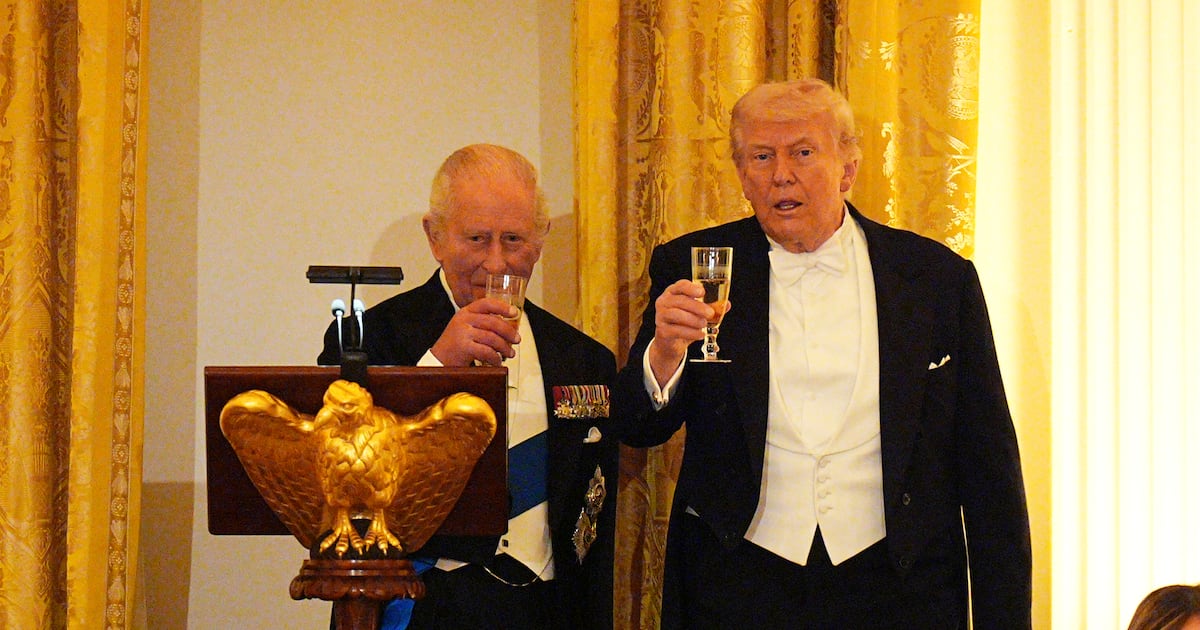
Trump says Charles agrees Iran should not have nuclear weapons 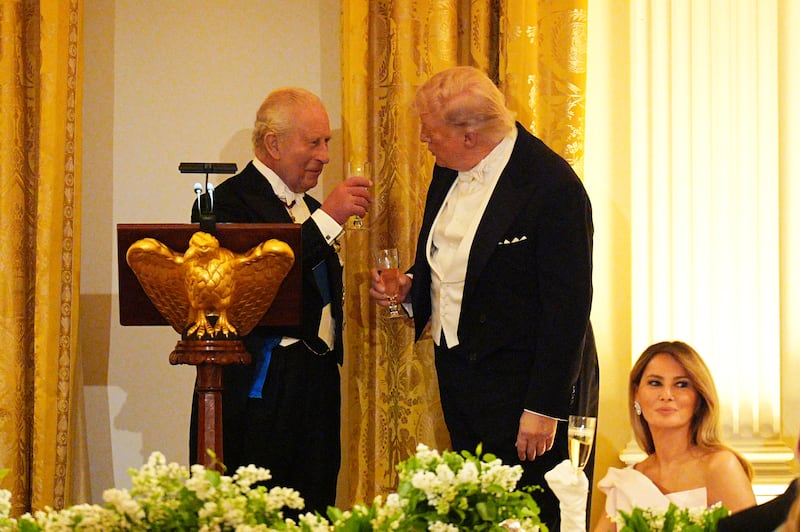 US president Donald Trump has said Britain’s King Charles agrees with him that Iran should never be allowed nuclear weapons. Photograph by Aaron Chown/PA Wire
Good morning. We’ll be bringing you the latest updates on the conflict in the Middle East throughout the day.
First up, here’s a roundup of what happened at the state dinner between the Trumps and the Mountbatten-Windsors last night.
US president Donald Trump insisted that Britain’s King Charles agrees with him that Iran should never be allowed nuclear weapons.
Trump made the remarks at the White House event on Tuesday night, saying he had “militarily defeated that particular opponent”.
Trump in his toast at the grand event in honour of Charles and Queen Camilla said: “We’re doing a little Middle East work right now … and we’re doing very well.
“We have militarily defeated that particular opponent, and we’re never going to let that opponent ever, Charles agrees with me even more than I do, we’re never going to let that opponent have a nuclear weapon.
“They know that, and they’ve known it right now, very powerfully.”
Charles told the dinner guests, who included Amazon founder Jeff Bezos and golfer Rory McIlroy: “And yes, we have had our moments of difficulty even in more recent history.
“When my mother visited in 1957, not the least of her tasks was to help put the ‘special’ back into our relationship after a crisis in the Middle East.”
Some of the guests laughed when Charles said: “Nearly seventy years on, it is hard to imagine anything like that happening today.” – Press Association