
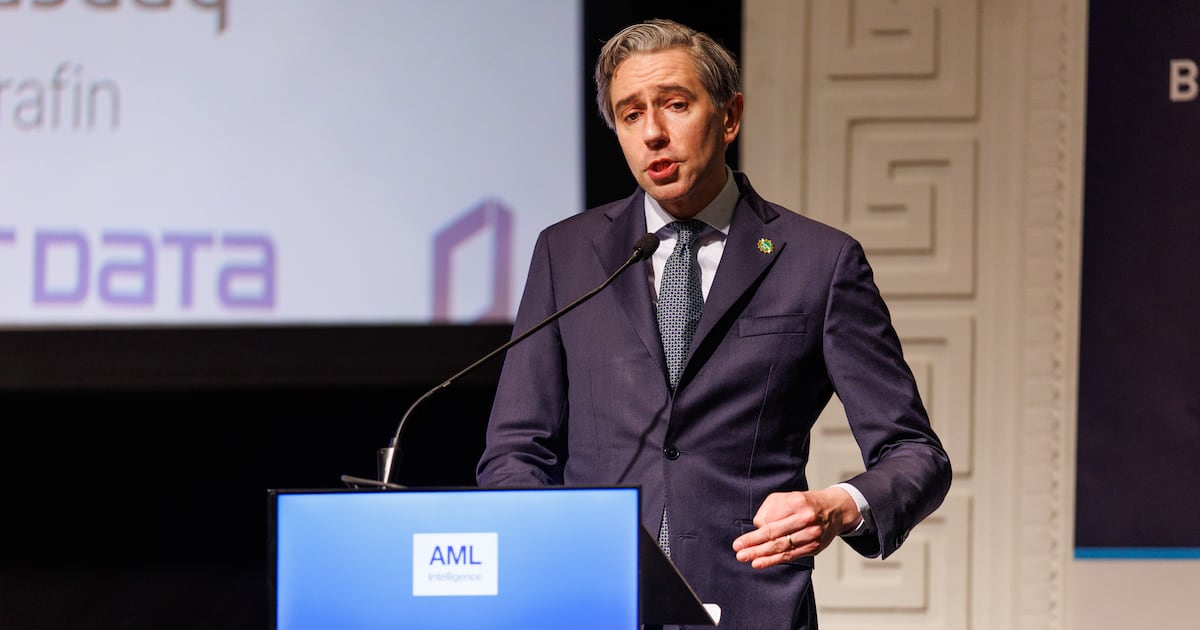
Tánaiste and Minister for Finance Simon Harris said “deep-faked” videos portraying him endorsing fraudulent investment products were so convincing he had to watch them twice to ensure they were not real.
Harris told an assembly of financial experts at the AML Intelligence European Anti-Financial Crime Summit at the RDS in Dublin that the “evolution of financial crime now fundamentally threatens the integrity of the financial system”.
One of those evolutions, Harris said, was the “emergence of deepfake technology being used to impersonate trusted individuals and promote fraudulent financial products online”.
The Tánaiste said he was one of the victims of the phenomenon.
“In recent months, a deepfake video circulated online falsely portraying me endorsing investment products that had no basis in reality,” he said.
The footage, though “entirely fabricated”, was so convincing that Harris said, with a laugh: “I had to watch it twice to check it wasn’t me.”
The video was posted following Harris’s announcement of plans for State-run savings and investment scheme for households aimed at making investing more accessible.
With considerable attention on the announcement, banking sector representatives contacted the Department of Finance to alert Harris to the videos.
“If those of us who are aware and are somewhat knowledgeable in this area have to look a second time, it shows the level and quality of these deepfakes,” Harris said.
He noted the videos generated by artificial intelligence (AI) were becoming more difficult for people to identify and easier for people to generate.
Harris stressed the need for public awareness on the matter, but he put the onus on technology companies.
Addressing the “tech giants” in Ireland, Harris said: “You can’t remove yourself from this conversation.
“Tech companies and social media are enablers if they don’t take strict action in relation to the massive crime [against] and exploitation of our citizens. It is a serious issue.”
He said that at a European level, the focus on financial crime could not merely focus on enforcement of banks, but there needed to be examination and scrutinisation of the role of big technology companies in the spread of deepfakes on social media.
This false information, Harris suggested, was distorting both “our democracy and our financial wellbeing”. He called for “very serious conversation” on how to tackle the “evolving and very damaging crime”.
Financial crime is a growing threat in Ireland, and across the world, with significant evolution in the scale, sophistication and impact due to the emergence of new technologies, the conference heard.
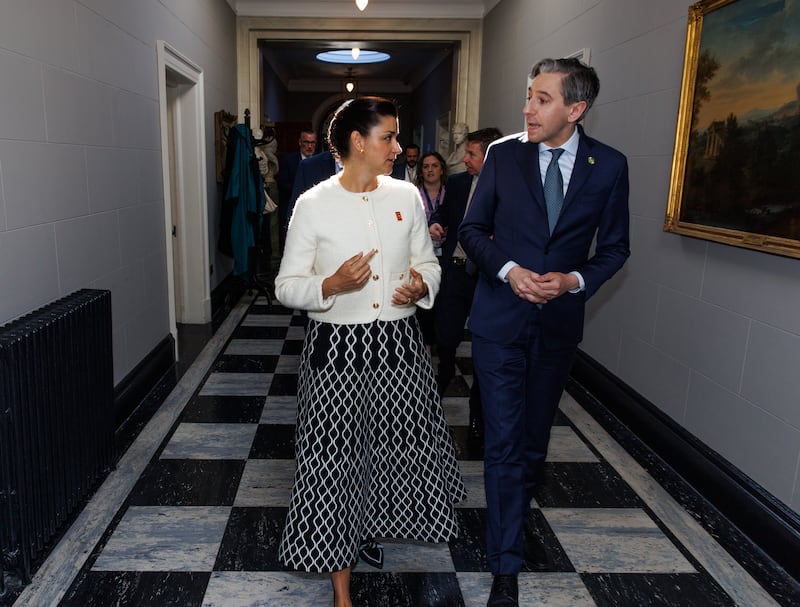 Simon Harris and Elisa de Anda Madrazo, president of the Financial Action Task Force, at the AML Intelligence European Anti-Financial Crime Summit at the RDS in Dublin. Photograph: AML
Among the other speakers, Patricia Dunne, a senior Central Bank of Ireland official, suggested the technology was “enabling the use of tools that were never meant to support financial crime”.
Dunne said criminals were gaining access to tools that allow them “faster and more efficient ways to deceive and break through regulatory controls and systems, causing significant harm to the [financial] system and to consumers”.