
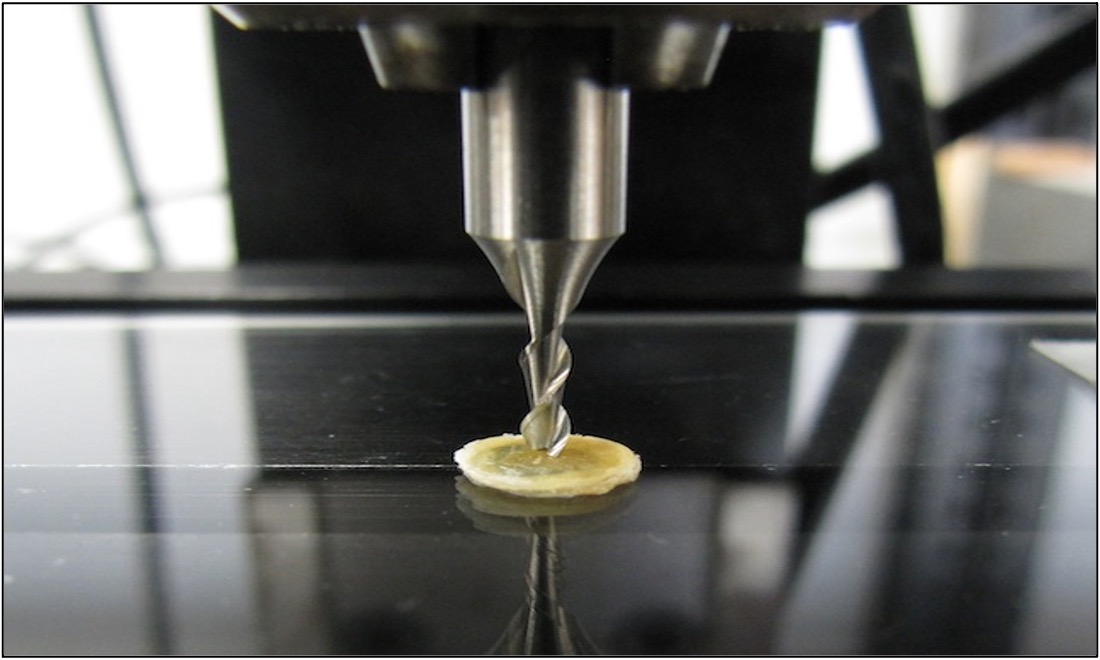
Radiocarbon signals have long been used to date archaeological items. But when researchers started using the method to age fish using their eyes, it created possibilities for other fields.
A team of UF researchers, including former UF postdoctoral researchers Bethan Linscott and Amy Wallace and UF Associate Professor of Biology Hannah Vander Zanden, Ph.D., applied the method to study the growth of turtle shells and found synchronous shifts in growth rates.
“The important part that we learned from this is now we have ages; we basically know how old tissue should be, and that helps us interpret stable isotope data from individuals to recreate their migratory or dietary history,” Vander Zanden said. “Now we know we have a more precise timeframe to characterize those patterns over time.”
Analysis of scutes, the plates that make up a turtle’s shell, which are made of keratin, has been used to understand turtles’ ecological pasts. However, the timelines represented by those samples were poorly understood.
This study established a scute growth rate by using sequential radiocarbon measurements on samples taken from loggerhead and green turtles. Since radiocarbon levels vary by location, the team used signals in local corals over time to understand those levels in their specific region.
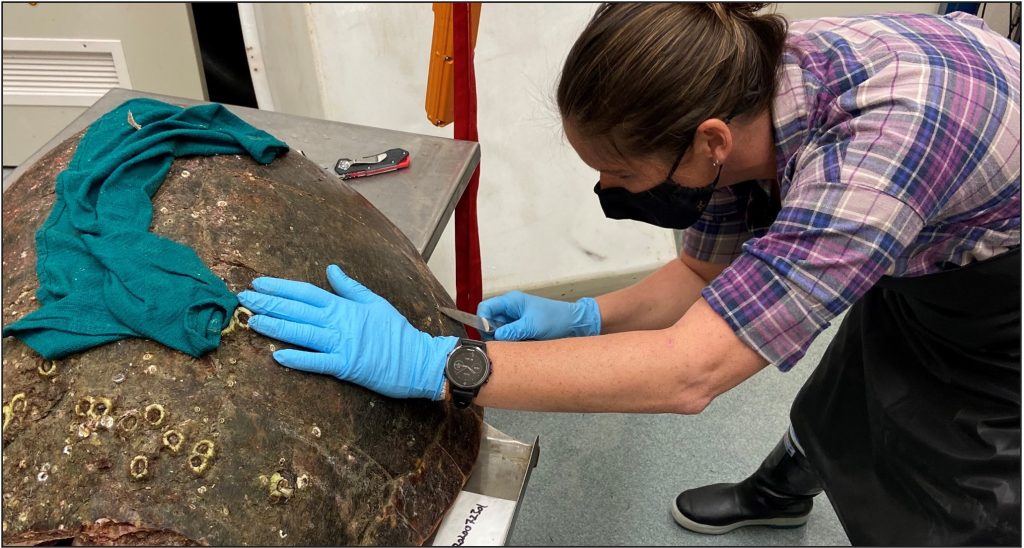 Former UF postdoctoral researcher Amy Wallace takes a sample from a turtle shell so it can next be analyzed.
Small samples of the turtle shell can be analyzed in layers, revealing details about a turtle’s past when that specific part of their shell was developing. Using the established local scale of radiocarbon levels from the coral, the researchers compared the levels of radiocarbon in the shell they were sampling to the coral to determine the age of each layer of scute formed.
This comparison helped the team determine a growth rate of the scutes that can be used to better understand the time represented by shell samples in the future. Since six species of sea turtles found in U.S. waters are listed and protected under the Endangered Species Act, understanding more about their past can assist conservation efforts.
“If you know where sea turtles are, then you can investigate the threats that they’re exposed to. You can understand a bit more about what their habitat requirements are and therefore what their foraging requirements are,” Linscott said. “We’ve been missing that chronological framework. The radiocarbon work contributes to a wider toolset that allows us to more deeply understand these animals, and the more we understand them the better we can conserve them.”
During the research, the group discovered that the growth rates noticeably slowed down around 2018, and it was consistent across samples.
The dip seemed to correspond with red tide events and sargassum blooms in the area, but the team could not say for certain what the cause of the change was. Vander Zanden said it was also possible that there was something resulting in higher-than-normal growth rates, and it returned to the norm in 2018.
“There might have been some environmental disturbances that affected many turtles in the region,’ Vander Zanden said. “If the scute growth rate is slowing down, maybe their overall body growth rate is slowing down, and maybe they’re not reproducing as much. We’re not necessarily seeing declines in populations, but maybe there are sublethal effects of these environmental disturbances that we wouldn’t have otherwise seen.”