
Main PointsBest ReadsHegseth denies Iran war is a “quagmire” as costs to US hit $25bnFinn McRedmond: Trump likes King Charles but “soft power” means nothing in Washington nowOil surges past $125 as fears of prolonged supply disruption growUS seeking forfeiture of captured oil tankers in move that is believed to include oil cargoes
The US is seeking forfeiture of two Iran-linked oil tankers seized by naval forces enforcing a blockade against Iran, according to a senior administration official.
The US Department of Justice has initiated the forfeiture process, the official said, without elaborating on what that entails or whether it signals an intent to seize the crude on board. The official, who requested anonymity to discuss sensitive operations, declined to detail what will ultimately happen to the vessels or comment on their current routes, citing operational security.
US forces boarded the vessels Tifani and Phoenix – the latter also known as the Majestic X – last week in the general vicinity of Sri Lanka, according to the Pentagon. The tankers continued to sail across the Indian Ocean in the following days, and appeared to make several course reversals.
The US and Iran have been enforcing dual blockades in and around the Strait of Hormuz as President Donald Trump ratchets up economic pressure on Tehran and the Islamic Republic seeks to counter American pressure.
In several cases where ship captains have attempted to test the US blockade, naval forces have directed intercepted vessels back to the Gulf ports. Confiscating oil cargoes aboard Iran-linked vessels would represent an escalation of Trump’s economic offensive – and dovetail with the administration’s strategy toward Venezuelan crude after the January ouster of strongman Nicolas Maduro.
As recently as late February, the Justice Department filed a forfeiture claim in US District Court in Washington DC, seeking possession of 1.8 million barrels of Venezuelan crude aboard a tanker linked to Iran’s Islamic Revolutionary Guard Corps.
The Justice Department uses asset forfeiture as a legal tool to seize property suspected of being connected to criminal activity, often through proceedings against the asset itself rather than an individual.
The US also took such action in 2023, when it ordered a tanker carrying China-bound Iranian crude to divert to the US, following similar measures in 2021. A year earlier, the Trump administration also ordered the seizure of four tankers carrying Iranian gasoline bound for Venezuela. – Bloomberg
Message from the Editor
 Irish Times Editor Ruadhán Mac Cormaic
Thanks for reading. If you’re interested in world news, The Irish Times has the largest network of foreign correspondents of any Irish news organisation.
Our team provides sharp reporting, in-depth analysis and thought-provoking commentary. Receive our Global Briefing newsletter in your inbox every morning to enjoy Denis Staunton’s guide to understanding world events; what’s happening, why it matters and how it affects you.
At The Irish Times, our journalism is free of any personal, political or commercial control. Unlike most publishers, we have no shareholders to satisfy, no media baron owner in the background telling us what we can and cannot publish.
We are owned by a Trust that mandates us to uphold a set of public-interest values. Those values describe a worldview that is outward-looking, tolerant, curious, interested in divergent views and attentive to the needs of minorities.
Our watchwords are fairness and accuracy. Our goal is to enable you to make informed and independent judgments. And any profit we make goes towards supporting our journalism.
Ruadhán Mac Cormaic
Editor
To join Ireland’s biggest community of news subscribers, sign up here Iran says it ‘will not tolerate’ an extended blockade as Trump ponders keeping pressure up for months
Iranian supreme leader Mojtaba Khamenei’s top military adviser has said Iran “will not tolerate” an extension of the US naval blockade, according to Iranian state media.
“If the blockade continues, Iran will respond,” Mohsen Rezaei said in an interview with Iranian state broadcaster IRIB on Thursday.
“Such a blockade has essentially achieved nothing and they have not been able to enforce it. The Indian Ocean is extremely vast, and we can easily pass through it, we have already done so,” Rezaei added.
His comments came as US President Donald Trump considers an extended blockade of Iranian ports.
Rezaei also urged the public not to listen to rumours about status of Khamenei, who has not been seen or heard from since he was announced as Iran’s new supreme leader more than six weeks ago.
“The Supreme Leader is young, healthy, and energetic, and is managing the affairs of the country,” Rezaei said, according to IRIB.
The Wall Street Journal reported president Trump has instructed aides to prepare for an extended blockade of Iran, targeting the regime’s coffers in a high-risk bid to compel a nuclear capitulation Tehran has long refused.
In recent meetings, Trump opted to continue squeezing Iran’s economy and oil exports by preventing shipping to and from its ports. He assessed that his other options – resume bombing or walk away from the conflict – carried more risk than maintaining the blockade, officials said.
On Wednesday Trump said Iran “better get smart soon” and in a meeting oil executives discussed what steps could be taken to “continue the current blockade for months if needed,” according to a White House official. Additional reporting -CNN
Further bad news for airline industry as Air France – KLM downgrades capacity due to war and rising fuel costs
Air France-KLM reported a smaller first-quarter loss than expected on Thursday, but downgraded its capacity outlook on the basis of uncertainty tied to the US -Israeli war with Iran and rising jet fuel costs.
European airlines, including EasyJet and TUI, have revised their outlooks as their jet fuel hedges shrink over time. They expect to feel the impact of the closure of the Strait of Hormuz more acutely in the coming months. “While fuel price increases are not yet reflected in the results we present today, they are expected to weigh on the coming quarters,” Air France-KLM chief executive Ben Smith said in a statement.
The company said its group capacity was now set to increase by 2% to 4% this year over 2025. It previously expected an increase of 3% to 5%. It also said it expects a 2.4 billion euro ($2.80 billion) increase in its fuel bill in 2026 compared with 2025.
Air France-KLM reported an initial boost after the Iran war broke out as more travellers booked on European carriers for flights to Asia, but was planning to expand its long-haul capacity in a more muted way as people were postponing travel plans or booking closer to the date of travel, concerned by the financial risk tied to long-haul trips. – Reuters
US seeks new Coalition to get ships moving in Hormuz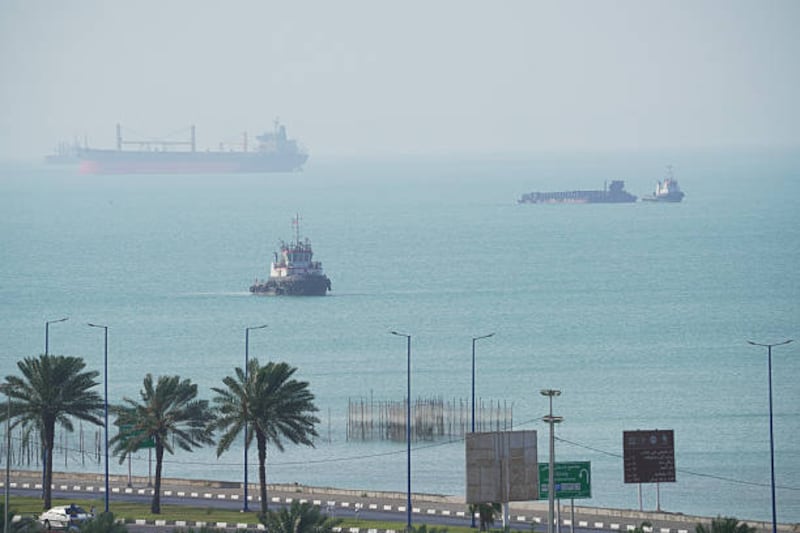 Boats off Iran’s Qeshm Island in the Strait of Hormuz. Photograph: Asghar Besharati/Getty Images
The Trump administration is seeking the participation of other countries to form an international Coalition to restore freedom of navigation in the Strait of Hormuz, according to a State Department cable.
US secretary of state Marco Rubio approved the creation of the Maritime Freedom Construct (MFC), the cable dated April 28th said, which it described as a joint initiative by the State Department and the Pentagon.
“The MFC constitutes a critical first step in the establishment of a post-conflict maritime security architecture for the Middle East. This framework is essential to ensuring long-term energy security, protecting critical maritime infrastructure, and maintaining navigational rights and freedoms in vital sea lanes,” the cable said.
The component of the initiative led by the State Department would serve as the diplomatic hub between partner countries and the shipping industry, while the Pentagon component operating out of US Central Command headquarters in Florida would co-ordinate real-time maritime traffic and communicate directly with vessels transiting the strait, the cable said.
The story was first reported by the Wall Street Journal on Wednesday.
US may cut number of troops in Germany 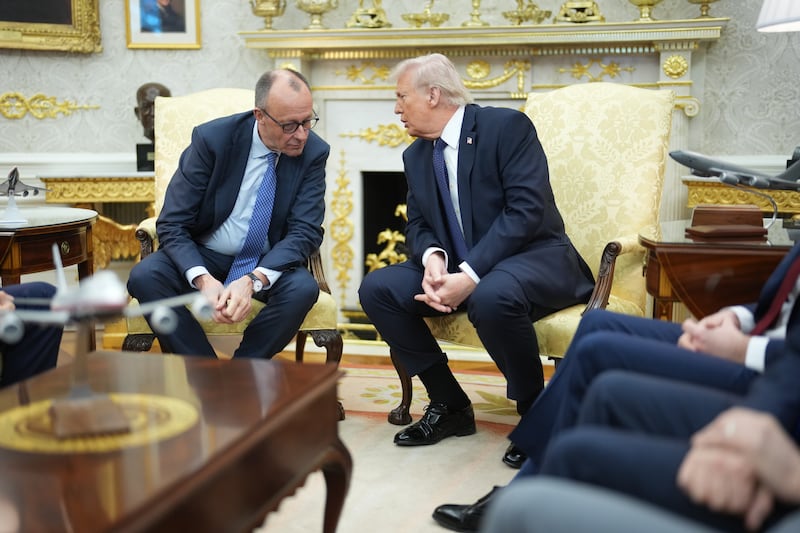 US president Donald Trump speaks to German chancellor Friedrich Merz in the Oval Office of the White House in Washington last month. Photograph: Doug Mills/The New York Times
The US may reduce its number of troops deployed in Germany, Donald Trump has announced, days after the country’s chancellor said United States was being “humiliated” by Iran.
In a post on his Truth Social platform, the US president said his administration was “studying and reviewing the possible reduction of troops in Germany, with a determination to be made over the next short period of time”.
On Monday, Friedrich Merz suggested the Trump team was being outplayed in its negotiations with Iran to secure an end to the ongoing war and a reopening of the strait of Hormuz.
“The Iranians are obviously very skilled at negotiating, or rather, very skilful at not negotiating, letting the Americans travel to Islamabad and then leave again without any result,” the German chancellor said.
Merz reiterated his criticisms on Wednesday, saying Europe was “suffering” from the consequences of the closure of the strait.
Trump cancelled a second trip by US negotiators to Islamabad last week. Since then, discussions over Iran’s nuclear programme and the strait of Hormuz have hit an impasse.
Trump on Tuesday accused Merz of thinking it’s “OK for Iran to have a nuclear weapon” and said the chancellor “doesn’t know what he’s talking about!”
Earlier on Wednesday Merz brushed off those comments, saying his relationship with Trump remains “as good as ever”, but the president’s threat to withdraw US troops is likely to cause concern in Berlin and across Europe, coming amid a period of heightened tensions between the US and its traditional allies in Europe that has seen Trump step up his threats to withdraw from the Nato alliance. – Guardian
Oil prices hit highest point since 2022
The price of Brent oil soared above $126 a barrel on Wednesday, its highest level since 2022, after Donald Trump warned the US blockade of Iranian ports could last months and peace talks remained stalled.
Surging more than 13 per cent in 24 hours, Brent crude hit a record price since the war began on February 28th. Not since Russia’s 2022 invasion of Ukraine has Brent topped $120, with the price then peaking at $139.
US oil prices were 2.3 per cent higher at $109.32 a barrel on Thursday, after a 7 per cent jump on Wednesday.
Oil markets have been spooked this week as Trump appeared willing to maintain the US navy blockade of Iranian ports, with Iran responding by keeping the strait of Hormuz all but shut to other oil tankers.
US-Iran talks set for Islamabad in Pakistan over the weekend failed to materialise, so the stalemate grinds on.
Trump said on Wednesday that Iran “better get smart soon” and in a meeting oil executives, discussed what steps could be taken to “continue the current blockade for months if needed,” according to a White House official. – Financial Times/Reuters
Trump to be briefed on new Iran military strikes 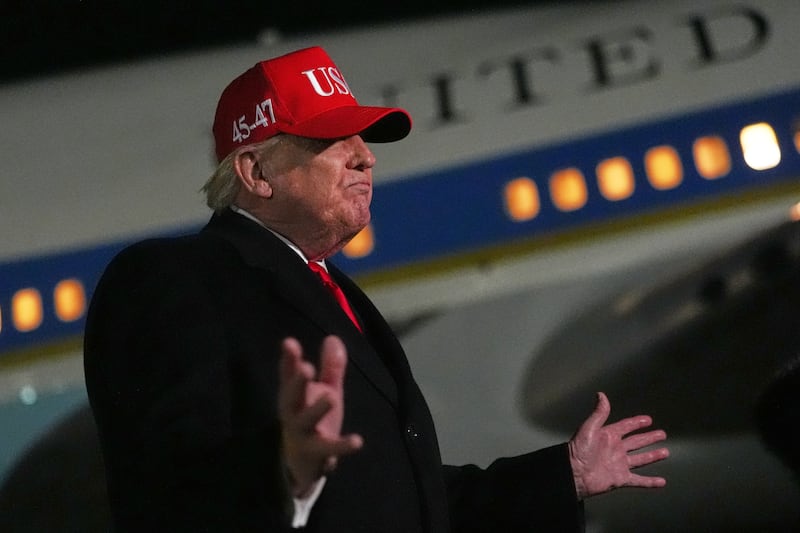 President Donald Trump: to be briefed on latest potential US military action against Iran. Julia Demaree Nikhinson/AP
Donald Trump is reportedly set to receive a briefing on Thursday from the leader of the US Central Command, Brad Cooper, on new plans for potential military action against Iran.
The military has prepared a plan for a “short and powerful” wave of strikes on Iran, likely including infrastructure targets, Axios reported, citing sources.
The White House and the US Central Command did not immediately respond to a request for comment.
A fragile ceasefire in the Iran war began three weeks ago. The war began when the US and Israel attacked Iran on February 28th.
Iran responded with its own strikes on Israel and Gulf states with US bases. US-Israeli strikes on Iran and Israeli attacks in Lebanon have killed thousands and displaced millions.
Trump has previously threatened to destroy Iran’s civilian infrastructure. International law experts say such strikes may amount to war crimes. The 1949 Geneva Conventions on humanitarian conduct in war prohibit attacks on sites considered essential for civilians.
Another plan expected to be shared with Trump is focused on taking over part of the Strait of Hormuz to reopen it to commercial shipping, the report added, saying such an operation may involve ground forces.
The Iran war, which remains unpopular in the US, has shaken markets and raised oil prices. – Reuters