
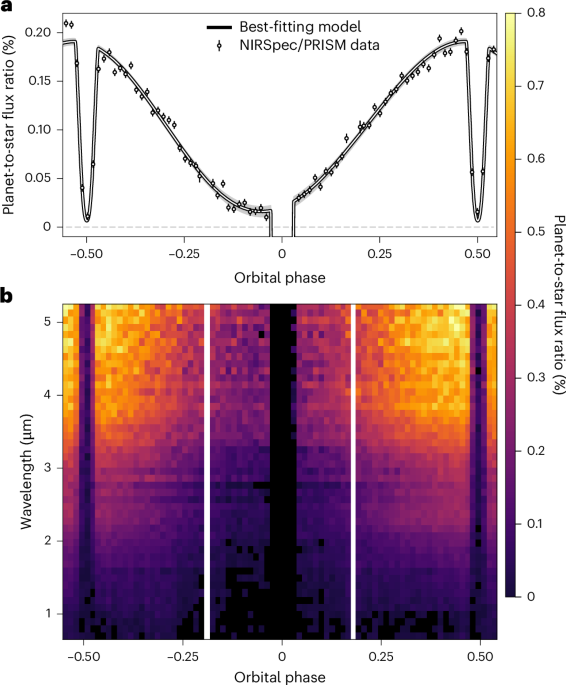
Showman, A. P., Tan, X. & Parmentier, V. Atmospheric dynamics of hot giant planets and brown dwarfs. Space Sci. Rev. 216, 139 (2020).
Knutson, H. A. et al. A map of the day–night contrast of the extrasolar planet HD189733b. Nature 447, 183–186 (2007).
Parmentier, V. & Crossfield, I. J. M. in Handbook of Exoplanets (eds Deeg, H. et al.) (Springer Nature, 2018).
Bell, T. J. et al. A comprehensive reanalysis of Spitzer’s 4.5 μm phase curves, and the phase variations of the ultra-hot Jupiters MASCARA-1b and KELT-16b. Mon. Not. R. Astron. Soc. 504, 3316–3337 (2021).
Sikora, J. T. et al. Seasonal changes in the atmosphere of HD 80606 b observed with JWST’s NIRSpec/G395H. Astron. J. 170, 105 (2025).
Gandhi, S. et al. Spatially resolving the terminator: variation of Fe, temperature, and winds in WASP-76 b across planetary limbs and orbital phase. Mon. Not. R. Astron. Soc. 515, 749–766 (2022).
Simonnin, A. et al. Time resolved absorption of six chemical species with MAROON-X points to strong drag in the ultra hot Jupiter TOI-1518 b. Astron. Astrophys. 698, A314 (2025).
McCormac, J. et al. NGTS-10b: the shortest period hot Jupiter yet discovered. Mon. Not. R. Astron. Soc. 493, 126–140 (2020).
Bell, T. J. et al. Eureka!: an end-to-end pipeline for JWST time-series observations. J. Open Source Softw. 7, 4503 (2022).
Stevenson, K. B. et al. Thermal structure of an exoplanet atmosphere from phase-resolved emission spectroscopy. Science 346, 838–841 (2014).
Cowan, N. B. & Agol, E. The statistics of albedo and heat recirculation on hot exoplanets. Astrophys. J. 729, 54 (2011).
May, E. M. et al. A new analysis of eight Spitzer phase curves and hot Jupiter population trends: Qatar-1b, Qatar-2b, WASP-52b, WASP-34b, and WASP-140b. Astron. J. 163, 256 (2022).
Parmentier, V., Showman, A. P. & Fortney, J. J. The cloudy shape of hot Jupiter thermal phase curves. Mon. Not. R. Astron. Soc. 501, 78–108 (2021).
Roth, A., Parmentier, V. & Hammond, M. Hot Jupiter diversity and the onset of TiO/VO revealed by a large grid of non-grey global circulation models. Mon. Not. R. Astron. Soc. 531, 1056–1083 (2024).
Welbanks, L. & Madhusudhan, N. Aurora: a generalized retrieval framework for exoplanetary transmission spectra. Astrophys. J. 913, 114 (2021).
Bell, T. J. et al. Methane throughout the atmosphere of the warm exoplanet WASP-80b. Nature 623, 709–712 (2023).
Line, M. R. et al. A systematic retrieval analysis of secondary eclipse spectra. I. A comparison of atmospheric retrieval techniques. Astrophys. J. 775, 137 (2013).
Arcangeli, J. et al. H- Opacity and water dissociation in the dayside atmosphere of the very hot gas giant WASP-18b. Astrophys. J. Lett. 855, L30 (2018).
Lodders, K. & Fegley, B. Atmospheric chemistry in giant planets, brown dwarfs, and low-mass dwarf stars. I. Carbon, nitrogen, and oxygen. Icarus 155, 393–424 (2002).
Beer, R. Detection of carbon monoxide in Jupiter. Astrophys. J. 200, L167 (1975).
Fegley, B. & Prinn, R. G. Chemical constraints on the water and total oxygen abundances in the deep atmosphere of Jupiter. Astrophys. J. 324, 621 (1988).
Mukherjee, S. et al. Probing the extent of vertical mixing in brown dwarf atmospheres with disequilibrium chemistry. Astrophys. J. 938, 107 (2022).
Mollière, P. et al. Retrieving scattering clouds and disequilibrium chemistry in the atmosphere of HR 8799e. Astron. Astrophys. 640, A131 (2020).
Welbanks, L. et al. A high internal heat flux and large core in a warm Neptune exoplanet. Nature 630, 836–840 (2024).
Visscher, C. & Moses, J. I. Quenching of carbon monoxide and methane in the atmospheres of cool brown dwarfs and hot Jupiters. Astrophys. J. 738, 72 (2011).
Venot, O. et al. Global chemistry and thermal structure models for the hot Jupiter WASP-43b and predictions for JWST. Astrophys. J. 890, 176 (2020).
Fortney, J. J., Marley, M. S. & Barnes, J. W. Planetary radii across five orders of magnitude in mass and stellar insolation: application to transits. Astrophys. J. 659, 1661–1672 (2007).
Cooper, C. S. & Showman, A. P. Dynamics and disequilibrium carbon chemistry in hot Jupiter atmospheres, with application to HD 209458b. Astrophys. J. 649, 1048–1063 (2006).
Visscher, C. Chemical timescales in the atmospheres of highly eccentric exoplanets. Astrophys. J. 757, 5 (2012).
Kataria, T. et al. The atmospheric circulation of the hot Jupiter WASP-43b: comparing three-dimensional models to spectrophotometric data. Astrophys. J. 801, 86 (2015).
Bell, T. J. et al. Nightside clouds and disequilibrium chemistry on the hot Jupiter WASP-43b. Nat. Astron. 8, 879–898 (2024).
Evans-Soma, T. M. et al. SiO and a super-stellar C/O ratio in the atmosphere of the giant exoplanet WASP-121 b. Nat. Astron. 9, 845–861 (2025).
Beltz, H., Rauscher, E., Roman, M. T. & Guilliat, A. Exploring the effects of active magnetic drag in a general circulation model of the ultrahot Jupiter WASP-76b. Astron. J. 163, 35 (2022).
Gaia Collaboration The Gaia mission. Astron. Astrophys. 595, A1 (2016).
Gaia Collaboration Gaia Early Data Release 3: summary of the contents and survey properties. Astron. Astrophys. 650, C3 (2021).
Perrin, M. D. et al. James Webb Space Telescope optical simulation testbed I: overview and first results. In Proc. Space Telescopes and Instrumentation 2014: Optical, Infrared, and Millimeter Wave, Vol. 9143 (eds Oschmann, J. M. Jr et al.) 914309 (SPIE, 2014).
Boyajian, T. S. et al. Stellar diameters and temperatures. II. Main-sequence K- and M-stars. Astrophys. J. 757, 112 (2012).
Grant, D. & Wakeford, H. R. ExoTiC-LD: thirty seconds to stellar limb-darkening coefficients. J. Open Source Softw. 9, 6816 (2024).
Magic, Z., Chiavassa, A., Collet, R. & Asplund, M. The Stagger-grid: a grid of 3D stellar atmosphere models. IV. Limb darkening coefficients. Astron. Astrophys. 573, A90 (2015).
Kreidberg, L. BATMAN: basic transit model calculation in Python. Publ. Astron. Soc. Pac. 127, 1161–1165 (2015).
Tang, Y. et al. Reassessing sub-Neptune structure, radii, and thermal evolution. Astrophys. J. 989, 28 (2025).
Guillot, T. Probing the giant planets. Phys. Today 57, 040000–040070 (2004).
Guillot, T. On the radiative equilibrium of irradiated planetary atmospheres. Astron. Astrophys. 520, A27 (2010).
Lopez, E. D., Fortney, J. J. & Miller, N. How thermal evolution and mass-loss sculpt populations of super-Earths and sub-Neptunes: application to the Kepler-11 system and beyond. Astrophys. J. 761, 59 (2012).
Piskorz, D. et al. Ground- and space-based detection of the thermal emission spectrum of the transiting hot Jupiter KELT-2Ab. Astron. J. 156, 133 (2018).
Wiser, L. S., Roth, A., Parmentier, V. & Line, M. R. A comparison of one-dimensional and three-dimensional exoplanet atmosphere model grids: ScCHIMERA and the SPARC/MiTgcm. Astrophys. J. 997, 365 (2026).
Welbanks, L., McGill, P., Line, M. & Madhusudhan, N. On the application of Bayesian leave one-out cross-validation to exoplanet atmospheric analysis. Astron. J. 165, 112 (2023).
Welbanks, L. & Madhusudhan, N. On atmospheric retrievals of exoplanets with inhomogeneous terminators. Astrophys. J. 933, 79 (2022).
Rothman, L. et al. HITEMP, the high-temperature molecular spectroscopic database. J. Quant. Spectrosc. Radiat. Transf. 111, 2139–2150 (2010).
Yurchenko, S. N. & Tennyson, J. ExoMol line lists. IV. The rotation–vibration spectrum of methane up to 1500 K. Mon. Not. R. Astron. Soc. 440, 1649–1661 (2014).
Yurchenko, S. N., Barber, R. J. & Tennyson, J. A variationally computed line list for hot NH3: hot line list for ammonia. Mon. Not. R. Astron. Soc. 413, 1828–1834 (2011).
Barber, R. J. et al. ExoMol line lists. III. An improved hot rotation-vibration line list for HCN and HNC. Mon. Not. R. Astron. Soc. 437, 1828–1835 (2014).
Underwood, D. S. et al. ExoMol molecular line lists. XIV. The rotation–vibration spectrum of hot SO2. Mon. Not. R. Astron. Soc. 459, 3890–3899 (2016).
Richard, C. et al. New section of the HITRAN database: collision-induced absorption (CIA). J. Quant. Spectrosc. Radiat. Transf. 113, 1276–1285 (2012).
Madhusudhan, N. & Seager, S. A temperature and abundance retrieval method for exoplanet atmospheres. Astrophys. J. 707, 24–39 (2009).
Buchner, J. et al. X-ray spectral modelling of the AGN obscuring region in the CDFS: Bayesian model selection and catalogue. Astron. Astrophys. 564, A125 (2014).
Welbanks, L. et al. Mass–metallicity trends in transiting exoplanets from atmospheric abundances of H2O, Na, and K. Astrophys. J. Lett. 887, L20 (2019).
Madhusudhan, N. C/O ratio as a dimension for characterizing exoplanetary atmospheres. Astrophys. J. 758, 36 (2012).
Moses, J. I., Madhusudhan, N., Visscher, C. & Freedman, R. S. Chemical consequences of the C/O ratio on hot Jupiters: examples from WASP-12b, CoRoT-2b, XO-1b, and HD 189733b. Astrophys. J. 763, 25 (2013).
Parmentier, V. Data from NGTS-10Ab phase curve. MAST https://doi.org/10.17909/fa95-k770 (2026).
Parmentier, V. NGTS-10Ab JWST/NIRSPEC PRISM phase curve data. Zenodo https://doi.org/10.5281/zenodo.18861579 (2026).