
A new study has found that rare Antarctic floods can deliver sudden carbon pulses into a sealed lake, Lake Untersee, feeding hidden microbial reefs beneath permanent ice.
The discovery helps explain how living cones resembling some of Earth’s oldest fossils can endure for thousands of years in a carbon-starved world.
Under the ice of Lake Untersee

Beneath Lake Untersee, an ice-covered lake in East Antarctica, the finding rests in living mats and water chemistry, not along an open shore.
At the University of Ottawa, a Canadian public university, researcher Benoit Faucher connected those hidden records to rare floods that renewed microbial growth.
Those records showed that the lake did not rely only on slow glacial melting; occasional pulses could refresh a system cut off from air.
That boundary gives the lake unusual power as a natural record, while leaving its strange water world to explain next.
Very strange underwater world
Lake Untersee stays frozen year-round under 7 to 13 feet of ice, while its deepest water reaches nearly 558 feet.
Sunlight still filters through the cover, and a little warmth melts glacier ice from below instead of opening surface water.
Cold air and strong winds remove surface ice by evaporation and direct ice-to-vapor loss, keeping the cover largely sealed.
Such sealing traps unusual chemistry, including high oxygen and methane, little carbon dioxide, and strongly basic water.
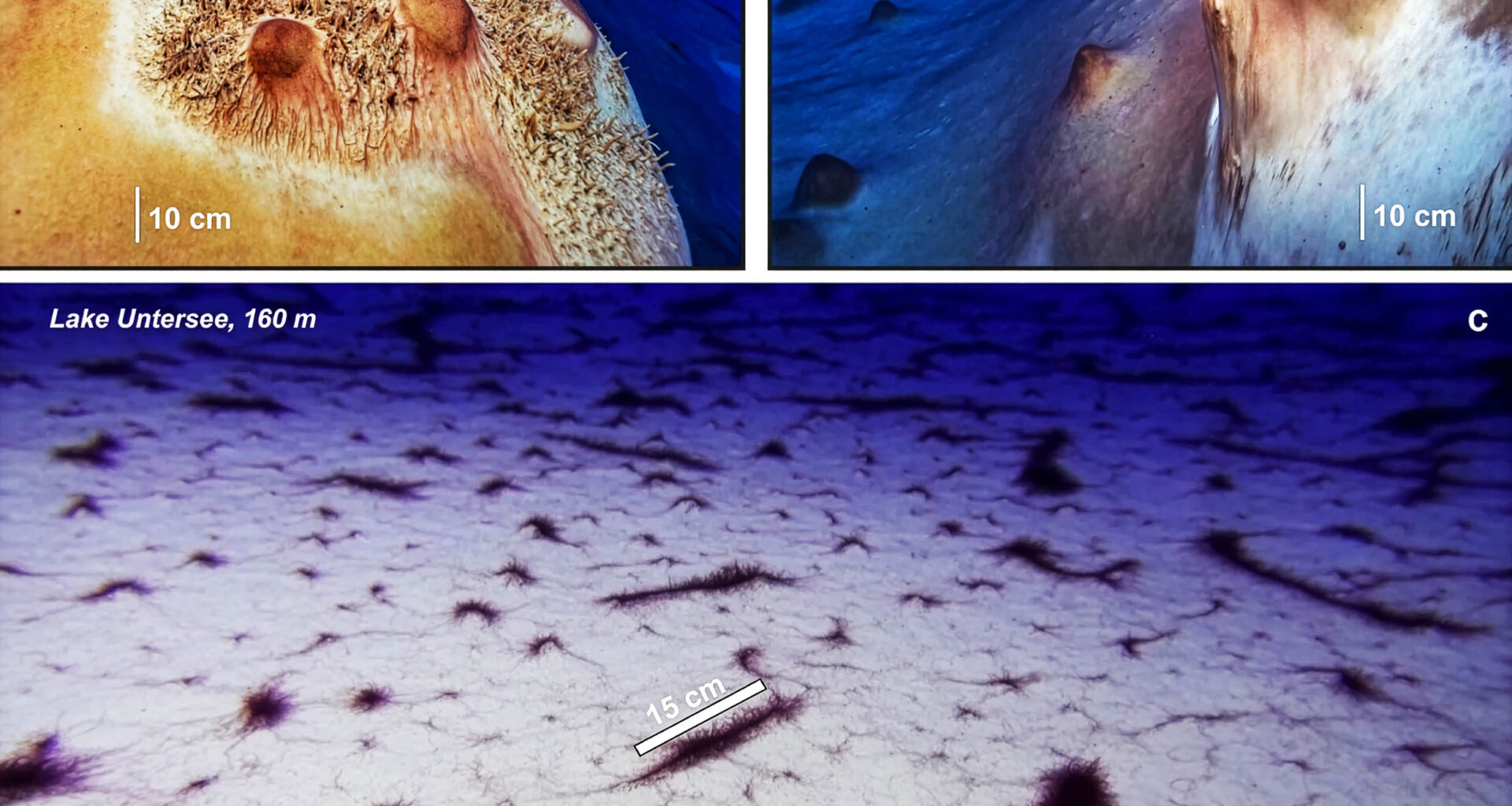
 Photographs of laminated microbial mats, cones and pinnacles growing in Lake Untersee. a, b Photos of mats at 12–13 m and c. 30 m depth near the sampling location of mats. c Photo of mats at 160 m depth. Note the water column’s clarity, reflecting the nutrient-starved water. Credit: co-author D. Andersen. Click image to enlarge.Reefs made by microbes
Scientists call these reef-like forms microbialites, layered structures built by microbes that trap sediment as they grow.
Cyanobacteria, photosynthetic bacteria, made the upper layers by using weak light and locking carbon into soft mats.
Soft cones grew beside smaller spikes and flat mats, with some rising up to 28 inches above the lake floor.
Because the builders trap sediment as they grow, their layered shapes can persist long enough to resemble ancient fossil structures.
The flood that fed
In January 2019, a glacial lake outburst flood, a sudden drainage from an ice-held lake, struck the sealed basin.
Water poured from Lake Obersee, a smaller neighboring lake, and raised Untersee by about 6.6 feet.
About 618 million cubic feet entered over three weeks, adding roughly 3% to Untersee’s volume.
Floodwater cut a channel and opened a small melt pool, giving sealed water brief contact with air.
Carbon changed Lake Untersee
Before the flood, Lake Untersee’s carbon supply was tight because sealed water had little carbon dioxide available for photosynthesis.
Fresh inflow lowered the water’s pH, a measure of acidity or basicness, from about 10.5 to 9.5.
That change added carbon-rich water, so photosynthetic mats could turn more carbon into new microbial growth.
Researchers estimated one flood delivered about 309,000 pounds of carbon, too little alone but powerful as a pulse.
Sediment layers kept records
The mats kept traces of older floods because each new layer held sediment grains and carbon signals from its time.
Sandier bands and younger carbon marks appeared together, pointing to repeated flood pulses during the Holocene, the current post-ice-age epoch.
At least five similar floods could explain the lake’s stored carbon, which was mostly locked in the microbial mats.
That record turned the lake floor into a long memory of rare disturbance, not a simple picture of steady isolation.
 Lake Untersee in Antarctica, sealed beneath thick ice, has unusual water chemistry and cone-shaped microbial structures resembling some of Earth’s oldest fossils. Credit: NASA. Click image to enlarge.Ancient Earth echoes
Ancient stromatolites, layered microbial rocks, are among the clearest fossils from Earth’s earliest life.
Untersee’s cones matter because they are living and soft, while most ancient examples survived only after hardening into rock.
Modern layers show how microbes can build shape before minerals harden them, clarifying what early fossils may preserve.
Such comparisons stay cautious because chemistry, temperature, and time separated ancient oceans from this Antarctic basin.
Clues beyond Earth
Scientists who study life’s chances beyond Earth use Untersee as a natural comparison for icy worlds sealed beneath ice.
Enceladus, Saturn’s ocean-bearing moon, releases plumes with water and chemicals that could support life without sunlight.
On early Mars, when the planet was wetter, ice-covered lakes may have preserved chemical traces rather than fossils.
“Our findings suggest that periodic flooding events may provide biological stimuli to other carbon dioxide-depleted Antarctic ecosystems and perhaps even icy lakes on early Mars,” wrote Faucher and colleagues.
What remains uncertain
No one has watched the cones grow from start to finish, so their exact pace remains hard to pin down.
Low light, high pH, and scarce carbon probably slow the builders, allowing layers to accumulate over long spans.
Sampling also reaches only parts of a 4-mile lake, so patterns may change with depth and distance.
These limits make the lake more valuable, because each field season tests which clues persist across hidden terrain.
Why this lake matters
Lake Untersee shows that isolation does not mean stillness: rare floods, trapped chemistry, and living mats can shape an ecosystem for centuries.
Future work can track fresh flood layers and microbial activity, while keeping clear limits around claims about ancient Earth or other worlds.
The study is published in Communications Earth & Environment.
—–
Like what you read? Subscribe to our newsletter for engaging articles, exclusive content, and the latest updates.
Check us out on EarthSnap, a free app brought to you by Eric Ralls and Earth.com.
—–