
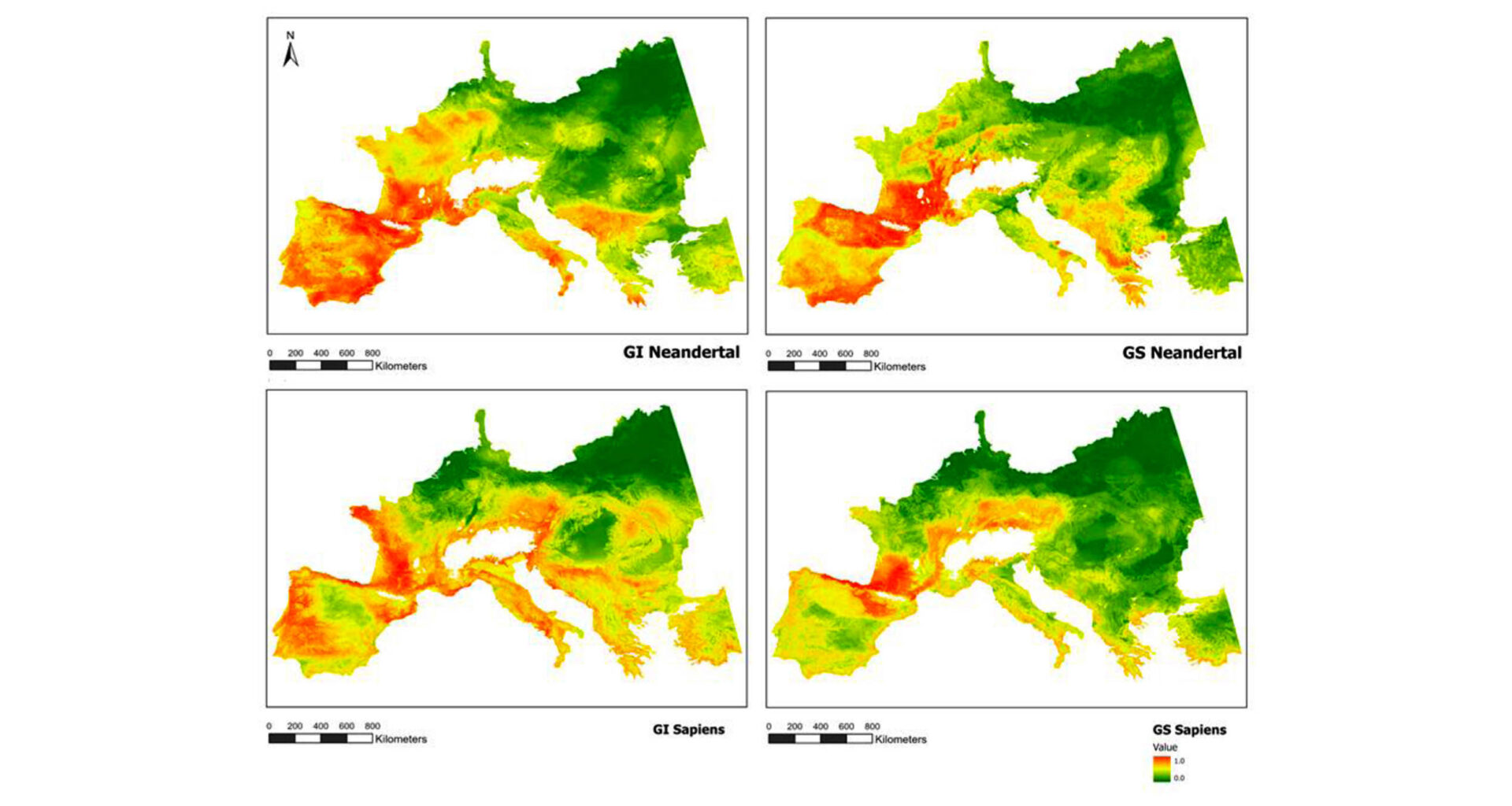
While Homo sapiens and Neanderthals lived near each other and likely interacted, they usually preferred living in slightly different environments.
A recent study suggests Homo sapiens survived Ice Age Europe because their different safe haven communities stayed connected to one another, while the Neanderthals’ network was patchier and prone to breaking apart.

The finding changes the most common Neanderthal extinction story. Survival may have come down less to brains or biology and more to whether a struggling group could still find its way to neighbors who could help.
Routes reveal survival
Across Europe from 60,000 to 35,000 years ago, scattered archaeological sites preserve traces of where ancient groups lived, moved, and endured.
By comparing those traces, Ariane Burke, an anthropology professor at the University of Montreal, showed that geography could strengthen one population while straining another.
The pattern did not show Neanderthals trapped in a dead landscape, but it did show many of their best regions linked less securely.
Stronger routes did not guarantee survival, but they made harsh years less likely to become final ones.
Climate still mattered
Cold phases did not simply erase Neanderthal habitat, because many usable areas stayed open across their European range.
Instead, climate variability, rapid and unpredictable environmental change, moved the best regions around and forced people to adjust their routes.
“Climate variability appears to have played a major role,” said Burke.
Earlier cold cycles had not wiped Neanderthals out, so the new map points beyond weather alone toward connection.
Networks became protection
Linked groups could trade news, partners, and temporary shelter when cold swings changed food supplies or pushed herds elsewhere.
Biologically, those ties kept small groups from shrinking alone, because people could move, marry, and share risk across distance.
“These networks act as a safety net,” said Burke. Without that cushion, a failed hunt or empty valley could cut a small population off from recovery.
Neanderthals stayed regional
Regional strongholds gave Neanderthals staying power, especially in southwestern Europe and southern parts of the Iberian Peninsula, the landmass holding Spain and Portugal.
Local groups of 25 to 50 people may have ranged across about 965 square miles during a year.
In eastern and central Europe, weaker routes made some Neanderthal groups more exposed to isolation and random losses.
Fragile regional ties could turn normal hardship into a deeper population problem when several pressures arrived together.
Overlap stayed small
Contact remained possible because the best regions for both groups sometimes touched, especially in northern Spain and Italy.
In the models, shared optimal habitat never rose above about 5 percent of either group’s available range.
A major radiocarbon dating effort , using carbon decay to estimate age, found Neanderthals and modern humans overlapped in Europe for roughly 2,600 to 5,400 years.
Competition still mattered in some western core areas, but the small spatial overlap weakens any one-cause explanation.
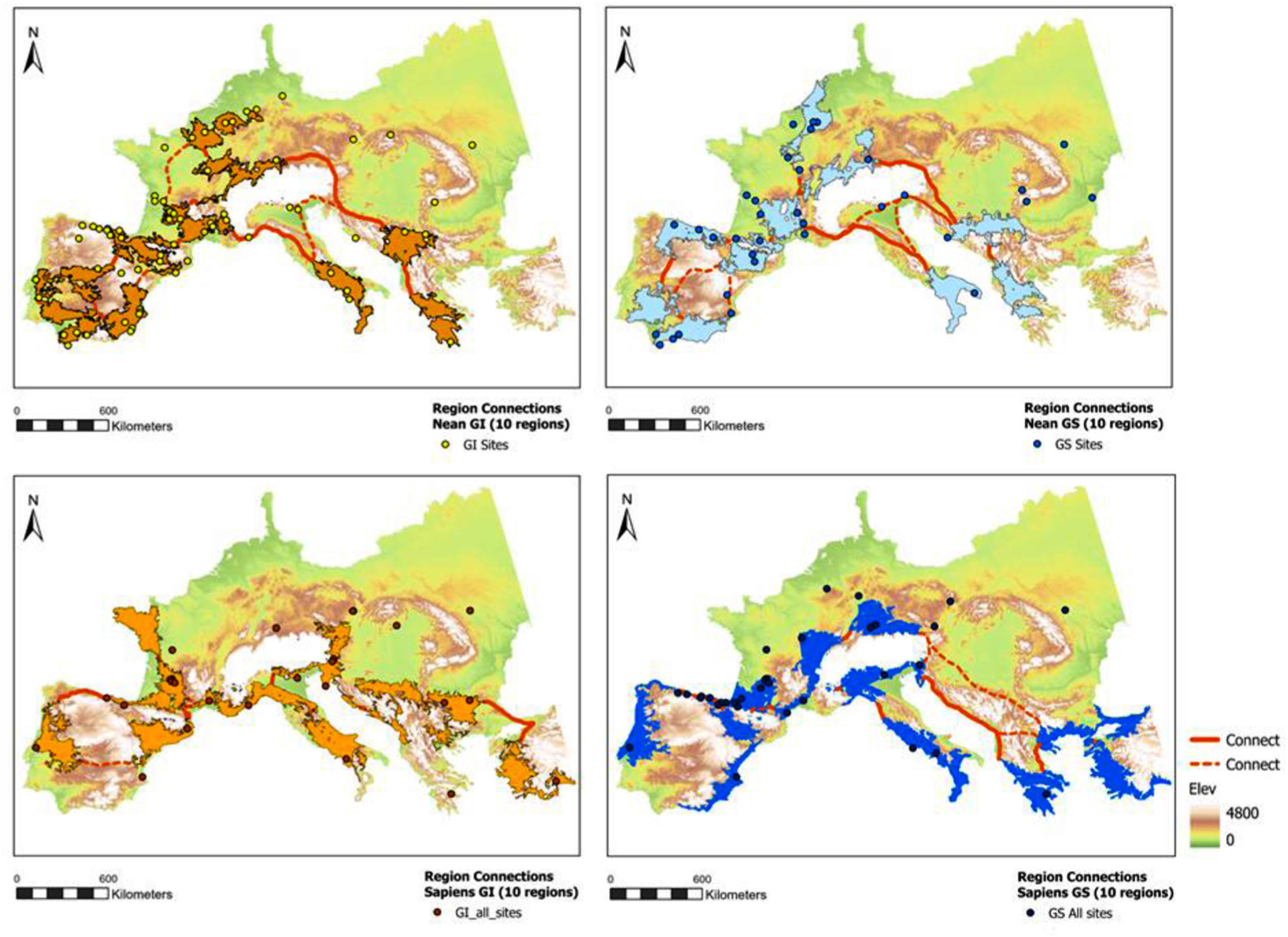 Ice Age Europe map showing Homo sapiens and Neanderthal communities. Connectivity between regions under the 4 test scenarios. Optimal connections are illustrated with solid red lines and neighboring connections are dashed. The distribution of sites used in the HS models is also indicated. Credit: Quaternary Science Reviews. Click image to enlarge.Genes complicated endings
Ancient encounters also left biological traces, because Neanderthals and Homo sapiens sometimes had children together.
DNA evidence from Bacho Kiro Cave, a Bulgarian site with early human remains, showed three early Homo sapiens individuals had Neanderthal ancestors only generations back.
Those mixed families make disappearance harder to define, because some Neanderthal ancestry entered expanding human populations.
Being absorbed into larger human groups could reduce a small Neanderthal population without leaving a clean extinction line.
Newcomers used corridors
Arrival did not happen through one neat path, because early Homo sapiens groups entered a Europe already full of local risks.
Fossils and tools from Ranis, a cave site in Germany, place Homo sapiens in colder northern Europe by 45,000 years ago.
Coastal and southern corridors looked especially useful when warmer intervals opened routes across the continent.
When conditions worsened, better-connected newcomers could keep moving while some Neanderthal links stretched thin across the same rugged continent.
Models carry limits
Computer maps need caution because they simplify weather, coastlines, and choices made by people under pressure.
Species distribution models, tools that predict where a group can live, treated archaeological sites as evidence of presence.
Since sunken coastlines were missing, some routes across lower sea shelves may be less clear than the maps suggest.
Even with those limits, the pattern points toward resilience built from reachable neighbors, not just better tools or smarter ideas.
Neanderthals and Ice Age Europe mobility
Ancient mobility was not aimless wandering. Movement helped people find food, relatives, mates, and safer ground.
“Human migration has always existed, facilitated by mobility and social networks,” said Burke.
Borders and modern inequalities change migration today, but the basic pull of security and connection remains familiar.
Seeing Neanderthals through this lens makes their loss less about failure and more about fragile access to help.
Survival in Ice Age Europe came from climate, geography, genes, and competition working through the hard limits of distance.
Future work can sharpen the map with better coastlines, more ancient DNA, and finer records, while keeping one lesson clear: isolation kills options.
The study is published in Quaternary Science Reviews.
—–
Like what you read? Subscribe to our newsletter for engaging articles, exclusive content, and the latest updates.
Check us out on EarthSnap, a free app brought to you by Eric Ralls and Earth.com.
—–