
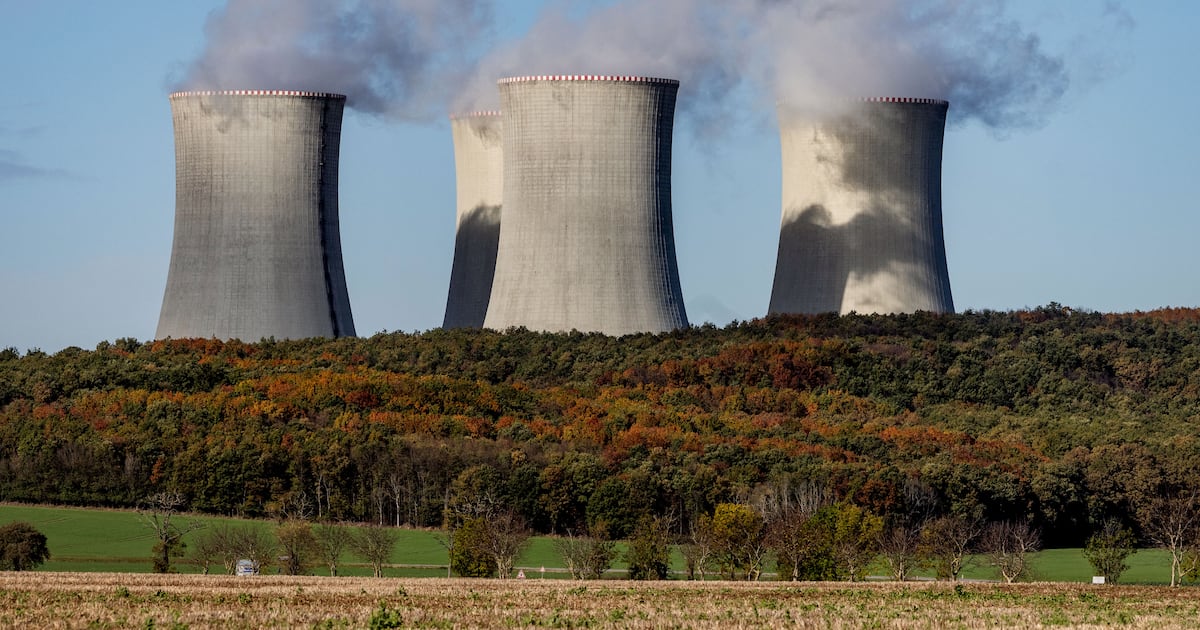
Ireland should seriously examine the idea of developing nuclear power as one way to reduce its future dependence on fossil fuels, Taoiseach Micheál Martin has said.
The immediate focus of the Government was to speed up the development of offshore wind farms, to further boost the Republic’s supply of renewable energy sources, the Taoiseach said.
The energy crisis set off by the war in Iran and closure of key supply routes for oil and gas coming from the Gulf has put pressure on governments across the world as the price of fuel soars.
Speaking on Monday, Martin said the Government should explore “all avenues”, including the development of nuclear-fuelled energy.
“We certainly should look and examine seriously options like nuclear power, simply examine the advances in technology that have occurred,” he said.
Fianna Fáil TD James O’Connor recently tabled legislation that would end a ban on developing nuclear power in the State, and that will be debated by the Dáil in the coming months.
Advances in nuclear technology, in particular around the development of small modular reactors, have lowered what was previously a very high bar required to build nuclear power plants on the time and cost front.
“We’ve witnessed over the last 50 years periodic moments of volatility and energy insecurity because of our over-reliance on imported fossil fuels,” Martin said.
The Republic had already made “significant progress” rolling out onshore wind production and solar power, he said. “The next big play for us is offshore wind and [a] significant amount of work has been put into that,” he said.
“So Ireland in the early 2030s will be in a strong position in terms of offshore wind combined with onshore wind, with solar,” the Fianna Fáil leader said.
Martin was speaking in Yerevan, Armenia, where he was attending a summit of more than 40 European leaders.
Fossil fuels had done “extremely serious damage” to the planet, he said.
“In many ways, fossil fuel has been the worst type of fuel in terms of its impact on people’s health and in terms of its impact on the environment and on climate, so we should look at alternatives,” he said.
Martin said there had been “tentative moves in the right direction” in ongoing talks between the United States and Iran, to end Tehran’s blockade of the Strait of Hormuz, through which a fifth of the world’s oil and gas is shipped.
“I would urge all parties to engage more intensively in dialogue to bring about a permanent cessation to hostilities,” he said.
The Government will take steps in the next budget to “alleviate the pressure on families and on workers” from steep rises in fuel and energy costs, he said.
“The precise means by which we do that will very much be decided upon in the lead up to the budget,” which will be announced in October, he said. Any decisions taken had to also be fiscally sustainable, he added.
Aspects of budget negotiations will be brought forward this year, he said.
This was due to the fact the Government will at the same time be steering EU-level negotiations for the second half of this year, when it holds the rotating Council of the EU presidency.
“Obviously it’s [a] budget that will focus on pressures that people are undoubtedly feeling because of all of the shocks over the last five to six years, exacerbated now by this war in the Middle East,” the Taoiseach said.
Martin also defended plans to stop providing accommodation housing supports to Ukrainian refugees who fled to Ireland following the 2022 Russian invasion of Ukraine.
“No one anticipated the war would go on for five years, but we will work with the Ukrainian community in Ireland in terms of the change of direction,” he said.
Ending the practice of housing Ukrainians in hotels paid for by the State would be done on a “gradual” basis. “The original approach was a very much emergency response,” he said.
The Ukrainian government had a need for people to return to help restore its economy, which was a factor Martin said had been “overlooked”.