
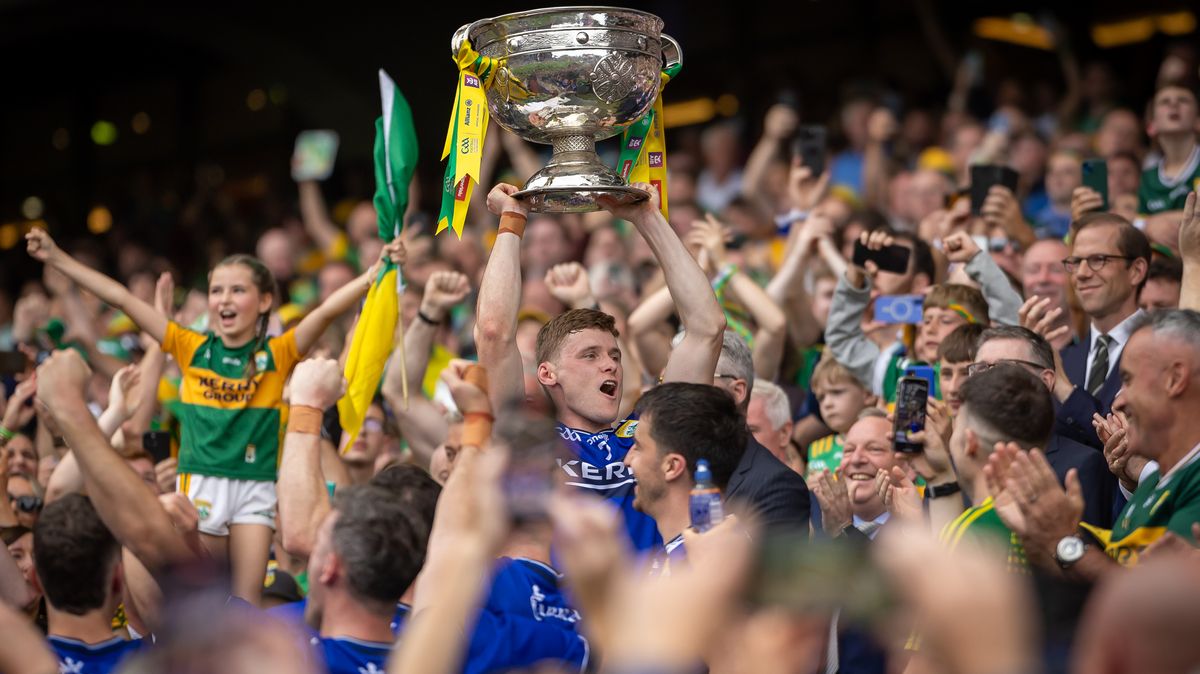
There are contenders, pretenders, and then there are the men they could not hang — which is a poetic way of describing the 16 counties left standing in the All-Ireland Senior Football Championship. But let’s start with an uncomfortable truth. These are not the best 16 teams in Ireland.
Down, for instance, have beaten five of the teams who remain over the past 15 months. Five. And yet they are not here. Their absence is not an accident, but a consequence of structure — a system that leans heavily on National League standings from 2025 and the random cruelty of a provincial draw in 2026.
No championship format is perfect. But this one, which assigns equal value to reaching a Munster, Leinster or Connacht final as it does to surviving Ulster, asks questions it cannot convincingly answer. Galway had to beat Leitrim, a Division 4 side, to reach the Connacht final. Cork overcame Tipperary and Limerick — Division 4 and Division 3 respectively — to make the Munster decider. Kerry needed one win, against a Division 3 team, to get there.
In Ulster, the path was different. Down had to beat what many would argue are the second and third best teams in the country in successive weeks just to reach a provincial final. That they fell short — and are now gone — tells you everything about the imbalance. Winning Ulster is hard. Winning an All-Ireland is harder still. It is less a journey than an ascent, and of the 16 who begin it, only four, realistically, have the oxygen to reach the summit.
The Contenders
Kerry, Donegal, Armagh, Galway.
They are the contenders, the teams who can see the path clearly because they have walked it before. Kerry and Donegal come into this on the back of recent setbacks — Kerry losing the league final to Donegal, Donegal then stumbling in Ulster. In boxing terms, they are heavyweights recovering from a knockdown. Not beaten, just reminded.
Armagh and Galway complete the quartet, and the reasoning is not simply based on this season. Since Tyrone won the All-Ireland in 2021, only five counties have reached a final. These four teams understand what it takes to get there.
That does not mean they are flawless. Far from it. Kerry depend heavily on Paudie Clifford’s fitness, though they possess the depth to compensate more than most. Galway live with the recurring uncertainty around Damien Comer and Shane Walsh. Armagh must manage without key figures such as Soupy Campbell and Rian O’Neill. Donegal have their own questions around Michael Langan.
Yet the flaws do not disqualify them. They simply humanise them. And then there is David Clifford. In the last four championship seasons, he has produced 12 goals, 12 two-pointers and 96 points. Numbers that impress many, and scare the rest. Kerry are favourites because they have the best player in the country, and the infrastructure to support him.
Beyond the contenders sit those who are harder to categorise.
Dublin, Tyrone, Mayo — the men they could not hang.
There is an old rule in obituary writing: do not declare death until the body is in the ground. It applies here.
Dublin appeared finished. A 12-week ban for their manager, relegation from Division 1, an unconvincing win over Wicklow. The narrative wrote itself.
Then came Portlaoise. Cormac Costello scoring at will, Louth dismantled, and suddenly the conversation shifted. This is still a squad heavy with All-Ireland experience. Still a group that understands pressure. Now, perhaps, a group with something to prove.
Tyrone are cut from similar cloth. Poor league form saw them written off, yet they pushed Armagh to extra time and could easily have won. Last year’s All-Ireland semi-finalists do not become irrelevant overnight.
Mayo? They remain Mayo — capable, competitive, but falling just short of conviction when it matters most.
Could any of these three reach a semi-final? Absolutely. Could they win the All-Ireland? It feels a stretch. Not impossible, but unlikely.
The Inbetweeners
Roscommon, Cork, Derry, Meath.
The championship has always allowed for the occasional disruptor. Fermanagh in 2004, Wexford in 2008, Tipperary in 2016. Teams that arrive uninvited and made it to the semi-final. Roscommon have the profile of such a side. Their scoring power is undeniable — 2-25 against Mayo in Connacht, 15 goals in seven league games. They play with intent and under Mark Dowd, there is structure.
What they lack is reliability. The difference between a quarter-finalist and a semi-finalist is often consistency, and that remains their challenge. Cork and Meath are on upward curves. Promotion has brought confidence, and both have recent experience of the latter stages. Derry, meanwhile, possess the raw materials but have yet to fully assemble them this season.
Could one of these teams break through to the final four? History suggests it happens more often than expected. All four are capable of getting there.
The Outsiders
Monaghan, Westmeath, Louth, Kildare, Cavan.
Pat Spillane made an astute observation recently. This is not a championship where all 16 teams can win it. But it is one where all 16 can have a moment. We have already seen evidence. Down beating one of the favourites. Westmeath overcoming Meath. Monaghan surprising Derry. Roscommon dismantling Mayo.
On any given day, the gap can close. What these teams lack is not belief but continuity. To reach a semi-final requires three victories against elite opposition. That is a different demand entirely. Could any of them take a scalp? Certainly. Could they take three? That is where the argument weakens.
And so the championship settles into its familiar shape. A small group capable of winning it. A slightly larger group capable of interfering. And a final group capable of moments. Who will win it? It reminds you of that Gary Lineker joke – how football was a game of 90 minutes and at the end, Germany won. Reword that for an Irish context and substitute Germany for Kerry. They are your favourites.