
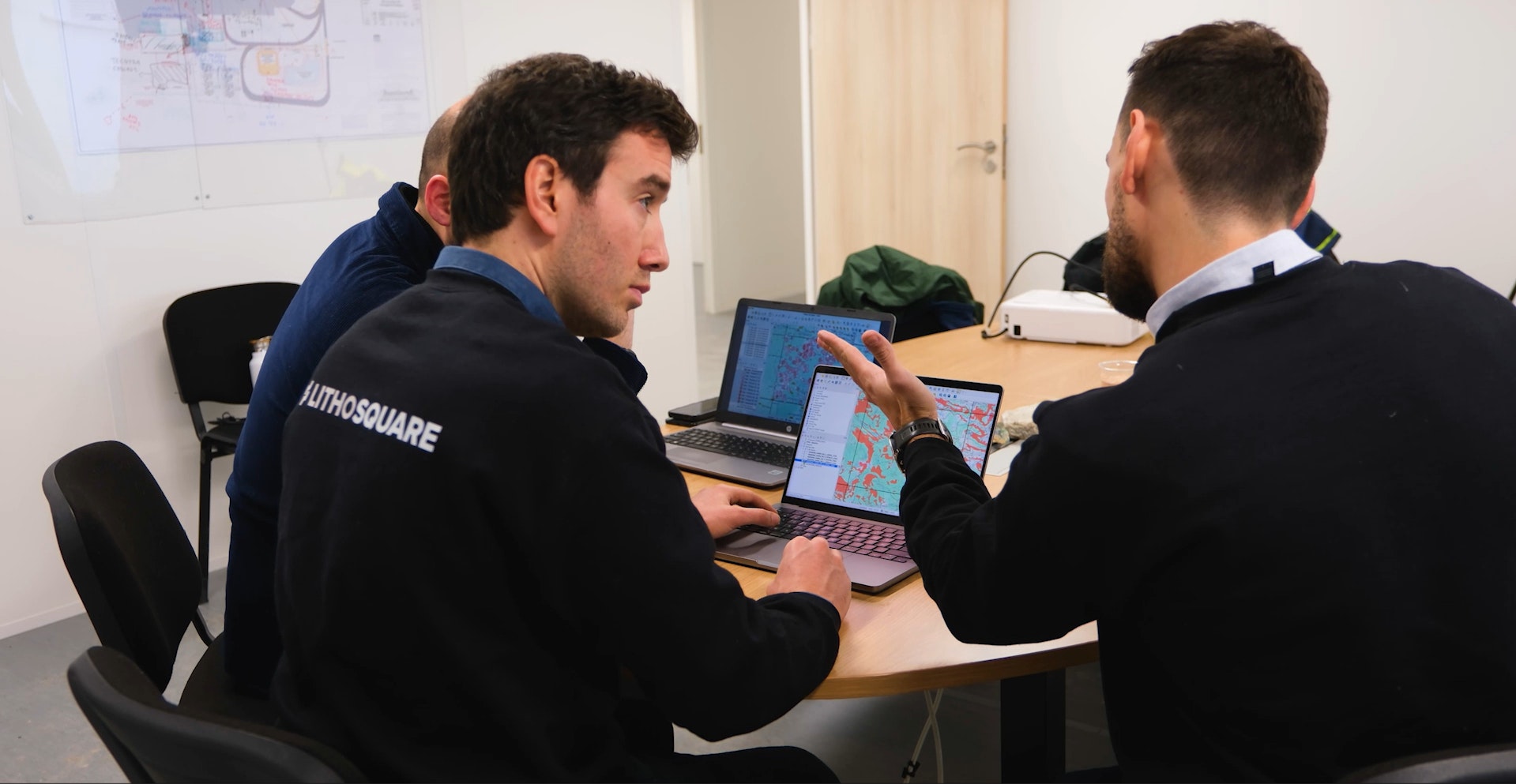
Lithosquare, a Paris-based startup leveraging AI to accelerate the discovery and identification of critical metals deposits across the world, has raised a $25m equity seed round.
The round was co-led by German climate tech VC World Fund and Kindred Capital, a UK-based early-stage deeptech investor. It included participation from French firms Daphni, Omnes Capital and Ovni Capital.
Critical metals like copper, lithium and nickel are key components of many electronic devices, and are particularly needed to make electric vehicle batteries and grid storage, meaning they are the backbone of large-scale decarbonisation.
The production of many critical metals is dominated by a few players: for example China produces 95% of rare earth metals. Countries, particularly in the EU, are becoming increasingly wary of their dependencies in the field, and interest in new technologies that can help strengthen supply chains is growing.
“Our technology helps open new geographies [to secure critical metals], diversify targets for deposit exploration, and reinforce the quality and resilience of supply chains,” says Lithosquare founder and CEO Aymeric Préveral-Etcheverry.
Foundational model based on multimodal data
To find critical metals deposits, geologists typically rely on machine learning tools called pattern-recognition models, which identify potential sites in satellite imagery and geological data based on the characteristics of deposits that have already been discovered.
“The problem with this is that you’re only looking for what you’ve already found,” says Préveral-Etcheverry. “And we need to find more sites and new sites […] New types of deposits, which are deeper, in places where we’ve never been.”
Préveral-Etcheverry says Lithosquare has “encoded” geological science in a foundational AI model, trained with multimodal data including maps, textual reports and surveys, and geophysical data like magnetism and radioactivity.
“We’ve developed an AI platform capable of helping geologists as they reason, test new hypotheses and search where they’ve never been,” he says.
The company says the technology reduces analysis timelines from months to days.
Commercialising the technology
Lithosquare is seeing increasing demand for its product, in part driven by growing sovereignty imperatives. In 2023, the EU passed the Critical Raw Materials (CRM) Act, setting a number of goals to hit by 2030 including growing domestic production to at least 10% of consumption and diversifying the source of imports.
The startup’s customers are mining companies, says Préveral-Etcheverry, largely based in Europe and North America, with operations in the Middle East, South America and Africa. Last year Lithosquare announced its first public partnership, a joint venture with UK-based mining company Aterian to apply AI to eight exploration projects in Morocco and Botswana.
As part of the partnership, Aterian made an initial €500k investment for the identification of copper and critical metals deposits by using AI, part of which was secured as revenue by Lithosquare.
The company is working with a handful of other customers, which are not yet public.
Lithosquare typically takes an upfront baseline payment for the exploration and identification of deposits, with future payments based on outcomes. It also expects to implement revenue-sharing agreements on future mines. The startup declined to share its latest revenues.
What’s next?
Préveral-Etcheverry says the next few months will see Lithosquare double the size of its team to 40 employees and open a new office in North America to boost commercialisation.
There are big competitors on the other side of the Atlantic, like Kobold Metals, which builds a similar technology and last year raised a $537m Series C at a $3bn valuation.
“There are a few big players but we’re in line to reinforce our leadership in Europe and then globally,” says Préveral-Etcheverry. “The ambition is huge.”