
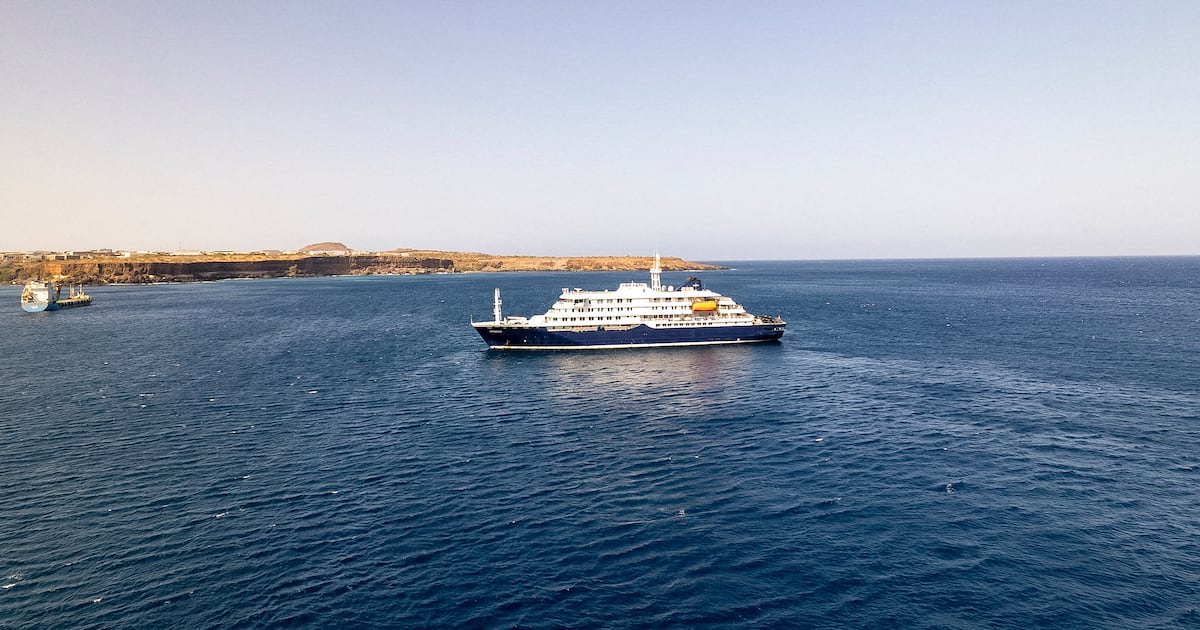
There may be some human-to-human transmission happening between close contacts on board the cruise ship hit by a hantavirus outbreak, the World Health Organisation (WHO) said on Tuesday.
The agency said the focus now was to evacuate two sick passengers and then for the ship, currently held in the Atlantic near Cape Verde, to continue to the Canary Islands. It said the risk to the wider public remained low.
Two cases of the deadly hantavirus have been confirmed, and five more are suspected, among people who fell ill on a cruise ship now marooned off Cape Verde and unable to put passengers ashore, the WHO said.
In its most detailed update on the outbreak, published late on Monday, the UN health body said the risk to the wider public was low from a disease typically spread from infected rodents that only rarely passes between humans.
But it added that limited human-to-human transmission had been reported in some strains of the virus.
The authorities in Cape Verde – an island nation in the Atlantic off west Africa – said they had not allowed the Dutch-flagged MV Hondius to dock as a precaution.
About 150 people are stuck on the Hondius, which was carrying mostly British, American and Spanish passengers on a luxury cruise that set off from the southern tip of Argentina in late March. Two Irish passengers are also on board. The cruise visited the Antarctic peninsula and South Georgia and Tristan da Cunha – some of the remotest islands on the planet.
The seven confirmed or suspected cases comprise three people who have died, one who is critically ill and three with mild symptoms, the WHO said.
The three fatalities were a Dutch couple and a German national, while a British national was evacuated from the ship and is in intensive care in South Africa, officials said.
As a precaution, passengers aboard the Hondius have been instructed to remain inside their cabins whenever possible, the WHO said, adding that the incubation period can last several weeks, meaning some people may not yet be showing symptoms.
Epidemiological investigations were under way to determine the source of the outbreak, the WHO said. Medical teams in Cape Verde are evaluating the patients and collecting additional specimens for testing.
The WHO added that although uncommon, limited human-to-human transmission of the Andes virus, a species of hantavirus found in Argentina and Chile, “has been reported in community settings involving close and prolonged contact”.
The Dutch couple who were the first to die had travelled in South America, including Argentina, before they boarded the cruise ship.
The ship’s operator, Oceanwide Expeditions, said authorities were working on a plan for a medical evacuation of two people on board who are ill, as well as a person who travelled with one of the passengers who has died.
There is no definitive plan yet for the disembarkation of the remaining guests on board, the company said. It only confirmed this would not be done in Cape Verde.
“Sailing on to Las Palmas or Tenerife is being considered, where further medical screening and handling could take place, organised and supervised by the WHO and Dutch health services. This is yet to be confirmed,” it said.
A spokesperson for Spain’s health ministry told Reuters they had not yet received a request to dock at the Canary Islands.
The Hondius left Ushuaia in southern Argentina in March, according to company documentation, on a voyage marketed as an Antarctic nature expedition, with berth prices ranging from €14,000 to €22,000.
The first stricken passenger, the Dutch man, died on April 11th. His body remained on board until April 24th, when it “was disembarked on St Helena, with his wife accompanying the repatriation”, Oceanwide Expeditions said.
His wife, who had gastrointestinal symptoms when she was disembarked, later deteriorated during a flight to Johannesburg. She died upon arrival at the emergency department on April 26th, the WHO said, adding that contact tracing was under way for passengers on that flight.
South African authorities have confirmed that the British patient, who is being treated in a Johannesburg hospital, tested positive for the hantavirus. The Netherlands has confirmed the virus in the Dutch woman who died. – Reuters