
A Middle Jurassic dinosaur has been unearthed 166 million years after it died. It was the size of a large dog and ate a vegetarian diet.
This skeleton was first noticed decades ago, but due to tricky access along the Isle of Skye, the fossil remained untouched. It ended up being the first and most complete partial dinosaur skeleton yet recognized from Scotland.

No one expected such an important specimen to lie overlooked for so long. Yet its remote position made collection efforts difficult until more recent years.
Tough spot for fossil hunting
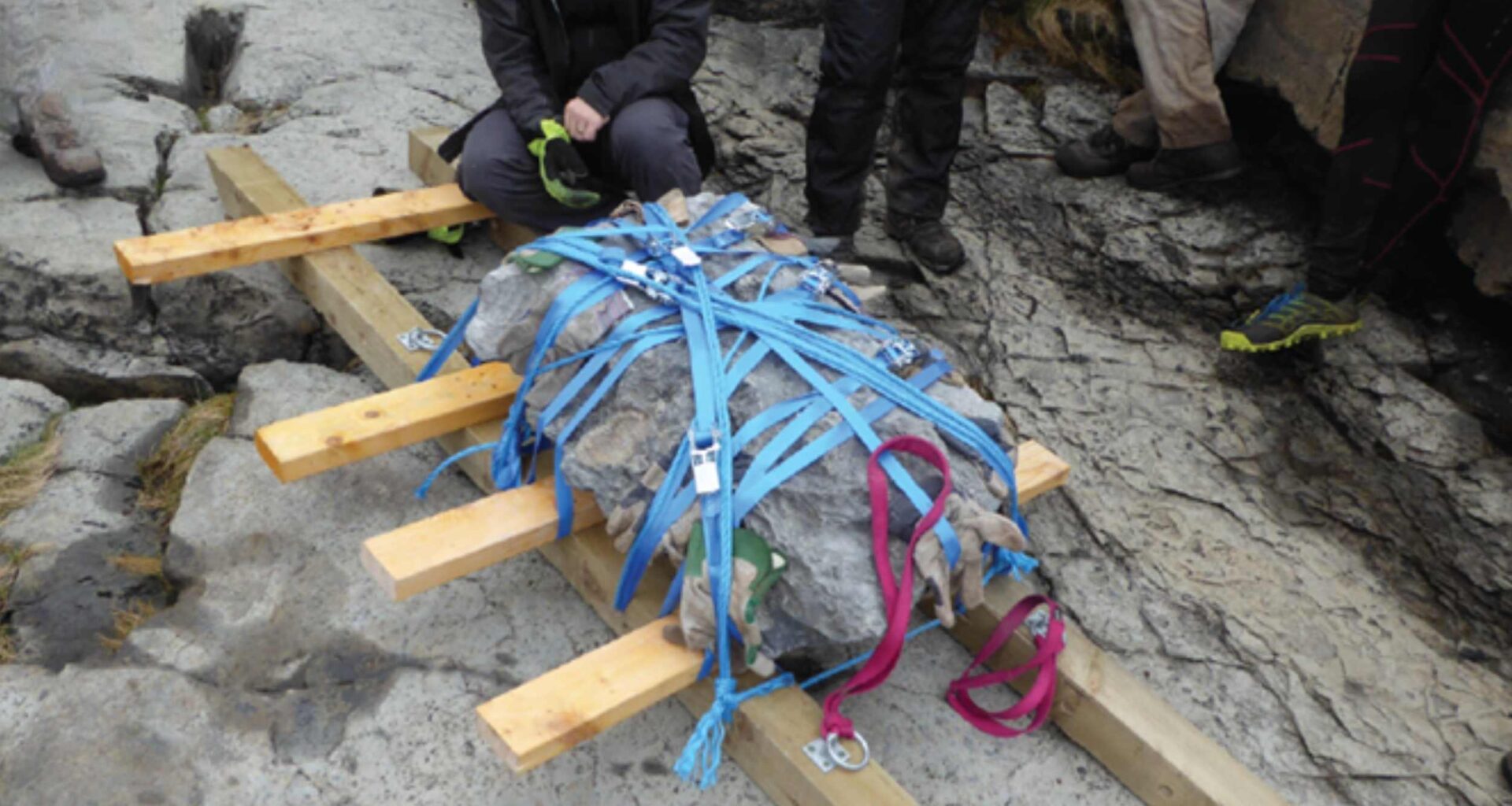
Getting this fossil out wasn’t easy. The skeleton was wedged into hard limestone along a rocky coastline, in a spot that is only reachable at low tide.
It took ropes, wedges, and even a motorboat to haul the block safely to a harbor. The team had to work under strict permits since the area is part of a protected Site of Special Scientific Interest (SSSI).
Middle Jurassic vegetarian dinosaur
Researchers have pieced together enough fossils to suggest that this creature reached roughly the size of a large dog and followed a herbivorous diet.
Its fragmentary but well-preserved bones indicate that it likely moved around on sturdy legs and feasted on vegetation.
“Dinosaurs from the Triassic and Early Jurassic were generally small, bipedal carnivores and omnivores, but by the Late Jurassic they had radiated into a highly diverse range of species that included some of the largest terrestrial vertebrates to ever walk the Earth,” observed Dr. Elsa Panciroli, a paleobiologist at National Museums Scotland.
Although this creature remained modest in size, it lived during a period in which some dinosaurs were rapidly branching into new forms.
Tapping into scarce Middle Jurassic secrets
These Middle Jurassic deposits rarely give up well-preserved dinosaur skeletons. Many known specimens from that stretch of prehistory consist simply of fragmentary teeth or broken limb bones.
Scientists crave more fossils from this interval to help fill gaps in dinosaur family trees. Every new example helps them map out when plant-eaters and meat-eaters evolved novel traits or reached record sizes.
 The process of extracting the dinosaur-bearing block. Photographs a-g by Elsa Panciroli. Click image to enlarge.Ornithischian dinosaurs ate plants
Experts analyzed the dinosaur’s skeletal features and found hints that it could belong to a group called ornithischian dinosaurs.
This clade includes many plant-eating forms that left footprints and sporadic remains, but few skeletons, from this geological slice.
“If the specimen does represent an ornithischian, as tentatively suggested from the partial ilium and histological sectioning, it represents the geologically youngest known occurrence in Scotland, and first from the Kilmaluag Formation,” shared Dr. Panciroli.
Researchers plan to compare these fossils with similar plant-munching species to confirm its family ties.
Examining the bones
The fossilized bone tissue showed clear signs of cyclical growth marks – rings laid down each year like those in trees. At least eight of these marks were visible, which suggests the dinosaur was eight years old, or older, when it died.
Despite its age, the creature hadn’t yet reached full size. Its bones were still actively growing, though at a slower pace. Researchers believe it was a subadult, probably approaching maturity but not quite there yet.
If the team’s identification holds, this could be the earliest known example of an ornithopod, a group of herbivorous Jurassic dinosaurs that later produced well-known species like Iguanodon and Hadrosaurus. That would shift back the clock on when these animals first appeared in the fossil record.
There’s even a chance it could be the oldest body fossil of an iguanodontian, a subgroup within ornithopods. Footprints have hinted at their presence this early, but until now, no bones backed this up.
Dog-sized dinosaur that has no name
It’s the most complete dinosaur skeleton ever pulled from Scottish ground. But the bones themselves? Not in great shape.
The best that Dr. Elsa Panciroli and her team could do was identify the animal as a basal ornithopod, or possibly a cerapodan. Either way, it belonged to a group of two-legged, plant-eating dinosaurs.
Naming a brand new species of anything isn’t simple, but that’s especially true for bones that have been in the ground for 166 million years.
You need what scientists call “diagnostic features” – physical traits that set it apart from every other dinosaur on record.
Therein lies the problem. The skeleton is fragmentary, and the rock holding it is brutally hard to work with. So far the team hasn’t pulled out enough unique “signatures” to justify a new genus and species name.
Middle Jurassic dinosaur research
New discoveries paint a picture of how life in the Jurassic Period thrived, long before famous beasts like Stegosaurus and giant sauropods reached towering heights.
Additional fieldwork is planned, with paleontologists combing Scottish shores in hopes of spotting more hidden remains. They suspect there may be other small herbivores tucked away in the rugged rock layers on the Island of Skye.
The study is published in Earth and Environmental Science.
—–
Like what you read? Subscribe to our newsletter for engaging articles, exclusive content, and the latest updates.
Check us out on EarthSnap, a free app brought to you by Eric Ralls and Earth.com.
—–