
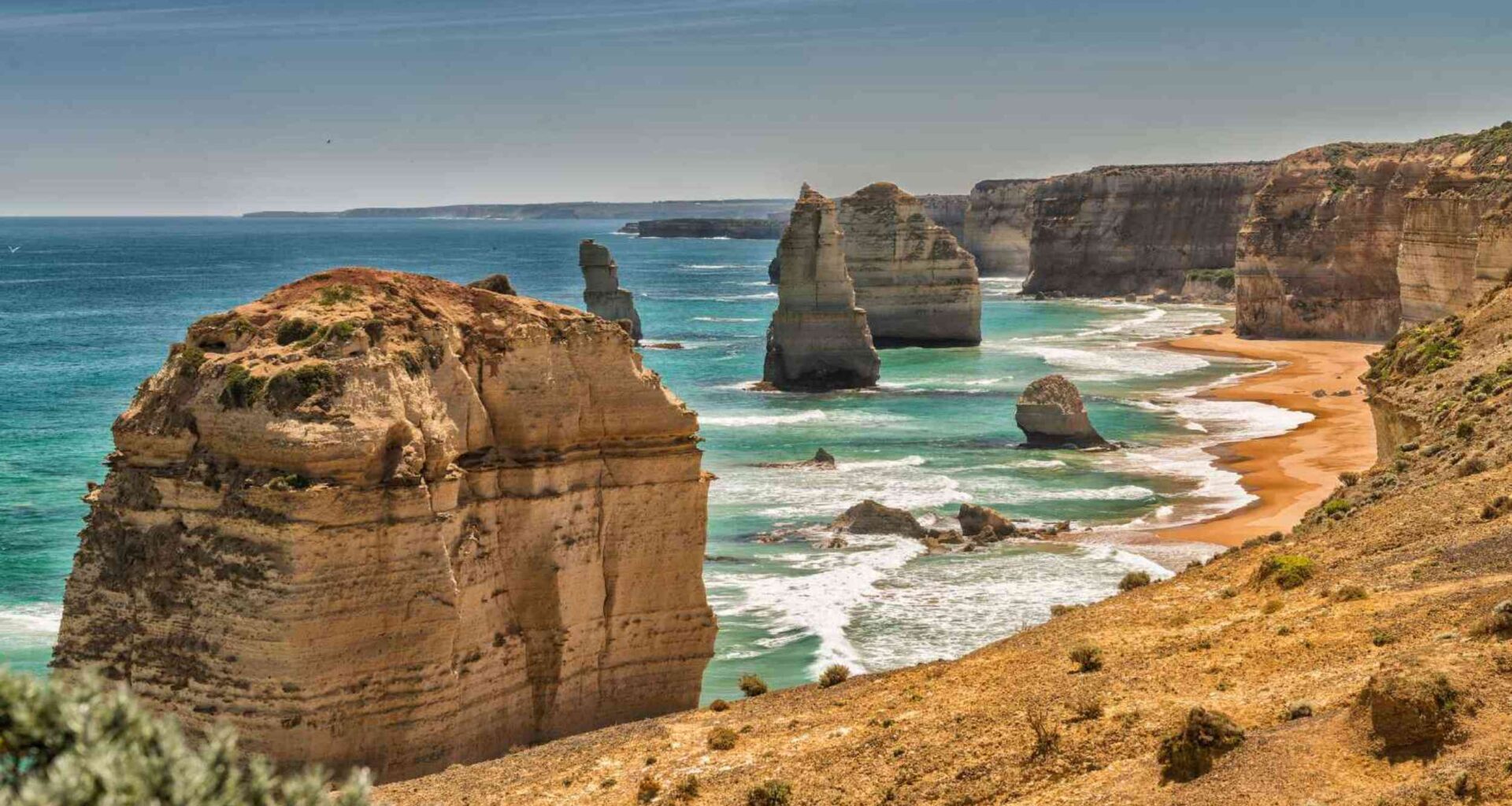
A new analysis has revealed that Australia’s Twelve Apostles – towering limestone rock stacks along the country’s southeast coast – rose after moving tectonic plates lifted old sea floor. Subsequently, the action of the waves carved the familiar pillars.
The finding turns a favorite tourist landmark into a record of buried pressure, warmer ancient seas, and earthquake damage that is still visible in the cliffs.
Finding the Twelve Apostles

At Port Campbell, on Australia’s southeast coast, the 130- to 230-foot (40- to 70-meter) cliffs and stacks hold the exposed rock layers behind that discovery.
By following those layers from beach to cliff, Associate Prof. Stephen Gallagher, a geologist, showed that the rocks formed under the sea before they rose, tilted, and cracked.
Working at the University of Melbourne, his team linked older, soft marine mud low in the section with tougher limestone near the lookout.
That deeper history sets up a harder question about age, because the pillars’ outward shape tells only the most recent part of the story.
Fossils reset the clock
Dates came from microfossils inside the limestone, not from the rock stacks’ outward shape. Different ocean species appeared and disappeared at known times, so their fossils worked as age markers.
“Early preliminary research indicated the ancient limestone layers ranged between seven and fifteen million years old, but we discovered microscopic fossils that more accurately dated the layers as 8.6 to 14 million years old,” Gallagher said.
Better dating makes the rock stacks younger than earlier work implied, even as the record below them reaches about 15 million years.
A rock stack built slowly
The oldest exposed Gellibrand Marl – a soft mudstone from an ancient sea floor – formed under quiet water 15 to 14 million years ago.
Above it, Port Campbell Limestone, the harder rock that builds the stacks, accumulated in shallow seas from about 14 to 8.6 million years ago.
Grey lower layers mark changing water depths; yellow upper layers formed on shallow sea floor near the coast. After that the land rose and erosion stopped the limestone buildup.
Pressure bent the coast
Pressure inside Earth’s crust did not raise the rock as a flat slab. As the Australian Plate – the moving crustal section carrying Australia – met a long crustal squeeze, the rocks folded, tilted a few degrees, and broke.
“Small fault lines can also be seen, which are records of ancient earthquakes,” Gallagher said. Those cracks show earthquakes shaped the foundation before surf made the pillars.
The modern rock stacks came late, after ice-age seas returned. Near the Last Glacial Maximum – when huge ice sheets held ocean water on land – global sea level stood roughly 410 to 440 feet (125 to 134 meters) below today’s level.
Rising water let waves exploit cracks, undercut headlands, and leave isolated rock stacks behind. So the rocks are ancient, but the stack shapes that tourists see are only a few thousand years old.
Rock stack layers held living clues
Inside the cliffs, single-celled foraminifera – ocean organisms with tiny shells – gave the strongest dates.
Because different forms lived during different ages, their shells placed each layer in the right age range.
Some floated in open water; others lived on the sea floor with clams, crabs, sponges, and sea stars. That mix showed whether the sea above them was deeper, calmer, or closer to shore.
Warmer seas left marks
About 13.8 million years ago, grey limestone captured a warm interval when seas stood higher than they do today.
Chemical and fossil work can reveal how marine life and coastlines responded when heat changed the ocean.
That record will not predict today’s coast inch by inch, because continents, currents, and ice sheets have changed.
Still, ancient warm periods give scientists real evidence for how sea level follows climate over long spans.
Twelve Apostles keep changing
Waves keep removing evidence while making new shapes. Official Parks Victoria guidance describes seven visible limestone stacks and states that two others collapsed in 2005 and 2009 respectively.
That uneven count explains the misleading name; twelve stacks did not always stand in the classic view.
Every fallen pillar narrows access to an archive, even as erosion creates new stacks from other arches and headlands.
Reading future coasts
The Twelve Apostles challenge a simple waves-only explanation. Plate pressure prepared the rock, fossil-rich layers recorded changing seas, and erosion finished the visible job.
That sequence matters because cliffs fail through rock strength, cracks, sea level, storms, and old faults acting together.
Better maps of hidden structure, paired with finer tests of individual layers, can help managers judge unsafe edges as waves keep attacking the base.
Lessons from the Twelve Apostles
A tourist landmark now reads three forces working at different speeds: ancient seafloor growth, later crustal squeezing, and recent wave attack.
Its value lies in that combination, because the same cliffs that guide future sampling and tell a deeper history can still lose pieces without much warning.
The study is published in the Australian Journal of Earth Sciences.
—–
Like what you read? Subscribe to our newsletter for engaging articles, exclusive content, and the latest updates.
Check us out on EarthSnap, a free app brought to you by Eric Ralls and Earth.com.
—–