
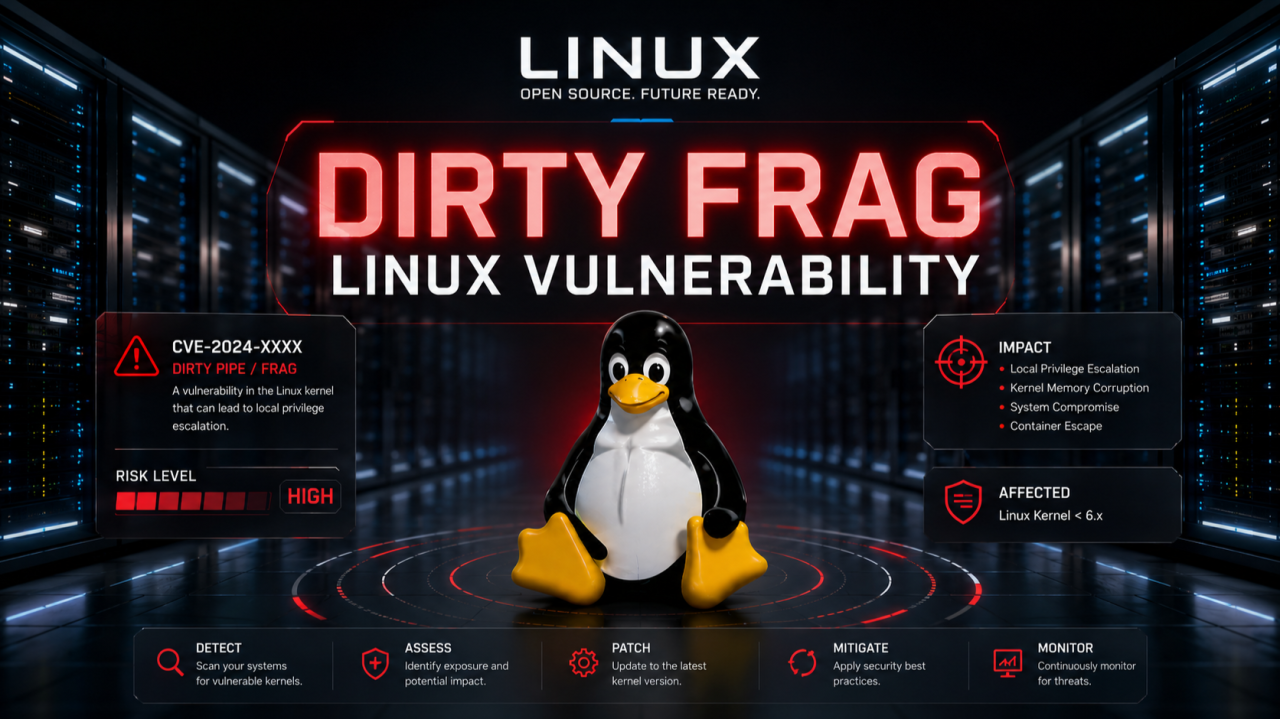
A newly disclosed Linux kernel vulnerability chain known as “Dirty Frag” is raising urgent concerns across the cybersecurity community after researchers revealed that the flaw can reliably grant root privileges on many of the world’s most widely deployed Linux distributions, including enterprise server environments and cloud infrastructure platforms.
Security researchers say the vulnerability represents the latest evolution in a dangerous class of Linux kernel memory corruption bugs that includes infamous exploits such as Dirty Pipe and the recently disclosed Copy Fail flaw. Unlike many local privilege escalation vulnerabilities that rely on unstable race conditions or timing attacks, Dirty Frag is described as highly deterministic, making exploitation significantly more reliable and potentially easier to weaponize.
The flaw was publicly detailed this week by security researcher Hyunwoo Kim, who said the issue combines two separate kernel page-cache write vulnerabilities to achieve full root access under different Linux configurations.
According to Kim, the exploit chain affects numerous modern Linux distributions, including Ubuntu 24.04.4, Red Hat Enterprise Linux 10.1, Fedora Linux 44, AlmaLinux 10, CentOS Stream 10, and openSUSE Tumbleweed.
The vulnerability chain arrives amid growing concern over Linux kernel attack surfaces, particularly as Linux continues to dominate cloud infrastructure, enterprise servers, containerized workloads, telecommunications infrastructure, and embedded systems worldwide.
A New Successor to Dirty Pipe and Copy Fail
Researchers are describing Dirty Frag as part of a broader and increasingly dangerous category of Linux page-cache corruption vulnerabilities.
The exploit chain builds on concepts previously seen in:
Like those earlier bugs, Dirty Frag abuses weaknesses in how the Linux kernel handles page-cache-backed memory pages. By manipulating pages shared between user space and kernel space, attackers can overwrite data that should ordinarily remain protected.
Kim described Dirty Frag as an extension of the same underlying bug class:
“Because it is a deterministic logic bug that does not depend on a timing window, no race condition is required, the kernel does not panic when the exploit fails, and the success rate is very high.”
That characteristic sharply distinguishes Dirty Frag from many previous Linux local privilege escalation exploits, which often depended on fragile timing conditions and could crash systems during failed attempts.
Deterministic exploitation dramatically increases operational reliability for attackers and lowers barriers for real-world abuse.
How the Exploit Works
Dirty Frag combines two distinct vulnerabilities:
xfrm-ESP Page-Cache Write
RxRPC Page-Cache Write
Together, the two bugs allow attackers to bypass environmental restrictions that would otherwise block exploitation on certain Linux distributions.
The first vulnerability exists within the Linux kernel’s IPsec implementation, specifically the xfrm-ESP subsystem used for encrypted networking traffic.
The flaw stems from Linux’s handling of MSG_SPLICE_PAGES fast paths during ESP-in-UDP processing. Under certain conditions, the kernel decrypts data directly into externally backed memory pages rather than copying the data safely into private kernel-owned buffers.
That behavior can allow attackers to overwrite kernel page-cache memory associated with sensitive files.
The second vulnerability affects RxRPC, a remote procedure call protocol subsystem originally developed for the Andrew File System (AFS).
While the xfrm-ESP vulnerability often requires namespace creation privileges, the RxRPC variant can function without those permissions. However, RxRPC kernel modules are not enabled by default on every distribution.
Kim explained that the two exploit paths effectively compensate for each other’s limitations:
Systems permitting unprivileged namespace creation are vulnerable to the ESP exploit path.
Systems like Ubuntu, which restrict namespace creation through AppArmor policies, may still be exploitable through the RxRPC path because the rxrpc kernel module is loaded by default.
This dual-path design substantially broadens the number of potentially affected environments.
Exploit Reliability Raises Serious Concerns
The exploit’s reliability may significantly elevate the threat level compared to typical local privilege escalation flaws.
According to security firm Wiz, Dirty Frag combines “two page-cache write primitives” capable of modifying memory pages not exclusively owned by the kernel.
Wiz researchers Merav Bar and Rami McCarthy warned that attackers could corrupt sensitive files and escalate privileges with relatively high reliability.
The researchers noted that the exploit class bears strong similarities to Dirty Pipe, which became one of the most severe Linux privilege escalation bugs in recent years due to its simplicity and reliability.
Highly reliable Linux kernel exploits are especially dangerous because they can rapidly move from proof-of-concept demonstrations into active exploitation campaigns.
That concern intensified after researchers released working proof-of-concept exploit code capable of obtaining root access using a single command.
Enterprise and Cloud Infrastructure at Risk
The disclosure has triggered heightened concern among enterprise defenders because affected systems include major enterprise Linux distributions commonly deployed in:
Cloud infrastructure
Kubernetes environments
Enterprise virtualization platforms
Telecom systems
Web hosting environments
DevOps pipelines
Managed service provider infrastructure
Linux remains the dominant operating system for cloud workloads globally, powering the majority of modern hyperscale environments.
Local privilege escalation vulnerabilities become especially dangerous in multi-tenant or containerized infrastructure where attackers may already possess limited user-level access through compromised applications, web shells, insider threats, or container escapes.
In updated guidance, Canonical warned that Dirty Frag may enable both local privilege escalation and potential container escape scenarios in environments executing untrusted workloads.
“In container deployments that may execute arbitrary third-party workloads, the vulnerability may additionally facilitate container escape scenarios.”
That warning is particularly significant for organizations operating Kubernetes clusters or shared hosting platforms where isolation boundaries are critical.
Patches Still Incomplete
Compounding the urgency is the fact that the vulnerability chain remains only partially patched.
The xfrm-ESP Page-Cache Write vulnerability has now received the identifier:
The issue was patched in the Linux mainline kernel through commit:
However, the second vulnerability:
currently lacks a publicly available patch as of publication time.
The disclosure process itself also became complicated after details and exploit information for the xfrm-ESP issue reportedly leaked publicly before coordinated disclosure procedures had concluded.
As a result, Linux maintainers and downstream vendors have been forced into accelerated incident response and patch coordination efforts.
Linux Vendors Issue Advisories
Several major Linux vendors and security organizations have now published advisories or mitigation guidance, including:
Researchers noted that systems previously hardened against Copy Fail may still remain vulnerable to Dirty Frag.
Specifically, mitigation strategies involving blacklist protections for the algif_aead module do not prevent exploitation of Dirty Frag.
Temporary Mitigations
Until complete patches become available, researchers recommend disabling vulnerable kernel modules where operationally feasible.
Suggested mitigation commands include blocking the esp4, esp6, and rxrpc modules:
sudo sh -c “printf ‘install esp4 /bin/false\ninstall esp6 /bin/false\ninstall rxrpc /bin/false\n’ > /etc/modprobe.d/dirtyfrag.conf; rmmod esp4 esp6 rxrpc 2>/dev/null; true”
Security teams are also being advised to:
Restrict local shell access where possible
Harden container runtime policies
Limit namespace creation privileges
Audit systems for unusual kernel module activity
Monitor for unexpected privilege escalation attempts
Apply kernel updates immediately once patches become available
Organizations operating exposed multi-user Linux environments are being urged to prioritize patch management efforts due to the exploit’s reliability and public proof-of-concept availability.
A Growing Pattern in Linux Kernel Security
The emergence of Dirty Frag continues a broader trend of increasingly severe Linux kernel memory corruption vulnerabilities discovered over the past several years.
Linux page-cache handling remains a fertile attack surface due to the complexity of modern zero-copy networking optimizations, splice operations, memory sharing mechanisms, and high-performance packet processing paths.
Many of these vulnerabilities stem from performance-oriented kernel optimizations designed to minimize memory copying overhead in networking and filesystem operations.
However, those same optimizations can unintentionally create dangerous edge cases where user-controlled memory pages become improperly trusted by privileged kernel code.
As Linux kernels continue expanding to support increasingly complex cloud-native networking architectures, researchers warn that attack surfaces within networking subsystems such as XFRM, IPsec, eBPF, and zero-copy packet handling may continue producing high-impact vulnerabilities.
The latest disclosures are likely to intensify scrutiny of Linux kernel networking internals and memory management logic, especially among cloud providers and enterprise infrastructure operators seeking to reduce kernel-level attack exposure.
🚨 Webinar: New survey of 400+ enterprise cybersecurity leaders on targeted social engineering, and the findings are highly relevant for anyone responsible for protecting their business from cyberthreats in 2026. This webinar discusses the report and examines what security teams are seeing across large enterprises, and where organizations are prioritizing their defenses. Click the graphic to register 👇🏻