
When a planet circles its star every four days, the heat should strip its atmosphere down to basics. Heavier molecules burn off. What’s left is mostly hydrogen and helium – the lightest elements, not much else.
A small planet 190 light years away doesn’t follow that rule. Its atmosphere is loaded with water vapor, carbon dioxide, and sulfur dioxide – compounds far too heavy to have formed where it now sits.
An odd couple

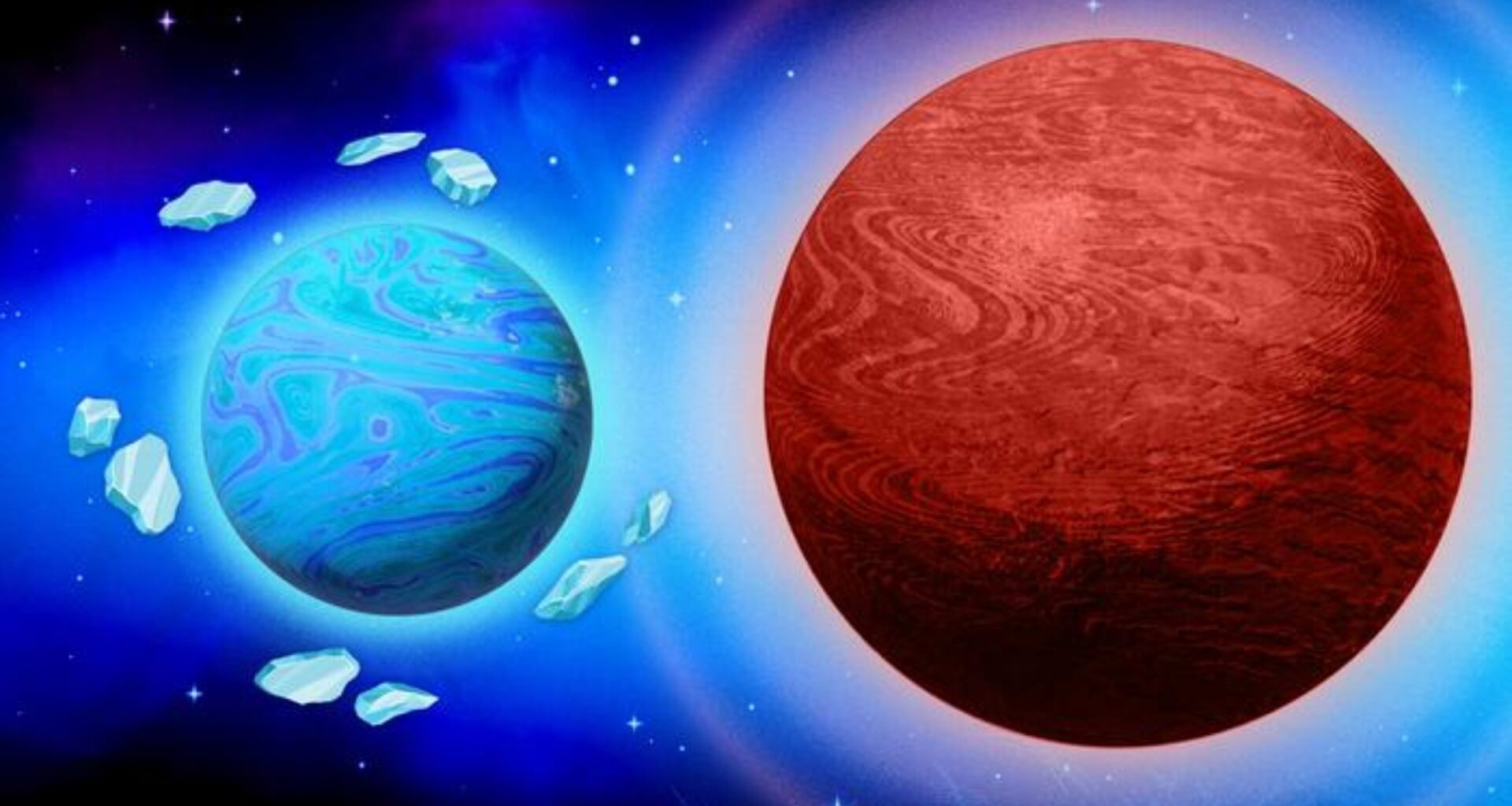
At the heart of the story is a system called TOI-1130. Its outer planet is a hot Jupiter, a gas giant about the size of our own Jupiter, completing a lap every eight days.
The inner planet is a mini-Neptune, smaller and lighter, sweeping around in just four.
No one had a good explanation for how the two ended up sharing space at all. Chelsea X. Huang and her colleagues spotted the pair in 2020 with NASA’s TESS satellite, and their paper was the first to show that the architecture could even exist.
Saugata Barat, a postdoctoral researcher at the Massachusetts Institute of Technology (MIT), led a team that turned NASA’s James Webb Space Telescope on the smaller world to read its atmospheric chemistry.
Lonely no more
Most hot Jupiters drift through their planetary systems without company. They’re so massive, and their gravity so dominant, that anything orbiting nearby gets thrown clear or pulled into the star early in the system’s life.
That picture has held up under careful searches. One study looked for nearby worlds across nearly 200 known hot Jupiter systems and came up with no new candidates, consistent with decades of similar results.
Then TOI-1130b showed up, parked even closer to the star than its giant neighbor. By any standard explanation of how planets form, it shouldn’t be there.
Capturing the inner planet
Pointing a telescope at TOI-1130b is harder than it sounds.
The two planets orbit close enough to pull on each other gravitationally, and that constant tug makes each one run early or late – sometimes by as much as five hours.
Predicting exactly when the inner planet would cross the star became a puzzle in itself.
Catching a clean view meant predicting exactly when the inner planet would cross the star at the right angle for Webb to see.
Judith Korth at Lund University led that prediction, building a timing model from years of follow-up work.
A heavy atmosphere
What JWST does is read colors. Each molecule in a planet’s atmosphere absorbs a specific set of wavelengths, leaving dark gaps in the starlight that filters through during a transit.
The gaps in TOI-1130b’s spectrum told a clear story. Water vapor, carbon dioxide, and sulfur dioxide all showed up at high confidence. Methane was detected too, but more faintly.
These molecules are what scientists call “heavy.” Atom for atom, they weigh more than the hydrogen and helium that fill out gas giants such as Jupiter.
In abundance, they signal an atmosphere built from very different stuff.
Beyond the frost line
Where TOI-1130b sits now, a heavy atmosphere shouldn’t form. The planet swings around its star every four days, reaching temperatures above 1,000 degrees Fahrenheit.
Water and other compounds evaporate at those conditions – they don’t pile up.
That mismatch sent the team looking outward – way outward. The composition fits with formation past the frost line, which is the cold zone in a young star’s disk where water freezes onto bits of dust.
A young planet growing out there can scoop up icy pebbles in great numbers.
Those pebbles could account for an atmosphere thick with water and other heavy compounds – which may explain exactly what Webb is seeing on TOI-1130b.
Drifting inward together
If TOI-1130b built up its atmosphere out in the cold, the obvious question is how it ended up so close to the star. The team’s best answer: both planets made the trip, slowly, while the system was young.
Astronomers have long suspected that giant planets can migrate inward through the gas-and-dust disk surrounding a newborn star, losing energy as they push through the leftover material.
What no one had captured before was the chemistry that should result if a smaller companion came along for the ride.
“This measurement tells us that this mini-Neptune indeed formed beyond the frost line, giving confirmation that this formation channel does exist,” said Barat.
The picture rests on one system. TOI-1130 is already extraordinary – almost no other hot Jupiter systems have had a close-in companion’s atmosphere measured at all.
Confirming whether the same migration story holds more broadly will take finding and measuring more rare pairs like this one.
Clues about the most common planets
The result settles a question that’s nagged at the field for six years. Mini-Neptunes – the galaxy’s most common planet – don’t all form where they end up.
Some are clearly built out in the cold and pulled inward, atmosphere intact, even alongside a hot Jupiter that should have wrecked the neighborhood. Improbable, but real.
That opens a different way to think about the broader mini-Neptune population. Some may be locals; others are visitors from far out who arrived with their atmospheres intact.
The study is published in The Astrophysical Journal Letters.
Image Credit: Jose-Luis Olivares, MIT
—–
Like what you read? Subscribe to our newsletter for engaging articles, exclusive content, and the latest updates.
Check us out on EarthSnap, a free app brought to you by Eric Ralls and Earth.com.
—–