
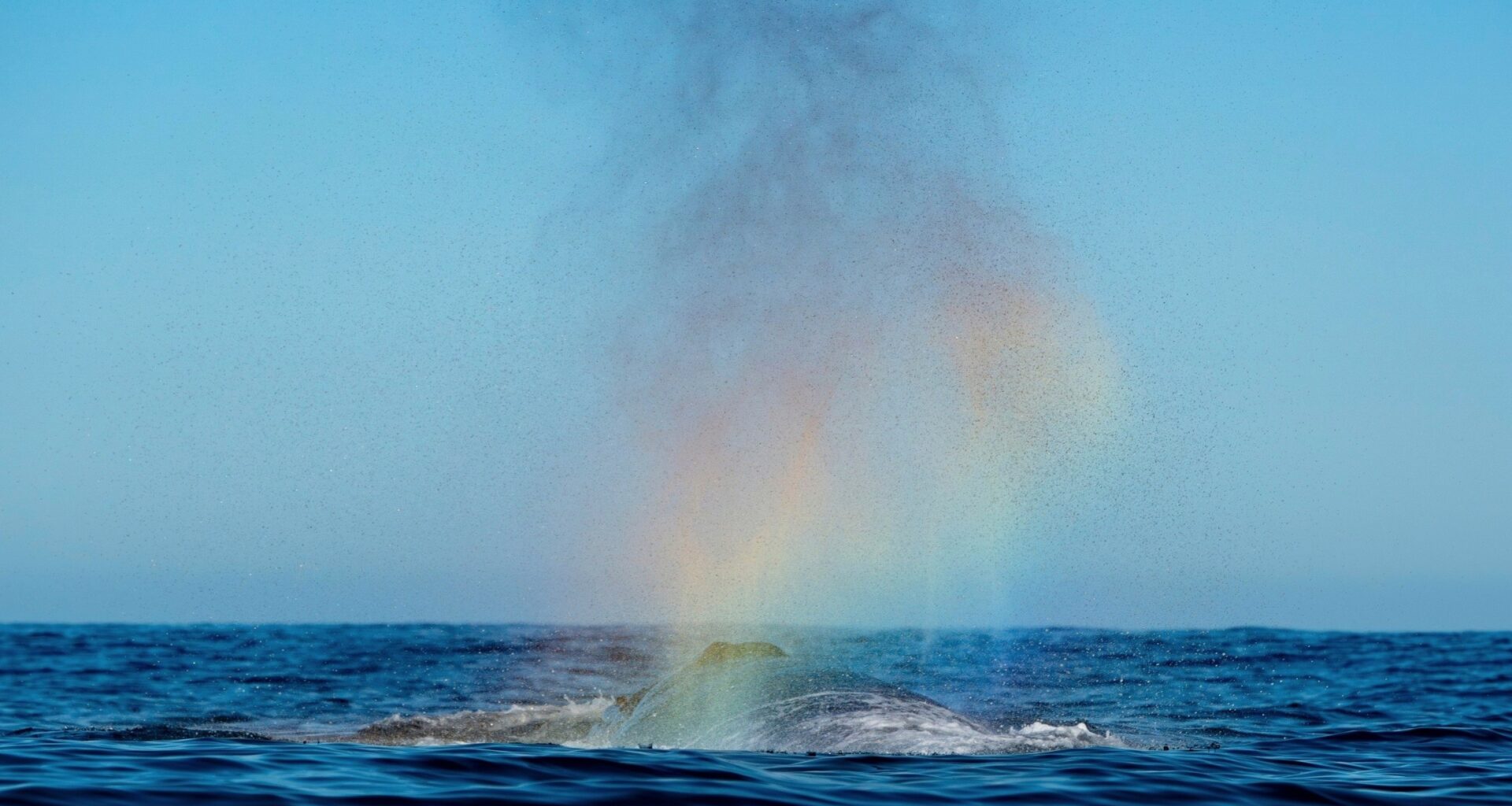
A new study has found a way to count whales by looking not at the animals themselves, but at the microscopic traces they leave in the surrounding water.
The method proves 53% more accurate than conventional approaches. This is a significant leap for a field where population estimates directly drive conservation decisions.

The research was conducted by marine biologists at Scripps Institution of Oceanography at UC San Diego and statisticians at California Polytechnic State University (Cal Poly).
The team focused on whale populations along the California coast between 2014 and 2020, covering the stretch of ocean from San Diego to Morro Bay.
Why counting whales is so hard
Whales travel enormous distances, spend most of their time below the surface, and surface on their own terms.
Standard methods – visual surveys from boats or planes, photo identification, acoustic monitoring, satellite imagery – all run into the same fundamental problem.
The animals simply don’t cooperate with consistent observation.
What the researchers suspected was that the water itself might hold a better signal. Not the whales directly, but the ecological mark they leave behind.
Baleen whales are filter feeders. They gulp vast quantities of seawater, push it through their baleen plates, and trap krill, zooplankton, and small fish.
Done repeatedly, at scale, over weeks and months, this activity reshapes the microbial and plankton communities in the surrounding water.
The team’s idea was to detect that reshaping and use it to infer how many whales had been present.
The tool they used was environmental DNA, or eDNA. A seawater sample is filtered, the DNA of whatever organisms were living in it is extracted, and specific genetic markers are amplified.
The result is a detailed snapshot of the microbial and plankton community at that location.
Tracking whales through DNA
The team drew on data from the California Cooperative Oceanic Fisheries Investigations (CalCOFI), the world’s oldest marine ecosystem monitoring program, currently in its 77th year.
The researchers compared the microbial community profiles against whale density estimates gathered through direct visual surveys.
Then, they built statistical models to test how well one could predict the other.
“Many approaches rely on indirect environmental proxies that are several steps removed from the actual biology of the whales,” said study lead author Erin Satterthwaite.
“Our work uses eDNA to characterize the structure of the microbial and small plankton community which adds to existing oceanographic information by incorporating ecological habitat information of whales, which improves our ability to predict whale densities.”
Collaborators across different fields
The results were striking. The microbial-based models outperformed traditional forecasting methods by 53 percent.
“The concept of this project was to try and find an indirect signal that’s based on ecological relationships in the microbial communities that are in the water and how they respond to macro-organisms, such as whales,” explained co-author Trevor Ruiz.
The project brought together researchers from fields that don’t usually sit at the same table.
“It had many collaborators across different fields, from statistics to marine ecology to genomics, and seeing everyone from these disciplines coming together to form the final product was one of the most interesting aspects,” said co-author Nick Patrick.
The team has also released their statistical methods as downloadable software, making the approach available to other researchers working on different problems.
Future research directions
For conservation managers, better population monitoring relies on protecting whales from ship strikes, fishing gear entanglement, and noise disturbance.
This all depends on knowing where whales are, in what numbers, and at what time of year.
The study also opens a window onto a relationship that ecologists have long been curious about: how the ocean’s largest animals shape communities of its smallest.
As eDNA technology continues to drop in cost and grow in accessibility, the same method could potentially be applied to other large marine species such as sharks or open-ocean fish.
For now, the study makes a quietly compelling case: if you want to find a whale, sometimes the best place to look is the water it left behind.
The study is published in the journal PLOS One.
—–
Like what you read? Subscribe to our newsletter for engaging articles, exclusive content, and the latest updates.
Check us out on EarthSnap, a free app brought to you by Eric Ralls and Earth.com.
—–