
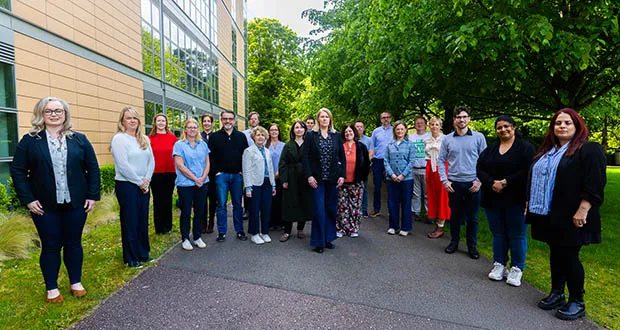
PD-Life will aim to establish first all-island dedicated, virtual centre of excellence for Parkinson’s research
A new all-island research group specialising in Parkinson’s disease will transform the quality of life of people with the condition.
PD-Life consists of more than 30 senior researchers, clinicians and advocacy groups from across Ireland and Northern Ireland.
Key to the hub’s work will be a four-year programme to establish the first dedicated, virtual centre of excellence for Parkinson’s research on the island.
Led by Prof Suzanne Timmons of University College Cork (UCC) alongside Dr Mihalis Doumas of Queens University Belfast (QUB), PD-Life will focus on three interconnected pillars that are priorities for the Parkinson’s community: tackling stigma, supporting mental health, and promoting exercise and physical activity through initiatives like dance. These themes will be explored through the critical lenses of gender, culture, and technology.
The project has already garnered support from patient advocacy groups, with Parkinson’s Ireland and Parkinson’s UK Northern Ireland represented on the project’s steering committee.
Director at Parkinson’s Ireland Dr Brenda O’Connell – who is also living with the disease – said: ‘Projects like PD-Life give me an immense sense of hope for the future, as living with Parkinson’s can be a lonely experience.
“This project will further raise awareness in the public domain, which is crucial. We know there is no cure for Parkinson’s disease, but if a solution could be found to ease the challenging symptoms, both motor and non-motor, it would have an enormous impact.
“The non-motor symptoms are a hidden element of Parkinson’s disease, and I would like more conversations about this to help the public gain a better understanding of the mental challenges many of us deal with.”
The hub will build research capacity by supporting scientists, including a cohort of nine funded PhD students and several postdoctoral researchers. These junior researchers will be mentored by interdisciplinary supervisory teams from across the partner institutions, fostering cross-border collaboration and developing future leaders in Parkinson’s research.
“Parkinson’s is a complex, multi-faceted disease, and it demands an equally multi-faceted research approach,” said Prof Timmons, who is also head of the UCC Centre for Gerontology and Rehabilitation.
“Until now, universities across Ireland have largely worked independently. PD-Life creates a framework for us to combine our expertise, share knowledge, and avoid unnecessary duplication. Crucially, people living with Parkinson’s and their advocates are core partners in this hub, ensuring our research is relevant and makes a real difference to their lives.”
The PD-Life hub will run until April 2030. “By uniting the complementary strengths of the PD research clusters at UCC and QUB, and bringing in expertise from universities across the island, we can generate robust, all-island data,” said Dr Doumas, who is a senior lecturer in psychology.
“This evidence will be vital for informing healthcare policy, improving clinical practice, and ultimately ensuring that people with Parkinson’s receive the best possible care and support, no matter where they live.’