
Scientists estimating how often sinking ocean particles bump into each other have worked from two competing models for decades. When those models gave different answers, researchers added them and called it close enough.
New calculations from physicists in Poland show the combined approach can miss the true collision rate by a factor of 100. That gap runs straight through the numbers used to track how much carbon the ocean actually sequesters.
Marine snow stores carbon

Marine snow forms near the sunlit top of the ocean. Phytoplankton turn carbon dioxide into tissue, and their dead remains clump with mucus and fecal pellets into loose flakes.
Some are smaller than a speck of dust. Others stretch a fraction of an inch across, drifting downward at up to several hundred feet a day.
Flakes that survive lock carbon into the deep sea for centuries through the biological carbon pump, one of the planet’s main routes for removing heat-trapping gas from the air.
Only a small fraction reaches the deep ocean. Most gets eaten by bacteria or zooplankton in the upper layers, according to a paper reviewing decades of measurements.
Jan Turczynowicz is a physics student at the University of Warsaw (UW) and lead author of the new study. He set out to understand why upper-layer encounters are so consequential.
Two pictures of collision
On the way down, particles run into each other. Some collisions glue smaller flakes onto larger ones, speeding the descent. Others pick up bacteria that eat the flake from inside, breaking it apart.
How often a flake reaches the bottom depends partly on how often it bumps into something else. Researchers have used two competing models to estimate the bumping.
One treats it as Brownian motion – the random jitter of small particles knocked around by water molecules. The other describes a fast-sinking flake intercepting smaller, slower objects in its path.
Both are right. Both are wrong. Neither captures what happens when a flake meets a busy stretch of ocean full of smaller particles.
Bridging both at once
In practice, both effects work at once. A sinking flake sweeps up some particles through direct interception, and catches others because random motion brings them into contact.
The trouble is that the two models give wildly divergent answers at the extremes. One predicts almost no encounters; the other predicts many.
Turczynowicz and colleagues solved the equations for a sphere settling through fluid while smaller objects diffuse around it. They ran simulations spanning the full range of particle sizes and sinking speeds.
The result was a single formula that works whether particles are nudged by random jitter or swept up by the flake’s path – and everything in between. Two pictures, one equation.
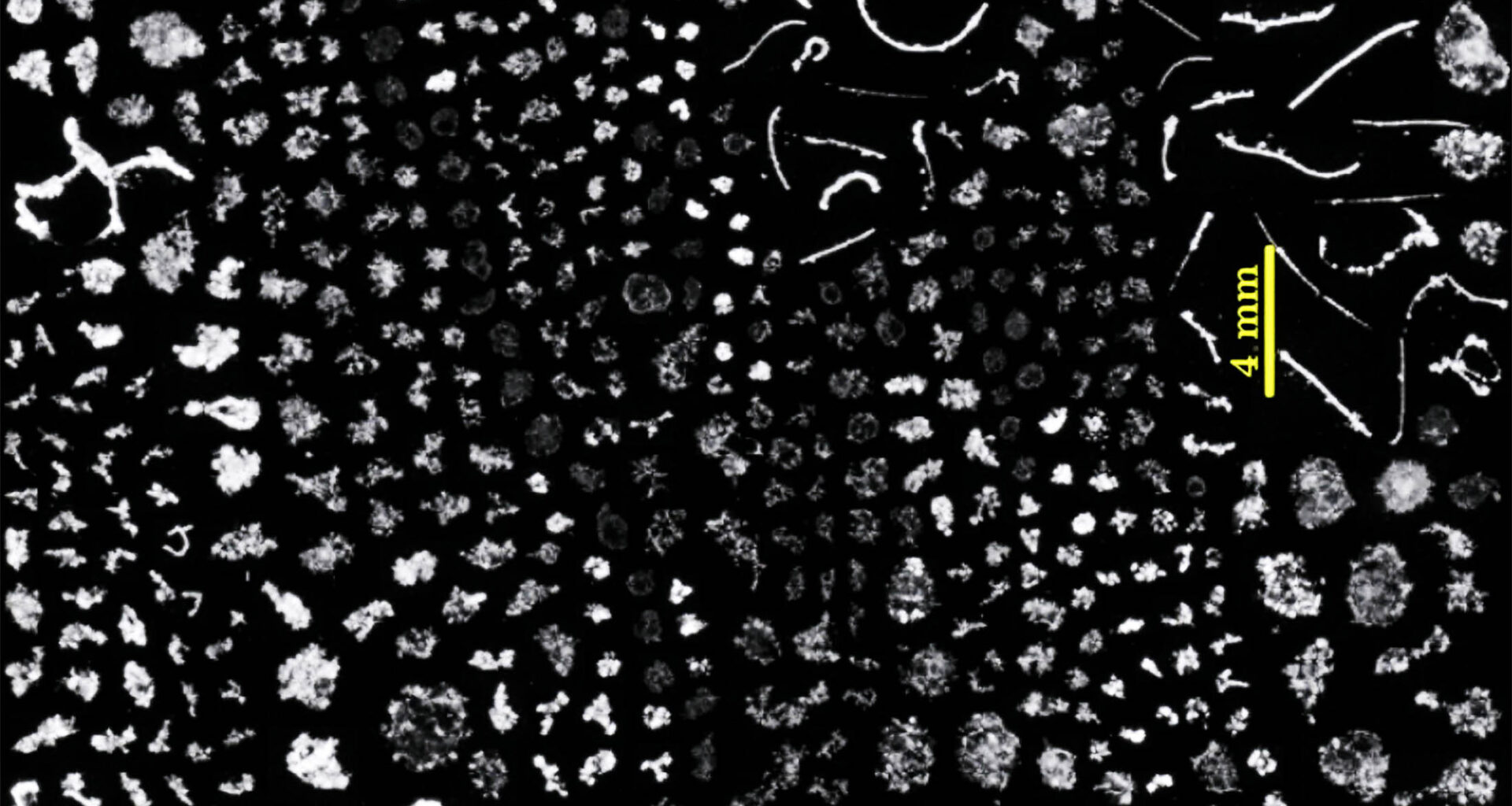
 A variety of marine “snowflakes” that can be observed in the ocean. They vary in shape, density, size, and origin. Credit: Prof. Emilia Trudnowska (Instutute of Oceanology, Polish Academy of Sciences). Click image to enlarge.Underestimating marine snow
The headline finding lies at the fast-sinking end of the spectrum. For large flakes plowing into tiny picoplankton, the older sweep-up model misses most of the action. Diffusion was supposed to be negligible there. Not so.
“This method yields an error not exceeding 20%,” said Turczynowicz, referring to the practice of simply summing the two existing collision models.
Adding the rates was close, but the physics behind the sum was wrong – and pushing that practice further could blow up the error.
Comparing the standard sweep-up approach against the full bridged model, the gap reached two orders of magnitude. Encounters happened up to 100 times more often than the old formula predicted.
Physics matches plankton groups
Something unexpected fell out of the math. The boundary between the two collision regimes – where Brownian wandering gives way to direct sweeping – sits almost exactly where biologists separate picoplankton from nanoplankton. Two different fields. Same dividing line.
The categories aren’t arbitrary. They track a real physical transition in how the smallest organisms interact with sinking debris.
What the model misses
The framework is a theoretical model, not a direct measurement. It assumes spherical particles in slow, smooth flow, and it treats interactions one pair at a time.
Real marine snow is lumpy, irregular, and often draped in slimy mucus halos that trail behind sinking aggregates like comet tails, as a recent study of Gulf of Maine particles showed.
The authors are clear about that gap. Their new formula gives a much cleaner starting point than the old binary choice, and shrinks the part of the problem researchers have to fudge with assumptions.
Marine snow and ocean carbon
For 50 years, marine biologists have been trying to nail down how much carbon the deep ocean actually swallows. The answer feeds directly into climate models, fisheries forecasts, and predictions about how warming will change ocean chemistry.
If small particles meet large ones 100 times more often than assumed, how fast they clump together, how quickly microbes colonize them, and how soon that carbon gets broken back down may all need new numbers.
That does not necessarily mean more carbon reaches the seafloor. Faster encounters may speed up degradation just as easily as they might speed up sinking.
It suggests the underlying clock runs faster, and the models built on the old formula likely understate how quickly marine snow’s fate gets decided in the upper sea.
The study is published in the Journal of Fluid Mechanics.
—–
Like what you read? Subscribe to our newsletter for engaging articles, exclusive content, and the latest updates.
Check us out on EarthSnap, a free app brought to you by Eric Ralls and Earth.com.
—–