
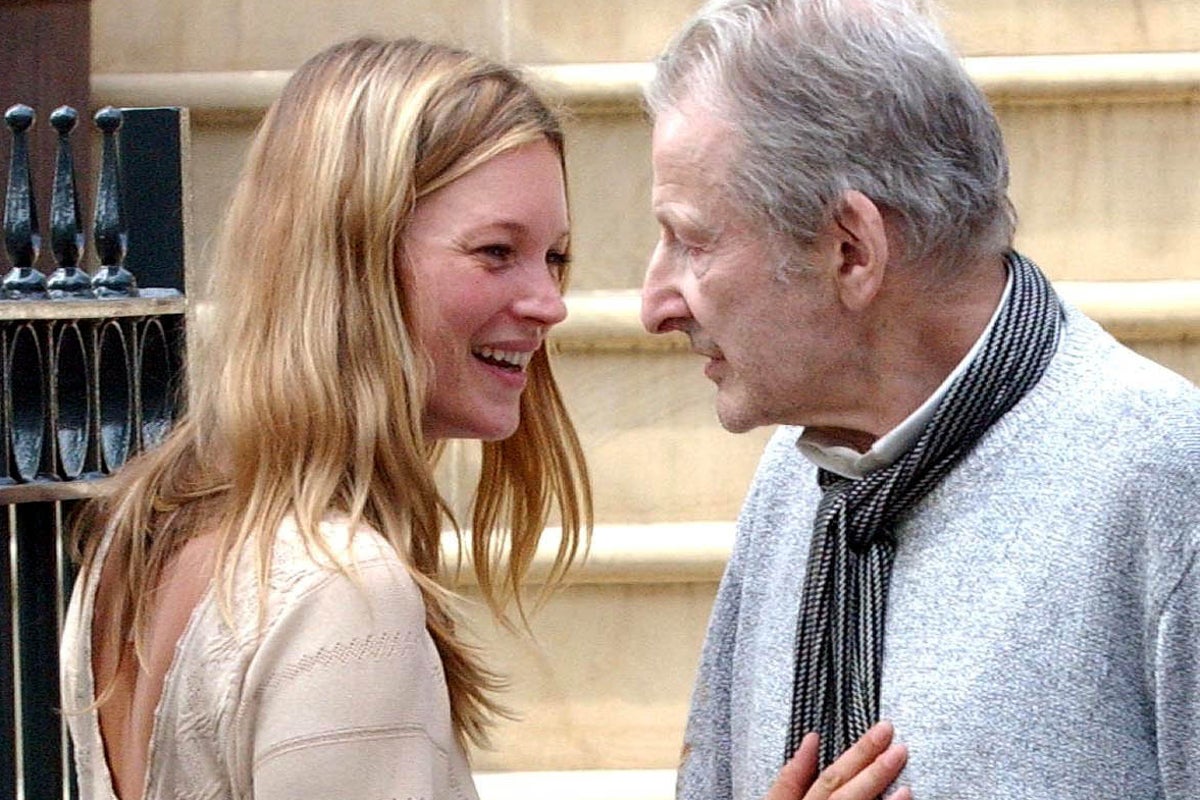
At first it didn’t make a lick of sense. Kate Moss, all fag ash, fashion, and glamorous, airbrushed artifice, colliding with Lucian Freud, who was concerned with anything but. The paparazzi photos caused a right old stir: the Croydon model and the cantankerous German-born painter, her hidden behind black shades, him looking for the nearest escape hatch from prying eyes.
Were they friends? Lovers? A secret third thing? Then, finally, the outcome: Naked Portrait 2002, painted over the course of nine months; the gorgeous, grotesque, eternally divisive result of one of the art world’s most unlikely partnerships.
A film has now been made about the pair, simply titled Moss & Freud. It stars Ellie Bamber and Derek Jacobi, and dutifully recreates many of the conversations shared between artist and muse, to the best of Moss’s recollection (the memories she’s most comfortable sharing publicly, I suppose.) Moss is a producer on the film, though she skipped its London premiere earlier this week, perhaps because it would have been too exposing.
Like Freud in his lifetime, Moss is notoriously press-shy, particularly whenever she’s asked to be just Kate Moss, rather than Kate Moss: Superstar Supermodel. “I find it difficult to be myself in front of the camera,” she said a few years ago. “I find it much easier being someone else.” No wonder Freud found her so compelling, and that the resulting portrait he painted – dimpled, fleshy, real – proved so jarring for her.
It was Bella, Freud’s fashion-designer daughter, who introduced them. Moss had talked about her love for Freud in the pages of Dazed & Confused magazine. She dreamt of sitting for him, she said, despite the unlikelihood of Freud drawing professional models, or even stars. He’d long resisted them – turning down the Pope, Princess Diana, and endless requests from Andrew Lloyd Webber to paint his wife, Madeleine (“He even threatened me with theatre tickets,” Freud witheringly told a friend).
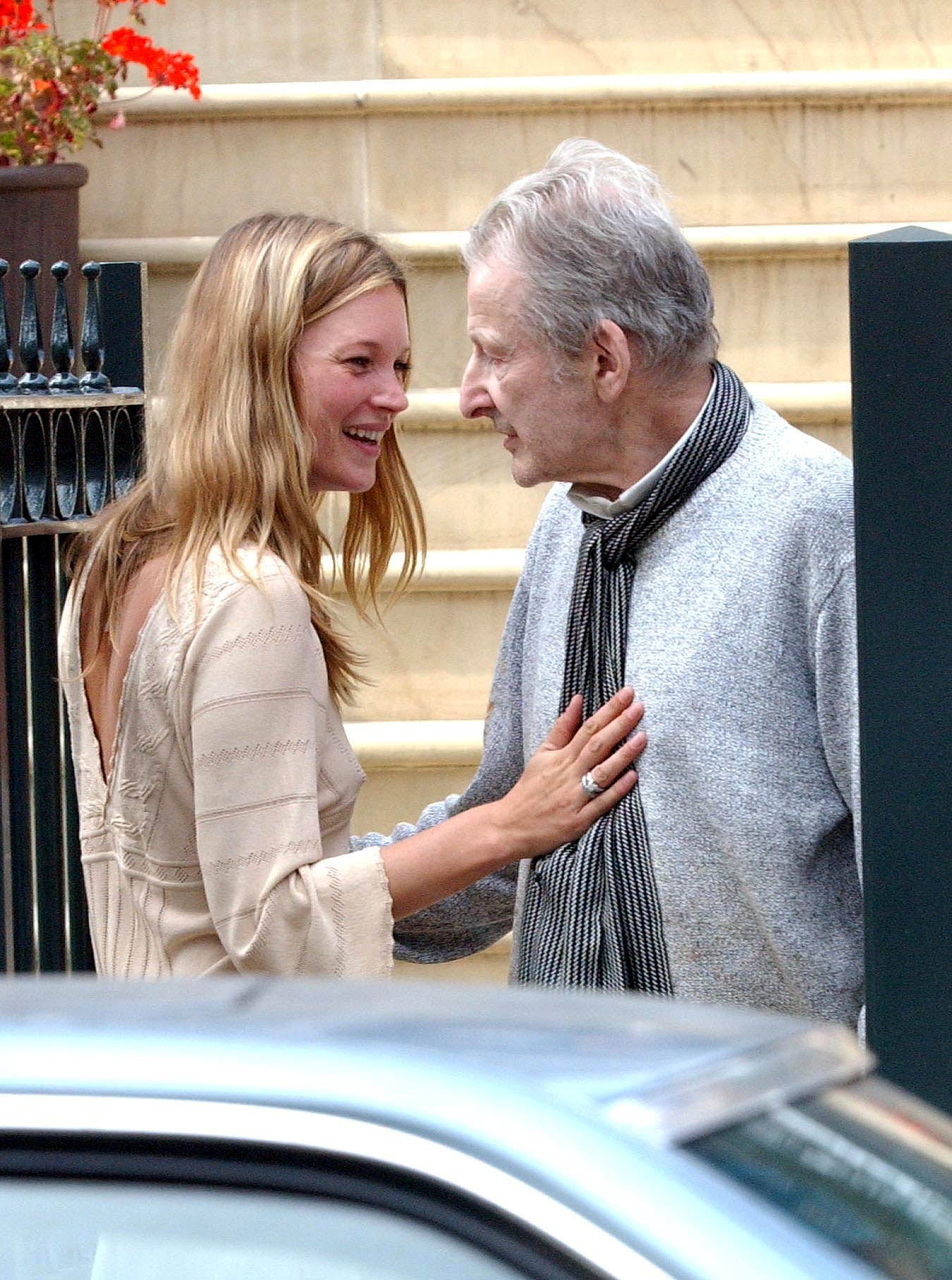 ‘She was late only in the way that girls are’: Kate Moss and Lucian Freud in 2003 (Stephen Butler/Shutterstock)
He was once so appalled by Jerry Hall’s cancellation of three sittings (she merely had the flu) that he quite literally scrubbed her out of a portrait he was drawing of her breastfeeding her newborn son. Hilariously, what remains is Hall’s nude lower body, with her head and breasts replaced by the upper body of David Dawson, Freud’s studio assistant. Fabulous, wasn’t he?
In 2001, Moss and Freud embarked on a series of clandestine meetings in galleries and at restaurants before painting began, getting along famously. They were more alike than one might assume. Moss was rebellious and unvarnished, her success in the fashion world of the early Nineties a direct juxtaposition to the big hair, long limbs and out-of-this-world spectacle of your Cindy Crawfords or Claudia Schiffers. She was comparatively short and grungy, a troublemaker and occasional self-saboteur, and so stick-thin that you were worried about her (“heroin chic” and all that). She swore like a truck driver.
Freud, meanwhile, was often dark and brooding, a gambler and a lothario. He was also mischievous, funny, and a gossip, and so naturally charismatic that many were able to forgive his foibles. When it came to his subjects, he needed substance, truth, and something that personally interested him. (Like Sue Tilley, who worked at an unemployment office when she was asked to begin modelling for Freud – one of their works together went up for auction this week, and could fetch £35m.)
On occasion he’d start drawing an individual, then call time on them on the second or third sitting – he realised he didn’t actually like them very much. But Moss, he liked. “He talked about foxes in the same way that he talked about [Kate],” restaurateur Jeremy King told The Independent’s editor-in-chief Geordie Greig, for his book Breakfast with Lucian. “He liked the free spirit. He liked the bite of danger.”
For their sessions, Moss was due at Freud’s studio on London’s Kensington Church Street at 7pm on the dot, seven days a week, with their days concluding at 2am. Freud abhorred lateness, which proved somewhat difficult for a model who found punctuality challenging. “She was late only in the way that girls are,” Freud would tell Greig. “Sort of 18 minutes late. I was cross, but tried to ignore it. I used other means to get her [there] on time, like sending someone to fetch her.”
I wish I hadn’t posed like that. It’s not like modelling, where you can change it. I had a dead arm
Kate Moss
Moss & Freud attempts to psychoanalyse the pair’s dynamic somewhat. To Bamber’s Moss, Freud is an avuncular, nurturing figure, and a safe respite from a hurtful, disreputable fashion industry. We see Moss, in flashback, expressing discomfort at being asked to sit astride a male model for a Calvin Klein campaign, and witness her smile drop during her famous beach shoot for The Face that turned her into a star. She was just 16, and being photographed topless – against her will – by the late photographer Corinne Day, with whom she’s admitted to having had a complex, tricky dynamic.
Her time with Freud also seems to push her into more quiet domesticity and maturity – at the start of their nine months together, she is gatecrashing Berlin sex clubs and driving erratically down country lanes; by the end, she is romantically involved with the media publisher Jefferson Hack, and pregnant with her first child. (Of course, the years of dating Pete Doherty and “Cocaine Kate” being splashed across the tabloids were still to come.) Jacobi’s Freud, meanwhile, is haunted by memories of his second wife, the socialite Lady Caroline Blackwood, whose flamboyant, bohemian insouciance the film parallels with Moss’s unruliness. It suggests that Freud was so drawn to Moss because she reminded him of his lost love.
How close all this is to reality will only be known to Moss – Freud, of course, having died aged 88 in 2011. Moss has spoken glowingly, if sparingly, about her nine months with him. “He was quite chatty, but he couldn’t paint and talk at the same time,” she told Radio 4’s Desert Island Discs in 2022. “So when he got going, telling me an amazing story, I would still be sitting in position but he wouldn’t be painting any more. I was like, ‘Please put the paintbrush on the canvas!’”
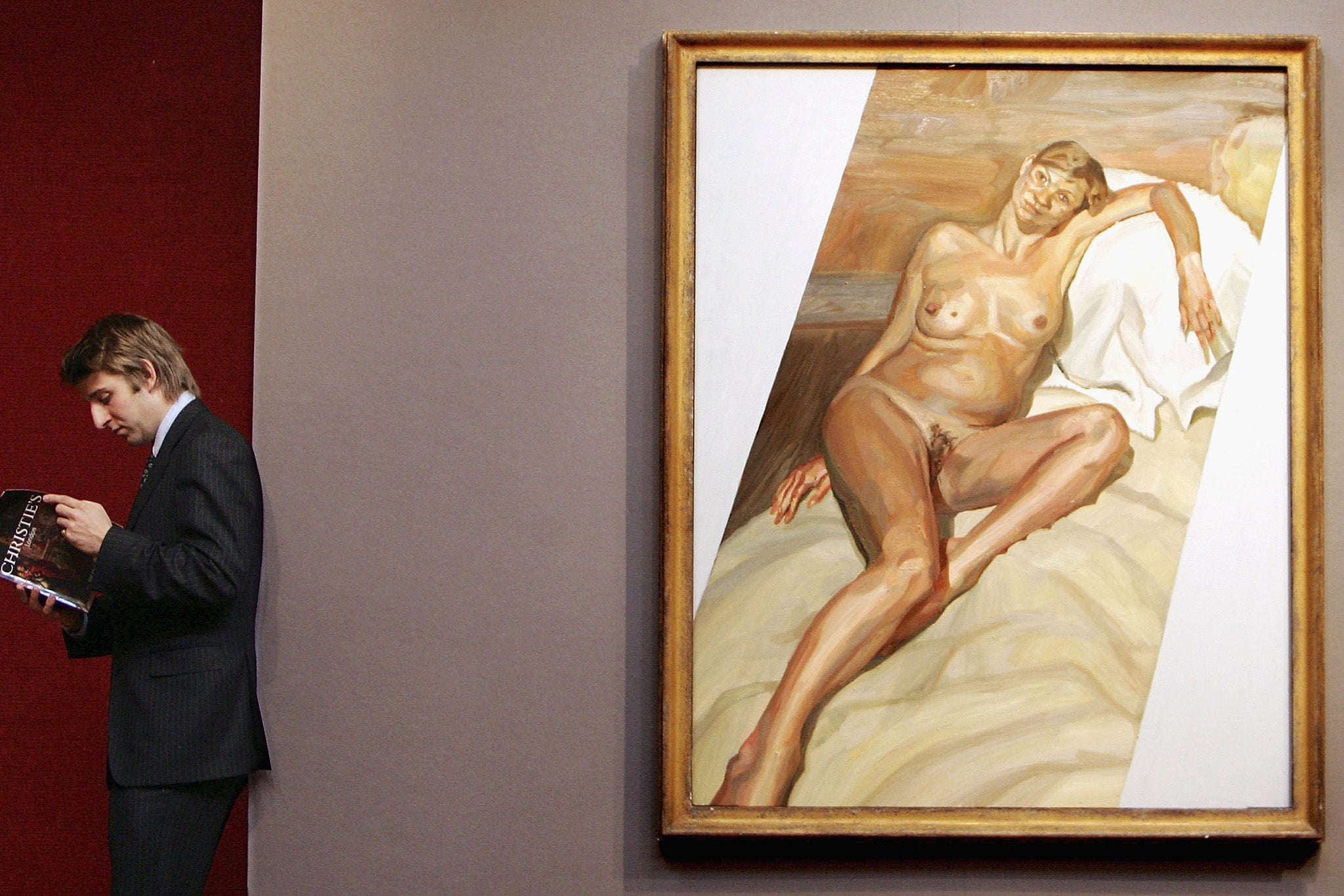 A Christies auctioneer stands near the finished ‘Naked Portrait 2002’ in 2004 (Getty)
Moss’s pregnancy provided an unexpected deadline for Freud’s portrait to be completed, and he ultimately presented it to her at the end of 2002. It’s very Lucian Freud – thick globs of paint, ungainly shadow, skin blotchy, crude, earthy. Moss reclines nude, her hair lank, her arm limp. There is a slight swelling to her belly, reflecting the early stages of her pregnancy. She seems physically disproportionate, a body all out of joint. Or perhaps that’s because it’s so unlike any of the hundreds of thousands of images of Kate Moss we’re so used to seeing. It is beautiful, strange, beguiling. Moss & Freud depicts her as being horrified by it.
“There is a distinction between fact and truth,” Jacobi’s Freud tells her. “Truth has an element of revelation about it. If something is true, it does more than strike one as being so. You are extraordinary because you are ordinary, and I mean this in the best possible way.”
Moss discussed the painting in 2012. “I wish I hadn’t posed like that,” she said. “It’s just the first thing I did – I fell on the side of the sofa and he said, ‘That’s fine,’ and started painting. It’s not like modelling, where you can change it. I had a dead arm.” Freud, too, had misgivings. “The picture didn’t really work,” he told Greig. Pressed further, he declined to elaborate. “That is like asking a footballer after the match why he didn’t score.”
Moss didn’t buy the portrait, despite expressing interest (or at least, that’s what she told a magazine in 2003). Instead it was bought by a private collector, before being sold once again in 2004 – that was when the public got their first look at it. “Moss is almost unrecognisable,” The Independent wrote that year. At auction in 2005, it was sold to a private bidder for £3.5m, the highest price for a Freud at the time.
Whatever her private misgivings about the painting itself, Moss has only ever spoken highly of Freud. In 2010, the year before he died, the pair were photographed by David Dawson while Moss visited Freud, who was unwell after (believe it or not) being knocked over by a zebra during the making of a young filmmaker’s short film.
“I’d let Kate into the house, brought her upstairs to Lucian, and said, ‘Oh, Kate, I just want to have a photo of the two of you together’,” Dawson told The Guardian. “Then she spontaneously jumped into bed and had a cuddle with him.” The resulting photograph is lovely. Freud has enormous affection in his eyes as he cradles his former muse, while Moss – eyes closed, an expression of total tranquillity on her face – hugs him back.
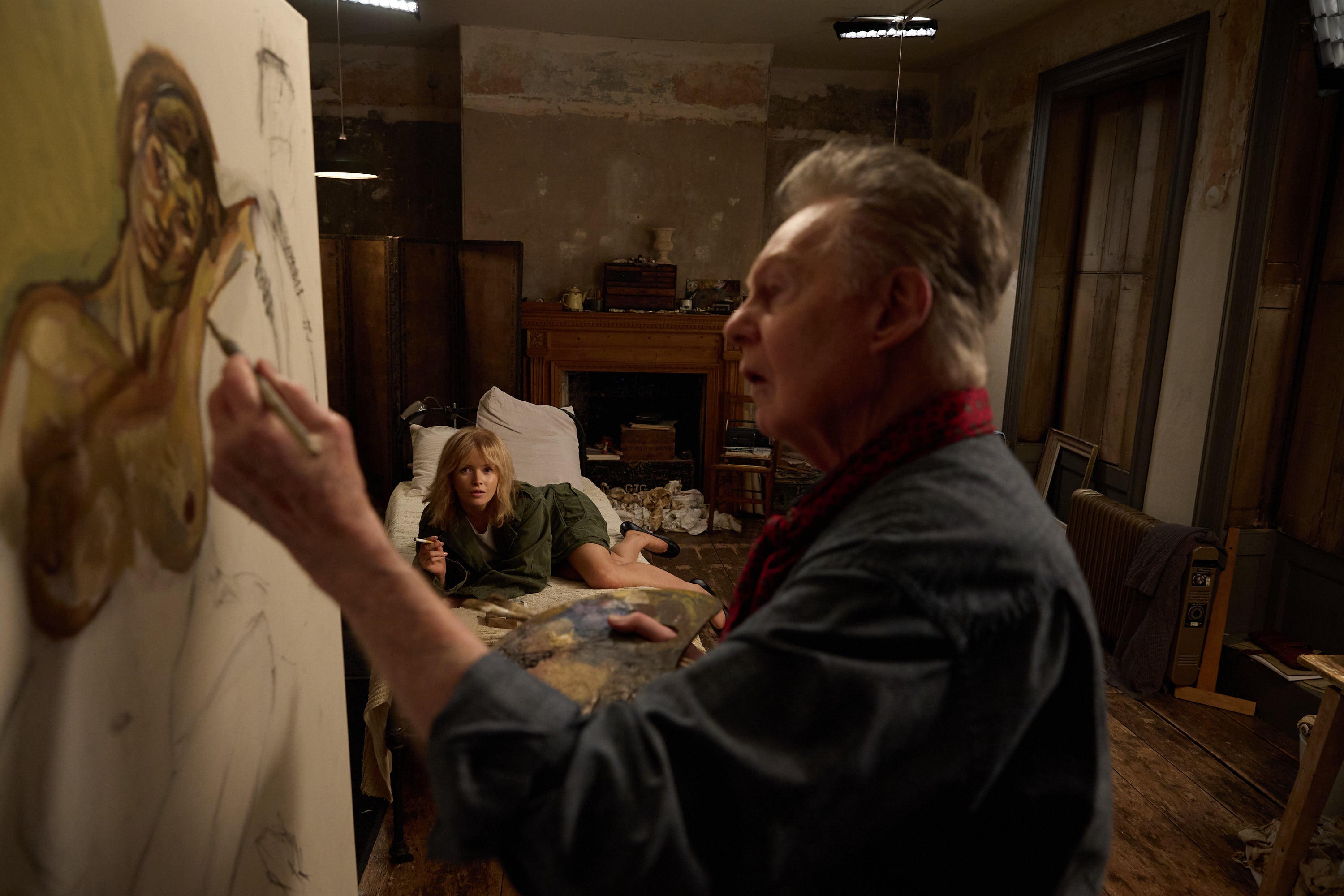 Ellie Bamber as Kate Moss and Derek Jacobi as Lucian Freud in ‘Moss & Freud’ (Vertigo Releasing)
She’s also discussed the tattoo Freud gave her – not the two swallows on her lower back, as has been speculated, but a flock of birds on her thigh. “He said, ‘Do you like the creatures of the animal kingdom?’ and I said, ‘Yeah, I like birds,’” Moss recalled during her Desert Island Discs episode. He offered to give her a tattoo of a chicken upside down in a bucket, which she kindly declined. “I was thinking more like [a] swallow,” she continued. “And he gave me a bottle of really good Rothschild wine, and he got out his etching needle and scraped into my thigh a flock of birds – which now look like varicose veins.”
She’s one of the most photographed people in the world. But there’s no photo of the tattoo to be found, as if it’s a secret shared only between two of the world’s most famous cultivators of pure, irresistible mystique.
‘Moss & Freud’ is in cinemas