
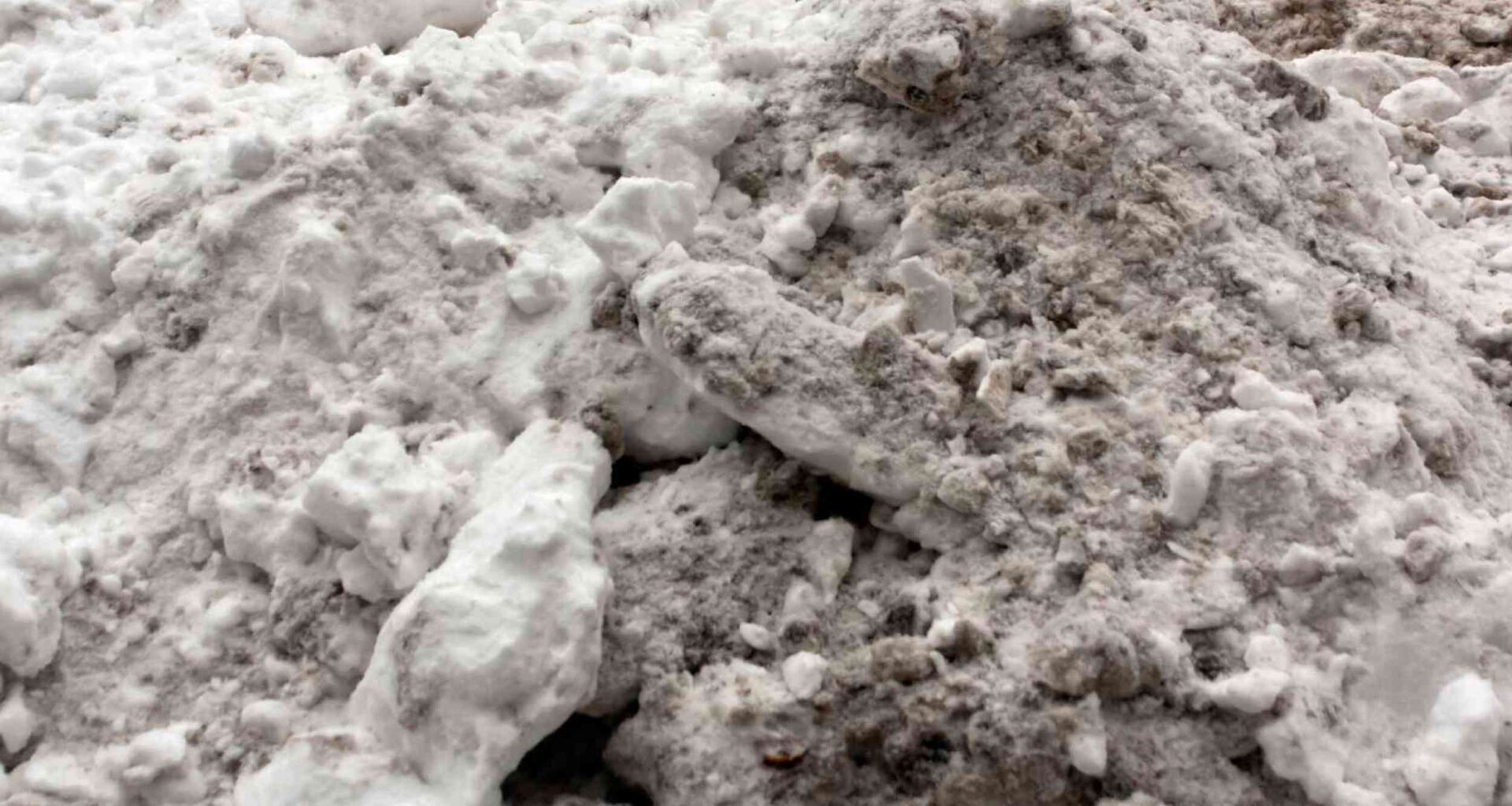
Climate models need accurate historical records to determine what was present in the atmosphere in the past. To simulate past Arctic warming, scientists must know how much soot fell on Arctic snow.
Those estimates come from records of fires, industry, and fuel use. Hidden within those estimates was a gap that the numbers alone could not reveal.

The evidence was found not in the Arctic, but in lake mud in China, thousands of miles away. The finding could change estimates of how quickly the far north has been melting.
Soot on Arctic snow
Albedo is the measure of how much light a surface reflects. Clean snow has a high albedo, bouncing most sunshine back into the atmosphere before it can warm the ground.
When dark particles settle onto that white surface, the effect flips. Black carbon is the sooty residue of burned fuel, wood, and crops and it absorbs sunlight rather than reflecting it.
Even a light dusting warms the snow and speeds the melt. Once melting starts, it tends to feed itself. Bare ground and open water soak up far more heat than snow does.
So the surface warms, more snow melts, and still more dark ground appears. Scientists have understood this feedback loop for years.
Mud as a record
Research had lacked a reliable picture of how much soot drifted across the Northern Hemisphere before satellites and monitoring stations existed.
A team at the Institute of Earth Environment, part of the Chinese Academy of Sciences (CAS) went looking for that history in an unlikely archive within lake sediment.
Fine layers of mud pile up year after year on lake bottoms, trapping whatever falls from the sky. The deeper you read into the mud, the further back in time you go.
The soot in each layer reflects what was burning and how much was burning when the mud first settled. Xuehong Gong and his colleagues analyzed those layers in lakes across China.
An emissions blind spot
The sediment told a story that did not match the official numbers. Researchers estimate past pollution by tallying known fires, industry, and fuel use.
Before the mid-1900s, those estimates came up short. The mud held considerably more black carbon than the tallies predicted. Far more was burning in earlier eras than the records show.
That gap fits a pattern other scientists have flagged. Ancient polar ice has also nudged historical soot estimates upward. One study suggests the older figures were well below the true total.
Running the model
Knowing the old numbers were too low is one thing. Showing what that means for the Arctic required a numerical climate model, a computer simulation of how air, heat, and surfaces interact.
So the team built a correction. They raised the historical soot figures to match what the mud and ice cores implied, then ran that adjusted history through the model.
Each run used a different strength to test how much the results changed with the assumption. No one can determine the exact historical value, so the simulations tested a range rather than one number.
Answers from the model
Across those runs, the extra soot left a clear mark. Adding the higher emissions warmed the far north in spring and summer, when sunlight returns to snow still waiting to melt.
More sunlight absorbed at the surface meant more Arctic snowmelt in the simulations. The snowpack pulled back faster, all from soot that earlier accounting had left out.
The size of the effect depended on how much additional soot the researchers assumed.
Even so, every version agreed on the direction of the effect. Correct the record upward, and the modeled Arctic warms and melts faster.
The spring connection
Soot does its worst where sunlight and snow overlap. Black carbon in Arctic air peaks in spring, just as the sun climbs and the snowpack is still thick.
That seasonal spike has turned up direct measurements before. Separate research found far more soot in Arctic air in spring, during the same season the model indicates is most sensitive.
Together, the timing and the corrected emissions sharpen a long-standing worry. The Arctic may have been warming under a heavier burden of soot than historical records suggested.
Fixing the baseline
Reconstructions of the early industrial era leaned on soot figures that the mud now suggests were too low. This study counters that assumption with physical evidence.
The finding could change how scientists construct their baseline estimates. If historical soot ran higher, some early Arctic warming long pinned on other causes may trace back to black carbon.
Projections resting on the old figures may need rethinking too. The researchers call their corrected emissions a range, not a verdict, and push for better historical records to tighten it.
Strip away the hedging, though, and the plain takeaway holds. The Arctic has been collecting soot for longer, and in greater amounts, than historical records have indicated.
The study is published in Communications Earth & Environment.
—–
Like what you read? Subscribe to our newsletter for engaging articles, exclusive content, and the latest updates.
Check us out on EarthSnap, a free app brought to you by Eric Ralls and Earth.com.
—–