
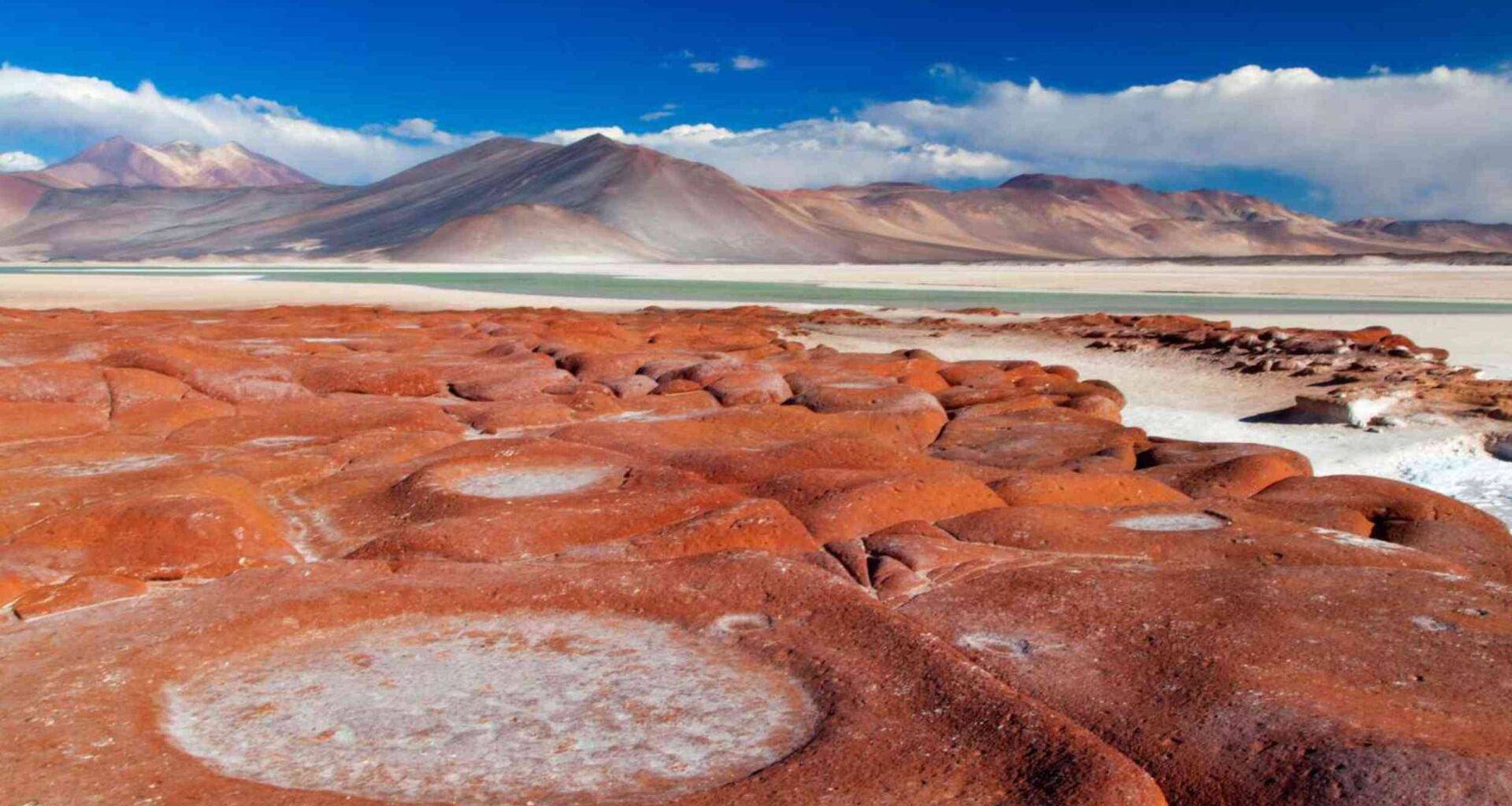
Geologists thought they knew why northern Chile’s Atacama Desert became one of the driest places on Earth. The explanation centered on two events that unfolded about 23 million years ago.
The explanation centered on two events – the rise of the Andes, which blocked moisture from the east, and the arrival of a cold Pacific current that suppressed rainfall.

Quartz pebbles from the desert’s driest core now challenge that timeline. According to a new study, the drying began tens of millions of years earlier, before either of those conditions existed.
A longer dry spell
The Atacama runs along Chile’s Pacific coast, and its core is the most arid place on Earth outside the poles. For years, researchers dated its extreme dryness to about 23 million years ago.
Geologist Benedikt Ritter-Prinz of the University of Cologne led a team to test that timeline.
The researchers sampled quartz pebbles from low hills in the desert’s core, stones that have gone undisturbed for ages.
The 23-million-year date lined up with the rise of the Andes and the arrival of the cold Humboldt Current. Both were blamed for choking off the rain. But the pebbles told a different story.
Atoms that keep time
Cosmic rays rain down on Earth constantly. When they strike exposed rock, they slowly create a rare form of neon called neon-21 inside it.
The longer a quartz grain sits exposed, the more neon collects. In most of the Chilean pebbles, the count was staggering.
Some contained over a billion neon-21 atoms per gram. That kind of buildup takes enormous spans of time with the stone barely moving.
For a pebble to gather that much, nothing can wash it away or bury it for long.
Heavy rain, flowing water, or slipping soil would each scrub the surface and reset the clock. Those totals also record how rarely water has moved through the landscape.
Secrets in old pebbles
When the team ran the numbers, the ages stretched back astonishingly far. Of 135 pebbles, about a quarter recorded exposure older than the previous best estimate for the desert’s dryness.
Until this study, the firmest record of extreme aridity reached the early Miocene, dating back to about 23 million years ago.
Many pebbles remained exposed for 20 to 40 million years, extending back into the Eocene, an epoch that ended about 34 million years ago.
A couple of stones were older still. One yielded an age of nearly 62 million years, indicating exposure since shortly after the dinosaurs vanished.
Hard salt crusts coat this ground and lock the pebbles in place. That helps explain how the stones survived so long with barely any burial.
Not from the Andes
One obvious catch needed checking. A pebble accumulates neon more quickly at high elevations, where thinner air allows cosmic rays to strike harder.
The team had to rule out a trip down from the high Andes. But local geography closes that door.
Roughly 23 million years ago, uplift cut these low hills off from sediment washing down from the peaks. Any older pebbles must have originated locally.
The early Andes also weren’t tall enough to produce the neon counts the readings demand.
Pebbles that originated in those mountains carry much lower neon-21 concentrations. The math kept pointing back to the desert itself.
Blame a cooling planet
If those regional factors arrived too late to initiate the drying, something larger must have been at work. The team’s best explanation reaches beyond Chile and to the slow cooling of the whole planet.
Around 50 million years ago, Earth reached a peak in global warmth and began a slow, drawn-out cooldown.
As the planet chilled, rainfall patterns shifted and dry zones began to spread worldwide.
Similar swings show up in dust records half a world away. The cold Humboldt Current and the towering Andes probably deepened the dryness later, the team says.
Both arrived after the desert core had already become arid. Exactly how global cooling pushed this region into a lasting drought remains uncertain.
The Atacama’s true age
What once read as a fairly young desert now looks like one of the longest dry spells on the planet.
The pebbles push the age of the Atacama Desert back to the Eocene, far earlier than previously thought.
That changes the questions scientists ask about deserts. If a global cooldown can flip a region into deep aridity, the driest places on Earth may owe less to local geography than anyone assumed.
The finding also sharpens the desert’s role as a stand-in for Mars. Researchers study its soils to learn how life persists, or vanishes, under endless drought.
A landscape this dry for this long becomes a rare natural experiment in survival under extreme conditions.
The study is published in the journal Nature Communications.
—–
Like what you read? Subscribe to our newsletter for engaging articles, exclusive content, and the latest updates.
Check us out on EarthSnap, a free app brought to you by Eric Ralls and Earth.com.
—–