
For years, a single fossil barely a tenth of an inch across sat at the center of a running argument.
Dug from limestone in southern China, it was either an early animal colony, a kind of seaweed, or possibly something else entirely – and no one could prove which.

The debate had dragged on for a reason. One whole branch of the animal family tree appeared to be missing from the dawn of animal life.
The branch was absent from the oldest rocks by roughly 50 million years – and the small disputed fossil was the only real clue anyone had.
Missing branch of animal life
The creatures are bryozoans, tiny filter-feeding animals that build colonies of near-identical individuals sharing one skeleton.
They coat rocks, shells, and seaweed across the world’s oceans, easy to overlook unless you know to look.
Most major animal body plans appeared during the Cambrian explosion about 530 million years ago.
Bryozoans seemed to miss the event entirely, remaining absent from the fossil record for another 50 million years.
Studies of living species’ DNA had long predicted that bryozoans arose early too. The rocks said otherwise, and the gap nagged at scientists for decades.
“Bryozoa has been the elephant in the room of Cambrian palaeontology for a long time,” said Dr. Timothy Topper, a paleontologist at the Swedish Museum of Natural History.
Fossils from China
The breakthrough came from limestone in southern Shaanxi Province, China, where rock layers called the Xiannüdong Formation hold fossils about 520 million years old.
An international team led by Baopeng Song of Northwest University (NWU) recovered tiny, beautifully preserved colonies from the stone.
Among them were fresh examples of Protomelission gatehousei, first proposed as a Cambrian bryozoan in a 2021 study, plus an entirely new species the team named Dayingomelission hexaclitia.
Two separate forms meant bryozoans were not only present but already branching into different kinds. Their preservation proved just as important as their age.
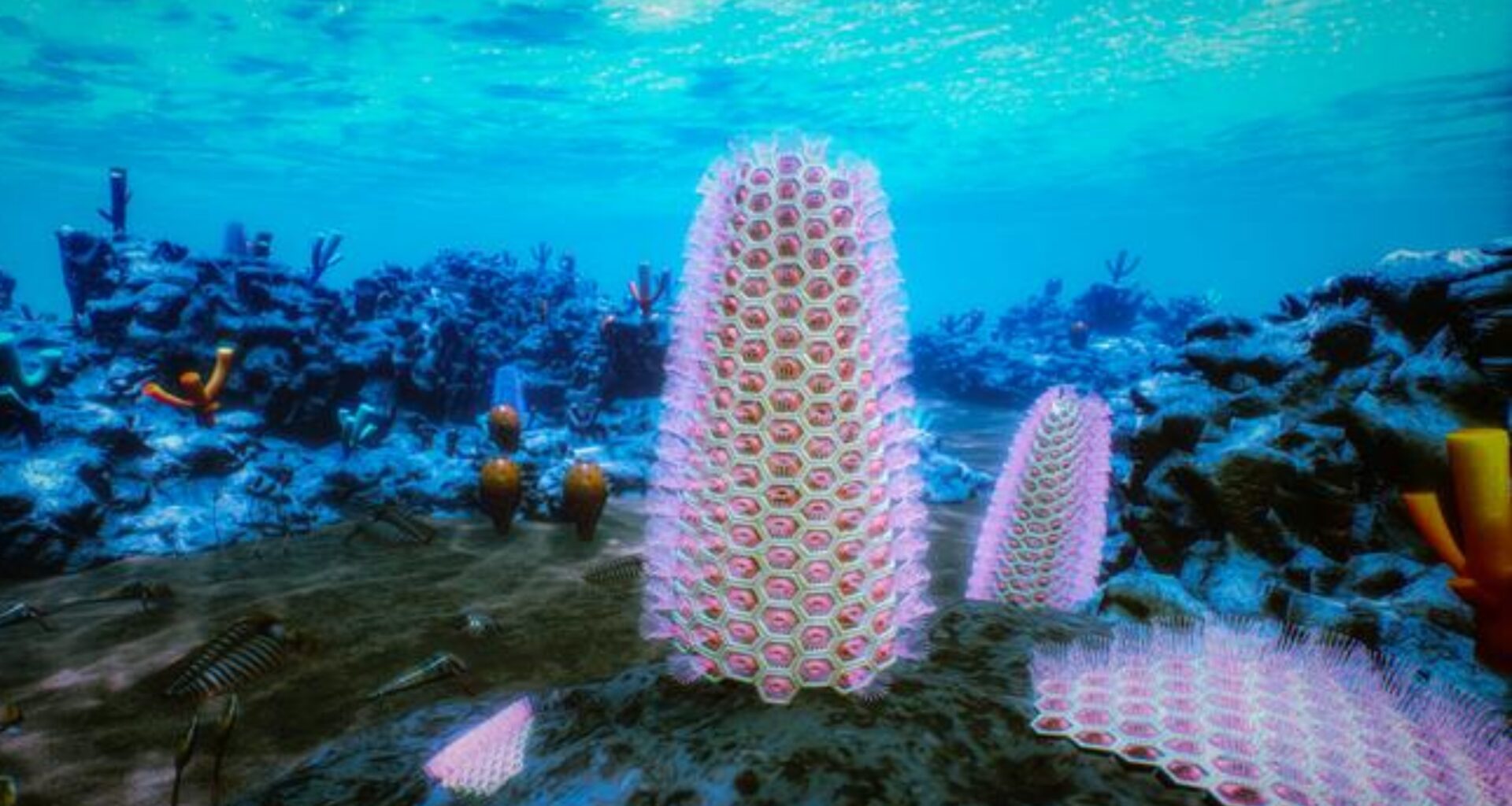
Barely a tenth of an inch across, the colonies kept their three-dimensional shape, with soft tissue turned to stone in phosphate while still sitting inside the original skeleton.
Soft tissue survives
Earlier bryozoan fossils were mostly bare skeletons. The soft body of the animal almost never makes it into stone. Not here. These specimens kept structures no one had seen this far back in time.
Inside each tiny chamber sat a thin-walled sac, the soft lining of a single animal.
Fine fibers wrapped and ran along it, preserved well enough that the team read them as fossilized muscle. A tiny, even gap separated each sac from the next.
One specimen kept slender spines, called styles, poking up through the skeleton.
The chambers locked together in a regular honeycomb of six-sided cells, each one holding a separate animal. Skeleton and soft anatomy together left only one answer.
Settling an old debate
The 2021 fossil had not convinced everyone. Some researchers argued in a 2023 paper that it was really a green alga, a kind of seaweed, not an animal.
Others suspected loose plates from some unrelated creature. The soft tissue settled the argument.
Algae do not possess muscle fibers or sac-like internal linings, and loose skeletal plates do not organize themselves into orderly budding chambers with shared walls.
The new fossils had all of it, preserved in place and unmistakably animal.
“These aren’t just simple precursors; they are complex, modular colonies,” said Song.
The skeleton and the internal anatomy both lined up with bryozoans and ruled out the rival readings. A decades-old objection had run out of room.
Deeper into the past
Placing the two fossils on the bryozoan family tree produced a surprise. They did not sit at the base, as crude first drafts. They landed well up an advanced branch, the kind with living relatives still in the sea today.
An advanced branch this early implies the group’s real start lies deeper still, before the Cambrian explosion had properly begun.
Genetic work on living bryozoans leans the same way, toward the Ediacaran period, the dim stretch just before the Cambrian.
The fossils back that up directly. Two distinct colony forms, side by side at 520 million years, show the group already experimenting with design.
These were not latecomers; they were diversifying while the great radiation still ran.
Why the animals were missing
A real puzzle lingered even after the identification. If these animals had been present all along, their long silence in the fossil record needed an answer of its own.
Most Cambrian sites are famous for soft-bodied fossils formed in deep, still water. These bryozoans lived elsewhere, in shallow, sunlit reefs, the kind of place that seldom preserves delicate tissue.
They had settled in the wrong setting for fossil hunters to find them.
The new specimens came straight out of that reef rock, freed from limestone with acid. Once researchers knew which rocks to search, the missing animals began turning up.
An ancient way of life
Before this, the bryozoan story had a hole at its very start that no one could fill. That hole is closed.
Their origin now sits firmly inside the Cambrian explosion, shown by animals preserved down to their muscle fibres and the cells that held them.
The study redraws part of the early animal family tree and hands paleontologists a fresh place to dig.
Shallow Cambrian reefs worldwide, long skipped for soft-tissue fossils, now look worth a much closer search.
Far from arriving late to the Cambrian explosion, bryozoans were already diversifying alongside it.
The colonial lifestyle that defines them today was not a later innovation but part of the earliest wave of animal evolution.
The study is published in the journal Nature.
Image Credit: Zhifei Zhang
—–
Like what you read? Subscribe to our newsletter for engaging articles, exclusive content, and the latest updates.
Check us out on EarthSnap, a free app brought to you by Eric Ralls and Earth.com.
—–