
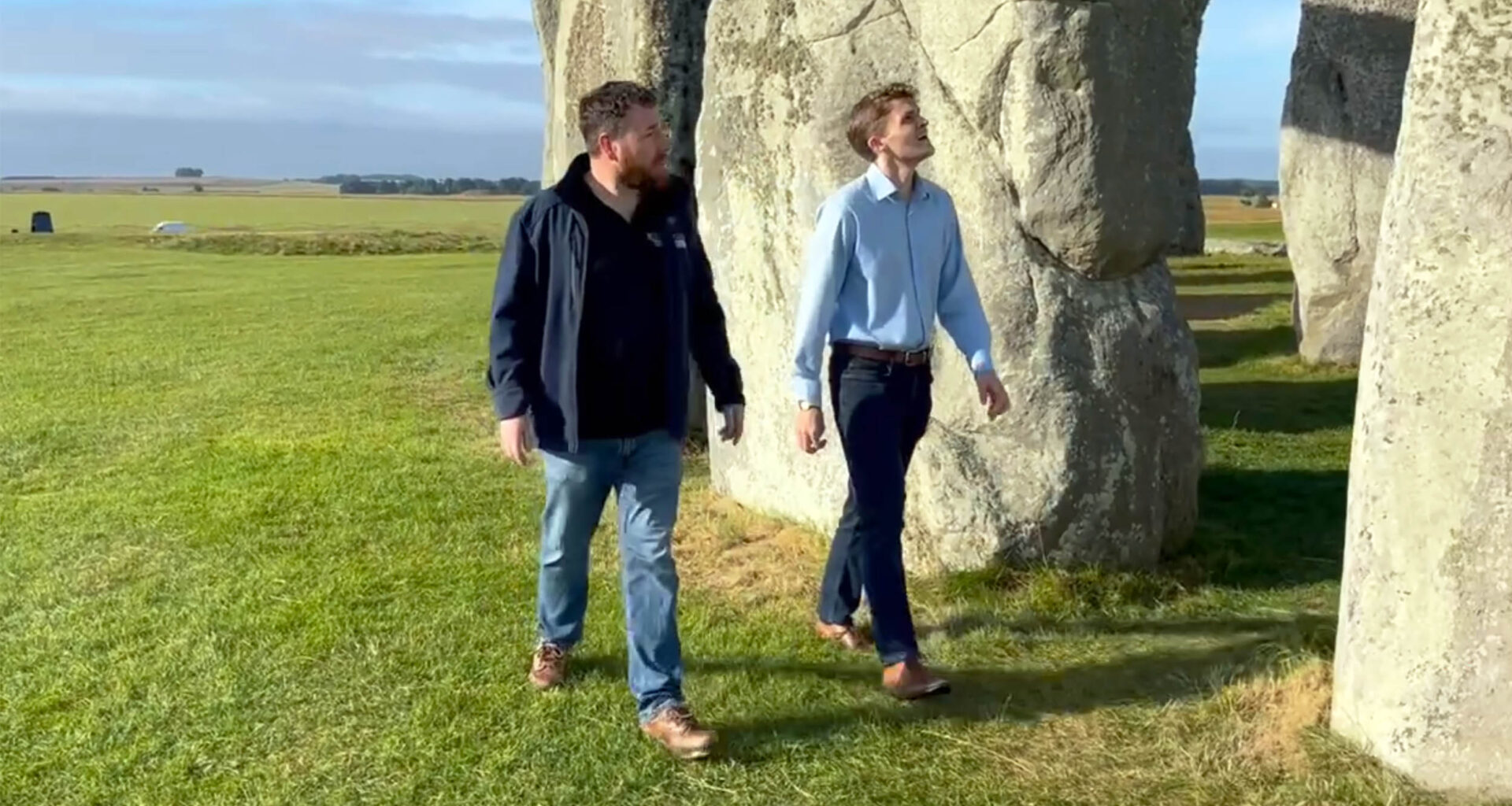
Stonehenge has a way of making people stop and wonder. Even if you have only seen it in photographs, the monument feels strangely powerful.
Huge stones stand in a circle on the open landscape of Salisbury Plain, as if they are guarding a secret from another world.

For a long time, people have asked why Stonehenge was built. Was it a place for ceremonies? Was it linked to the Sun and the seasons? Did people gather there to remember the dead?
These questions still matter, but another mystery is just as fascinating.
Mystery of the Altar Stone
At the centre of Stonehenge lies the Altar Stone, a flat sandstone slab that weighs about six tons (5.4 metric tonnes).
It is almost 16.4 feet (five meters) long, which means it is longer than many family cars. For decades, archaeologists have tried to work out where it came from and how people moved it.
New research is now bringing that story into sharper focus. The findings suggest that the Altar Stone may have come from northern Scotland, hundreds of miles from Stonehenge.
That makes its journey one of the most remarkable parts of the monument’s history.
Stonehenge built from journeys
Stonehenge may look like a single stone circle, but its stones came from different places.
The largest stones, called sarsens, were brought from West Woods, about 15.5 miles (25 kilometers) away. Other stones, known as bluestones, traveled from Wales, around 143 miles (230 kilometers) away.
These long journeys show that prehistoric people could move massive blocks of rock over great distances long before modern machinery existed.
Analysis of stone involves data from crystals so small that most people would never notice them.
Inside the Altar Stone are tiny minerals called zircons. They are like natural record keepers. When rocks form, zircons trap chemical clues that can last for hundreds of millions of years.
Scientists can read those clues and compare them with rocks from different places.
 A plan view of exposed megaliths at Stonehenge. The provenance for each type of building block is indicated. Credit: Journal of Quaternary Science/Curtin University. Click image to enlarge.Altar Stone came farther
The analysis suggested that the Altar Stone may have travelled farther than all the other stones.
It is made from a kind of sandstone called Devonian Old Red Sandstone. This rock does not occur naturally in the area around Stonehenge.
That told researchers one important thing: the Altar Stone was an outsider.
For years, they searched for its home. Now, the strongest evidence points to the Caithness coast in northern Scotland, about 435 miles (700 kilometers) from Salisbury Plain.
The researchers compared the Altar Stone with sandstone from several parts of Scotland. The closest match came from Sarclet, a coastal area in Caithness.
Other nearby places also looked similar, but Sarclet gave the strongest match.
That matters because it turns a broad guess into a much clearer picture. The Altar Stone was not just from “somewhere in Scotland.” It most likely came from a specific stretch of northern coastline.
That discovery is exciting, but it also makes the mystery harder to ignore. If the stone really came from Caithness, someone, or something, had to move it a very long way.
Did ice move the Altar Stone?
One possible answer is ice. During the last Ice Age, huge glaciers moved across Britain. Glaciers can pick up rocks and carry them far from where they formed.
So scientists asked a sensible question: could ice have transported the Altar Stone closer to Stonehenge before people moved it the rest of the way?
To test this idea, researchers used computer models of ancient ice movement. The models showed that ice from the Orcadian Basin, the wider region linked to the stone’s source, mostly moved north and east.
That direction does not help explain a journey toward southern England.
There is an ice exception
There was one possible exception. Under certain conditions, ice might have carried rocks toward Dogger Bank, an area that was once dry land but now lies beneath the North Sea.
Even if that happened, the glacier idea does not fully solve the puzzle.
“Our modeling shows glaciers may have transported rocks part of the way during the last Ice Age, potentially as far as Dogger Bank in the North Sea, but not into southern England, meaning the stone would still have needed to be moved hundreds of kilometers by people,” Dr. Clarke said.
Human strength moved the Altar Stone
Even if ice carried the stone part of the way, it could not explain how it reached southern England. The models do not show a direct icy route from northern Scotland to Stonehenge.
“Rather than being carried naturally by ice, the evidence points to a deliberate, carefully planned movement across a challenging and varied landscape,” said co-lead author Dr. Anthony Clarke, from Curtin University.
 Another study tries to answer exactly how primitive humans transported Stonehenge megaliths hundreds of miles across Britain. Click image to enlarge.Timing creates new problems
There is also a timing problem. Dogger Bank was slowly covered by rising seas between 7,000 and 8,000 years ago. The Altar Stone likely arrived at Stonehenge around 5,000 years ago.
That leaves a gap of thousands of years. For ice to explain the journey, the stone would have had to stay accessible for a very long time as the landscape changed.
Then people would still have needed to find it and move it. That is not impossible, but it is a difficult story to prove.
Dr. Clarke suggested that the stone was probably moved in stages by people, potentially combining overland hauling with river or coastal transport where possible.
Massive effort required
Moving a six ton (5.4 metric tonne) stone without trucks or cranes was no easy task. The builders of Stonehenge relied on simple tools, human strength, and careful planning.
Whatever the exact route, the work would have required many people acting together.
“Transporting a stone of this size over such a long distance would have required planning, coordination and a deep understanding of the landscape, not to mention tremendous determination,” Dr. Clarke said.
“The study demonstrates how combining geological analysis with computer modeling can help resolve long-standing questions about how Stonehenge was built.”
The study is published in the Journal of Quaternary Science.
—–
Like what you read? Subscribe to our newsletter for engaging articles, exclusive content, and the latest updates.
Check us out on EarthSnap, a free app brought to you by Eric Ralls and Earth.com.
—–