
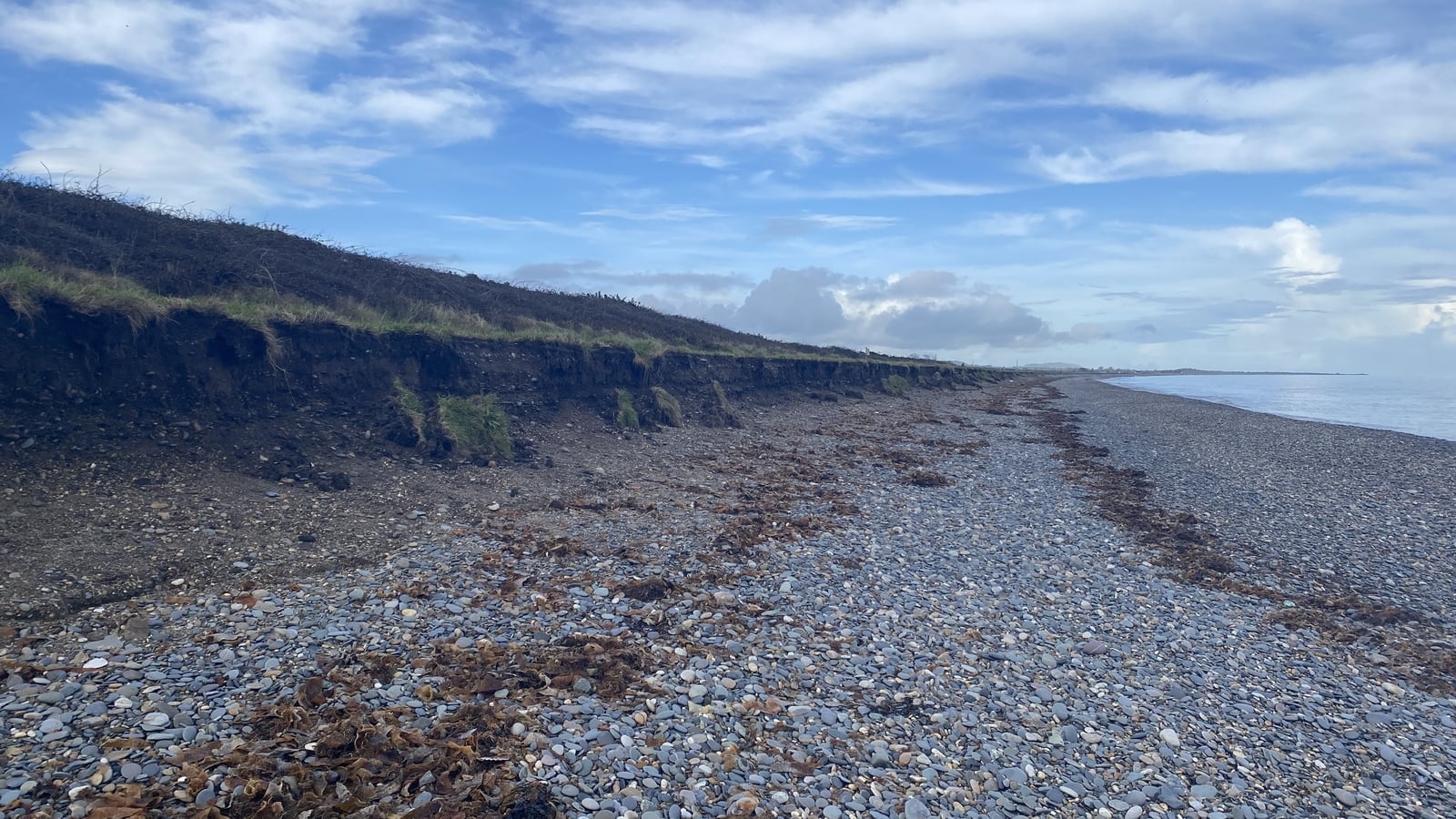
A working paper commissioned by the Climate Change Advisory Council from the University of Galway says the scale of the threat from coastal erosion in Ireland is immense.
It states that homeowners simply cannot be left to “be washed away” and urges the Government to put in place the urgent legal and financial mechanisms needed for the relocation of homes and infrastructure.
Surveys of the risks associated with coastal erosion and rising sea levels in Ireland have been undertaken in just eight out of 19 coastal counties.
They showed that in those eight counties alone, almost 2,300 properties and 570 kilometres of roads are currently at risk, with the number of properties exposed set to double by 2050.
The report from University of Galway states that the science has been clear for decades, the warnings have been widely available, and the Government and communities can no longer regard coastal erosion as an unforeseen outcome.
It says the Government needs to start planning now for the relocation of people, houses, commercial properties, roads, bridges, rail lines, ports and harbours, as well as telecommunication networks, utility plants and even graveyards, because of the potential devastation they could suffer from rising sea levels.
It is calling for the focus to shift rapidly away from simply monitoring coastal erosion and instead towards urgently implementing a national coastal erosion masterplan.
Lead author and Associate Professor Dr Eugene Farrell said implementing “planned relocation” from eroding coastlines is not optional and that decisive adaptive action is required immediately.
Last year, a separate report from the University of Galway found that Storm Éowyn would have coincided with the high-water spring tide if it had occurred one week earlier.
The associated storm surge would have been five to six metres high, inundating the homes of tens of thousands of people in Galway, Limerick and Shannon.
The report says relocation should be viewed through a human rights lens and fundamentally as a public health and social justice priority.
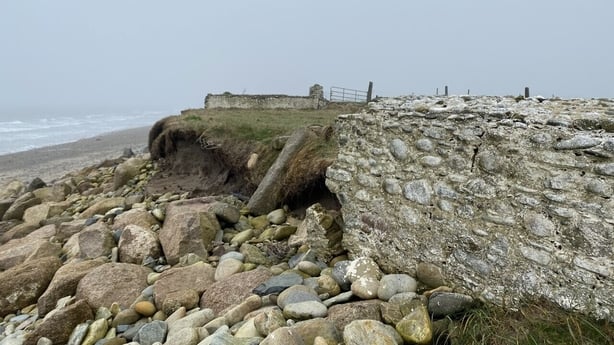
Coastal erosion in Wexford
It identifies potential policy levers, zoning tools and funding structures required for the relocation of people, houses, businesses and infrastructure to happen.
It also says relocation with community participation and fair compensation can improve long-term wellbeing.
Without it, there is a risk of deepening social inequalities and mental health trauma.
The ESRI has estimated that damage from sea level rise in Ireland could be as high as €2 billion per year by 2050 and €7 billion per year by 2100.
This new report says such estimates highlight that investing upfront in coastal adaptation now will turn out to be far cheaper than doing nothing in the long run.
It argues that while erosion is an inevitable natural process, the current lack of a binding framework for retreat has left the State in a cycle of ad hoc reactive engineering and unmanaged loss.
It says the protection of current and future generations requires the Government to prioritise the creation of a masterplan to operationalise how – and not just why – coastal communities will move to safety.
It also calls for mandatory natural hazard disclosure in property transactions so that prospective buyers would be formally notified if a home falls within a projected erosion or flood risk zone.
The working paper outlines a series of actions for Government to consider, including:
New legislation addressing coastal change and planned relocation
Consistent coastal planning and zoning guidance at a national level
Comprehensive, high-resolution coastal risk data
A national framework for funding and compensation for relocation
Clear governance structures and well-defined roles for all agencies
Substantial investment in technical capacity within local authorities to manage relocation
Robust community engagement to support meaningful dialogue around relocation