
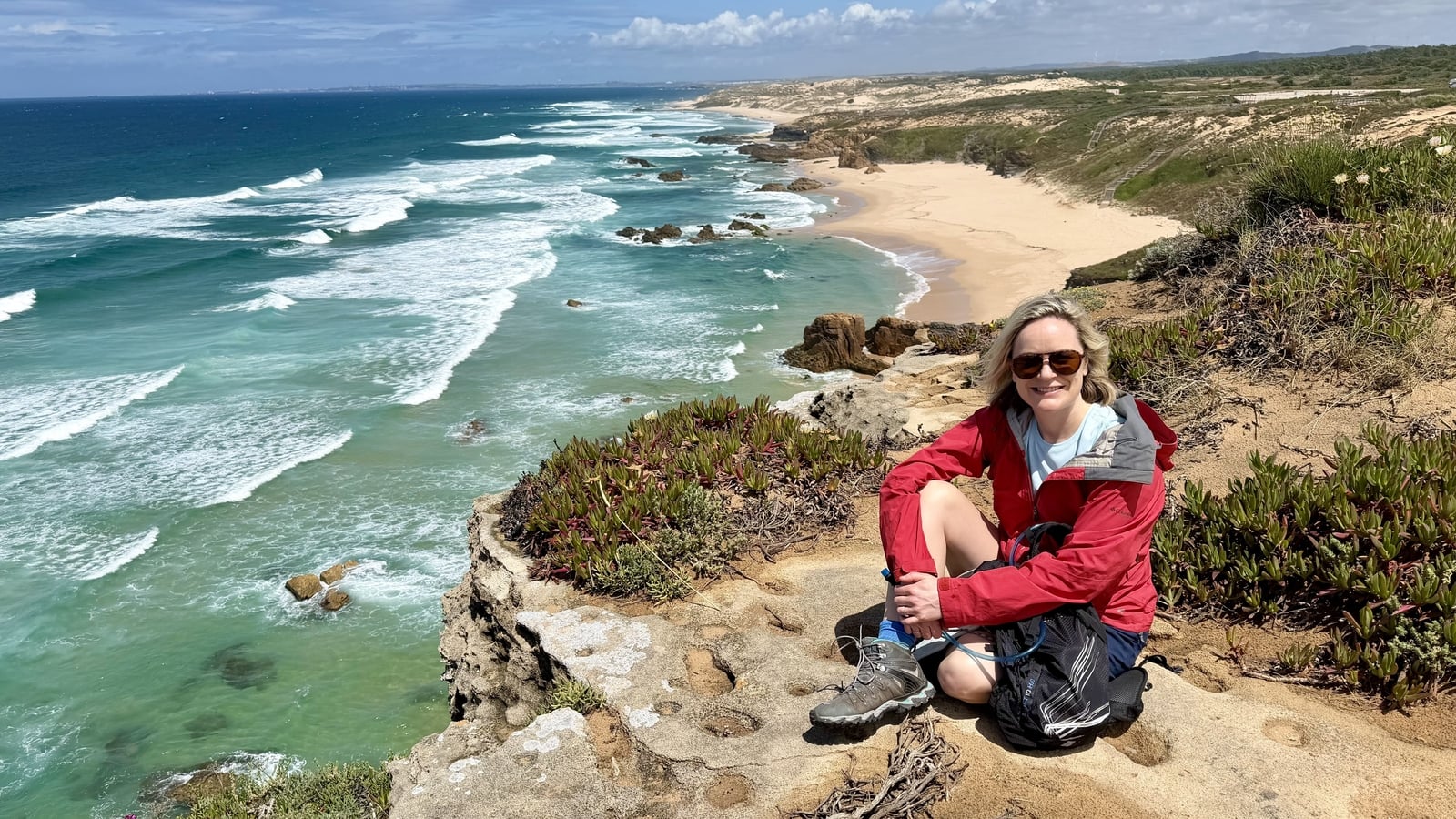
Deirdre Mullins hikes Portugal’s Rota Vicentina through the wild landscapes of Alentejo, discovering dramatic coastal trails, cork forests and a slower pace of life.
Walking through soft sand for hours quickly teaches you two things: humility and the value of proper gaiters.
As I hiked the cliff edges and beaches of Portugal’s Fishermen’s Trail, I found myself becoming obsessed with the walkers wearing gaiters over their boots to keep the sand out. Smug, sensible people who clearly knew exactly what they were doing.
By the time we reached the tiny coastal town of Almograve, my legs were wrecked. Sand had infiltrated every possible layer of clothing, while the Atlantic wind had spent the day battering me. Yet, after hours of walking beside crashing waves and vast stretches of coastline, I noticed something had shifted.
The usual mental clutter had quietened, replaced by the simplicity of putting one foot in front of the other.
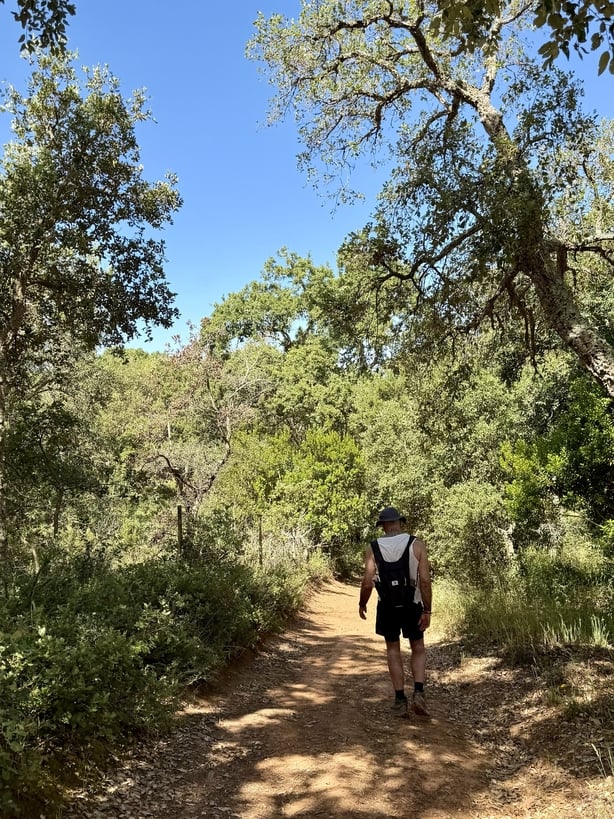
Walking on the Historical Way
The Rota Vicentina stretches across Portugal’s Alentejo region in an extensive network of walking trails that move between wild Atlantic cliffs, empty beaches, sleepy fishing villages, farmland and remote inland countryside. While the coastline is the route’s most photographed feature, large sections of the network also extend deep into Alentejo’s interior through rural landscapes that tourism has largely bypassed.
Its best-known trails are the dramatic coastal Fishermen’s Trail and the quieter inland Historical Way. Over several days, I moved between the two, sometimes hiking along cliff edges above crashing surf, other times walking for hours through flower-filled countryside without seeing another person.
What surprised me most wasn’t just the raw beauty of the scenery – although there was plenty of that – it was how undiscovered the Alentejo still feels. In an era when so many beautiful corners of Europe seem overcrowded, this part of Portugal felt almost like a secret I’d accidentally been let in on. Don’t tell anyone!
Even in some of the region’s most spectacular landscapes, it was baffling how few tourists I encountered once we left the better-known coastal stretches.
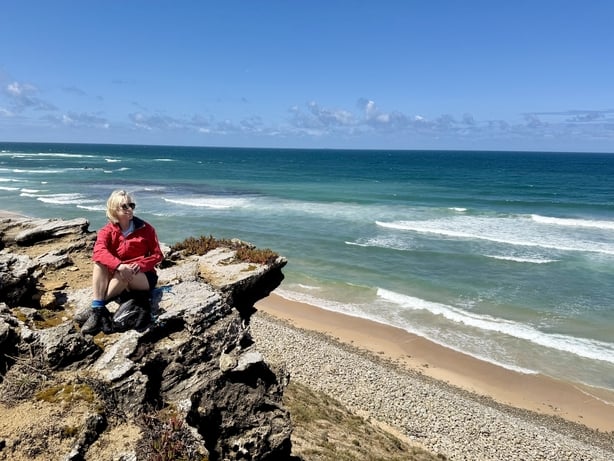
Deirdre on the Fishermen’s Trail
I had arrived late in Lisbon before taking a two-hour transfer south into the Alentejo countryside to Herdade da Matinha, a restored rural estate hidden among cork trees and wild countryside. The family-run property, once derelict, was rescued and restored in the 1990s, and felt less like a hotel and more like a beautifully eccentric home.
Mismatched furniture filled large communal rooms, and artwork painted by the owner covered the walls. The only disappointing thing about staying there was that I quickly realised it was somewhere I’d like to stay for days rather than one night.
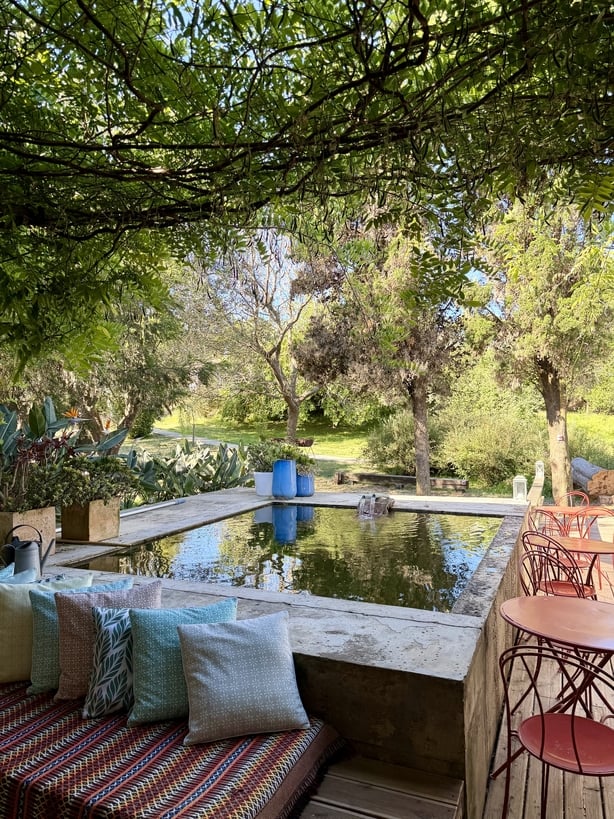
Herdade da Matinha
The following morning, after a delicious breakfast, we set off along the Historical Way carrying a packed lunch of homemade kombucha and one of the best peri-peri chicken sandwiches I’ve ever eaten. I opted to get my luggage transferred between hotels, so I didn’t have to lug a big bag around the trails.
The Historical Way immediately felt meditative. Cork forests gave way to eucalyptus groves and meadows overflowing with wildflowers. There were daisies, purple thistles and bright red poppies, the kind that once grew abundantly in Irish fields when I was younger.
The air was fragrant with eucalyptus and wildflowers. Butterflies fluttered around the trail while swallows darted overhead. It sounds idyllic because it was. Most striking of all was the silence. Hours passed without seeing another person.
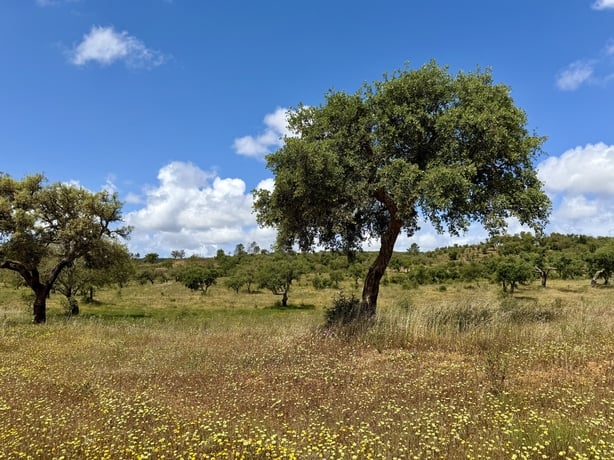
Historical Way, Cork Forest
After accidentally taking a wrong turn, a reminder to never trust trail markers alone, I eventually descended towards Porto Covo, where the smell of the countryside gave way to the scent of the salty sea. Whitewashed houses lined the streets, while hikers slowly drifted into town, wearing dusty boots and carrying trekking poles.
The following day’s section along the Fishermen’s Trail proved far tougher. Compared with the gentler inland walking, the coastline was more demanding on the body. Much of the route crossed soft, powdery sand, either on the beach or through the dunes.
Every step slid backwards slightly, while relentless Atlantic winds pounded at me for hours. But the scenery was so extraordinary that it was worth it.
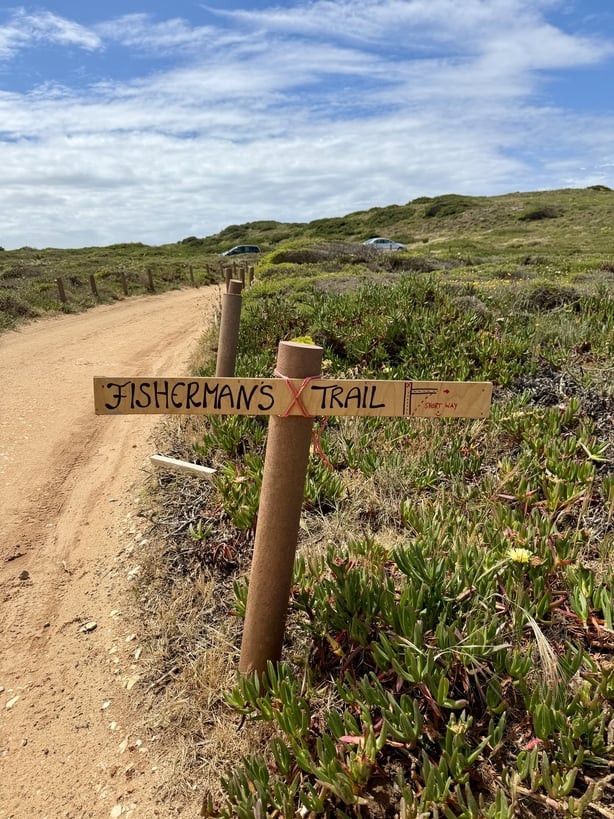
Fishermen’s Trail
Compared with the solitude of the Historical Way, the Fishermen’s Trail has a more social atmosphere, but the sheer scale of the landscape ensures it never feels overwhelmed by visitors.
White horses crashed violently against the rocks below sheer cliff drops, while enormous storks nested in seemingly impossible locations on cliff edges overlooking the Atlantic.
At Cabo Sardão Lighthouse, where local legend claims the builder accidentally reversed the plans, we watched adult storks carefully feeding their chicks above the crashing surf below.
The reward at the end of each day came not only from the walking itself, but from the people, places and meals waiting for us afterwards.
In Porto Covo, I dined at Lamelas, one of the best-known restaurants on the Alentejo coast. Here I ate delicious fresh seafood and learned of Adega do Mar, a wine that’s aged at the bottom of the Atlantic Ocean off the coast of Sines.
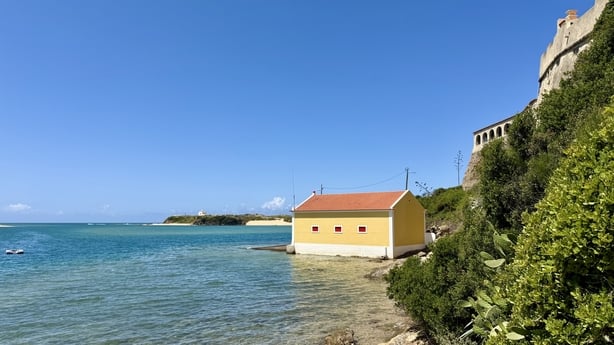
Vila Nova de Milfontes
Near Vila Nova de Milfontes, Monica, the owner of Monte do Zambujeiro, welcomed me to her estate, which has belonged to her family since 1632. Surrounded by cork oaks and overlooking the Mira River, it felt worlds away from the windswept coastline I had spent the day exploring.
That evening, over a seafood cataplana brimming with lobster, crab and prawns at Oasis Restaurant, Monica introduced us to açorda de camarão. Made from bread, rice and prawns, the dish was originally created to use up stale bread.
Like many peasant dishes, it transforms simple ingredients into something far greater than the sum of their parts.
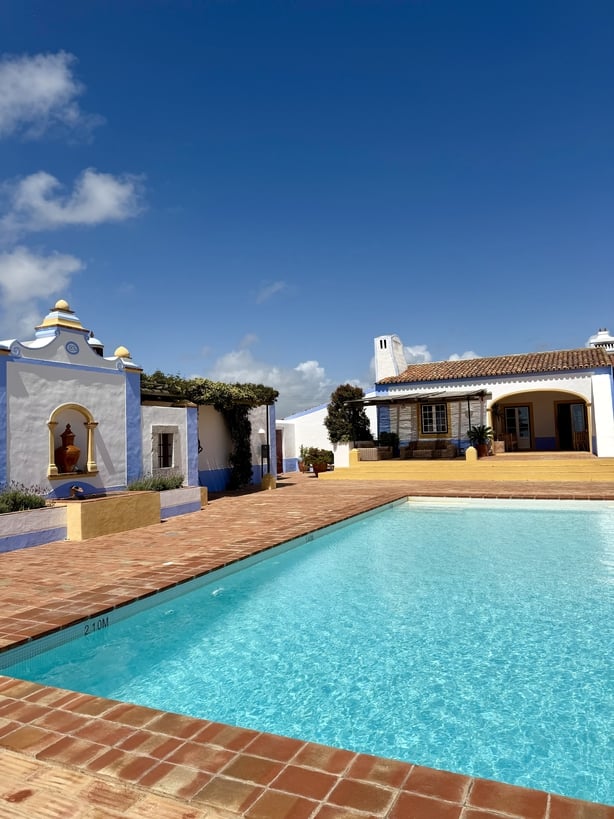
Herdade do Touril
At Herdade do Touril, a 200-year-old farmhouse transformed into a boutique hotel, dinner was served in a glass-walled dining room overlooking the estate’s fields.
The property has belonged to the Falcão family since 1826 and remains a working agricultural estate, with one branch of the family operating the hotel while another farms the surrounding land. It struck a balance that the Alentejo seems to do particularly well: understated luxury, firmly grounded in tradition.
What these places shared was a strong sense of place. Nothing felt manufactured for tourists. Walking between villages, farms and coastal towns provided an insight into a region that still moves at its own pace.
Back inland on the Historical Way near Odemira, the landscape changed again. Dirt tracks wound through rolling farmland and cork oak forests, the trees marked with painted numbers showing the year they were last stripped of their cork bark. The harvesting process occurs only every seven to nine years.
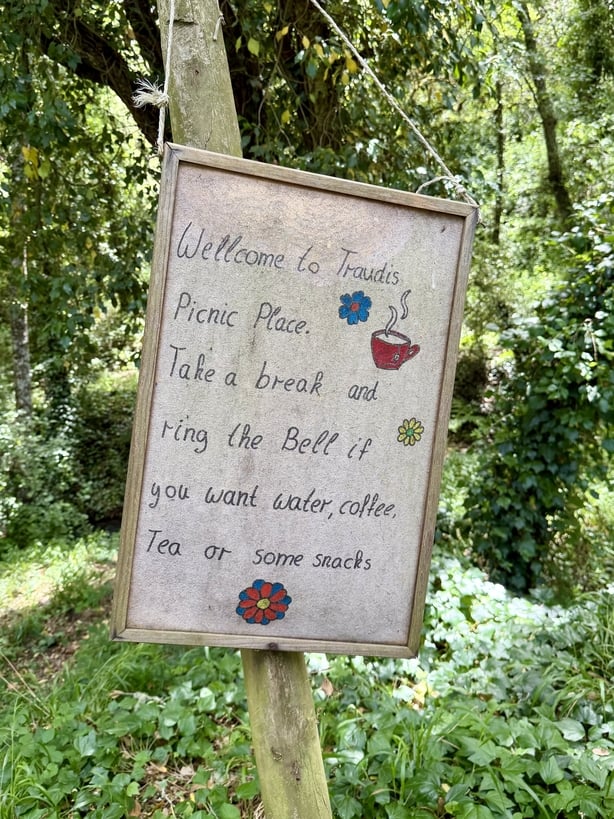
Refreshment on the Historical Way
Before setting out that morning, we had stopped for coffee in a tiny café busy with octogenarians chatting over a cuppa. After experiencing the region’s way of life, I wondered if Alentejo may be an unofficial blue zone. Later, I ate my packed lunch to the sound of birdsong and passed nobody on the trail.
In an era when travel often feels hurried and over-curated, there was something deeply restorative about moving through a place at walking pace and noticing the small details in the landscape around you. The scent of eucalyptus, swallows darting overhead, storks tending their chicks on cliff-edge nests, and wildflowers brightening the dusty trail.
There is also a particular kind of satisfaction that comes from walking all day. Your legs ache, your boots are full of sand, and you arrive hungry and tired, but somehow your mind feels lighter. In a fast-paced world, the Rota Vicentina is a reminder of the value of slowing down.
Deirdre Mullins was a guest of Visit Alentejo for the purpose of review. For more information about the Alentejo, go to Visit Alentejo. For information about the Rota Vicentina, visit Rota Vicentina.
You can follow Deirdre’s travel on Instagram @deirdremullins