
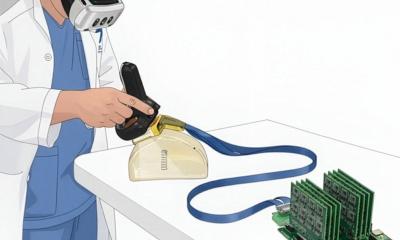
Each user performed identification tasks using four different ultrasound technologies. In one condition, they viewed 2D images on a regular screen, which is the way that most ultrasounds are now performed. They also viewed 3D images on a regular screen, as well as two augmented reality conditions: one 2D and one 3D (AR-VIU).
In one round of experiments, users were asked to identify an object embedded in gelatin — such as a spring, a ball, or a screw — inside an opaque container that was scanned with ultrasound. In a second set, they were asked to use a pen to mark the location of “tissue phantom” — a gel-like material engineered to mimic human tissue. This simulates the task of locating the right spot for a needle during a biopsy.
The researchers found that the AR-VIU system significantly improved all users’ ability to identify and locate objects. The effect was especially strong for novices, who performed nearly as well as experts when using AR-VIU. When using the traditional 2D imaging system, experts performed much better than novices. “Overlaying images with the anatomy and providing 3D visual context makes ultrasound significantly easier for novices to understand,” Viswanath says.
In interviews after the experiments, most of the novices reported that they preferred the AR-VIU approach, with many saying that it made the tasks easier. “The 3D system imposes less brain drain, it’s more intuitive, and it’s easier to understand what is happening in the targeted region,” Dagdeviren says.
Many of the experts said they preferred the traditional 2D imaging because that is what they were accustomed to and had been trained to use. However, those experts also said they could see the benefits of the AR-VIU system in some situations, such as placing a needle for a biopsy or visualizing the movement of the heart wall during echocardiography.
The researchers are now working on further improving the resolution of the imaging and doing additional tests to demonstrate the accuracy of the AR-VIU technology.
Source: Massachusetts Institute of Technology