
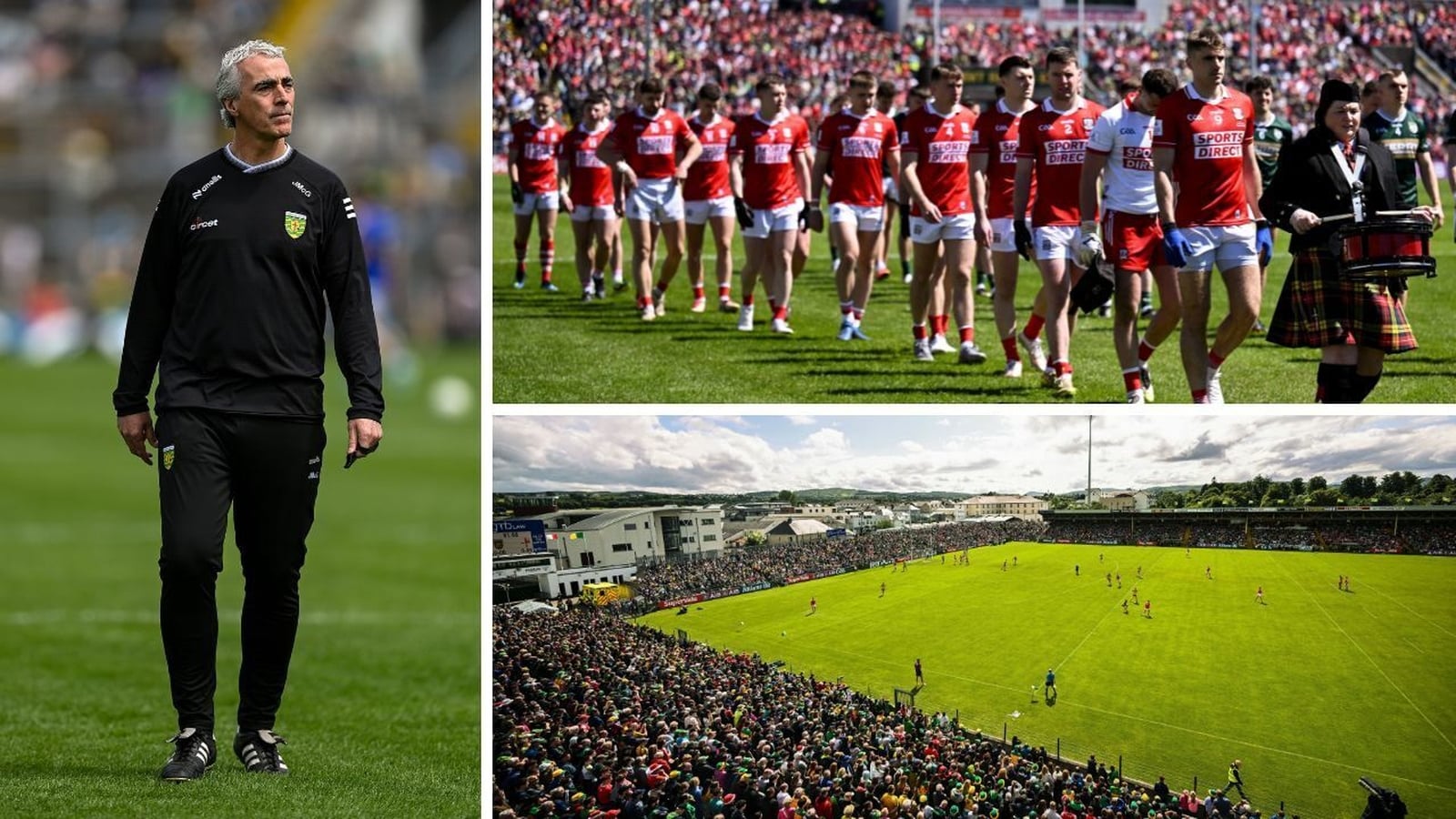
For a team Jim McGuinness never came up against as a player in championship, there has always been a healthy respect for the Cork footballers.
The early part of his playing career came after the Rebels’ All-Ireland successes of 1989 and 1990, yet still at a time where they held their own with Kerry in Munster.
Up until 20 years ago, the counties at either end of the country had never crossed paths in the championship, with Saturday’s sold-out clash at Ballybofey just the sixth occasion they do battle outside of league duties.
Similar to 2024 – when Cork thrilled a packed Páirc Uí Rinn to see off the Ulster champions in the round-robin stage – it won’t be do-or-die at MacCumhaill Park, yet it could be instructive into how the business end of the season plays out.
Donegal are strong favourites to level up the head-to-head – the Rebels currently lead 3-2 – and take a more direct route to the last eight.
The first time the sides locked horns in championship came in a 2006 All-Ireland quarter-final, where Armagh v Kerry was the undercard at Croke Park.
Billy Morgan’s side squeezed through by the bare minimum, centre-back Ger Spillane the unlikely injury-time match-winner as his side prevailed 1-11 to 1-10.
Three years later there was no such tension as Cork demolished their opponents, easing themselves into another All-Ireland semi-final against opposition that barely laid a glove.
“The Munster champions handed Donegal a lesson in life as much as in football and chalked up a truly staggering score of 1-27,” Keith Duggan wrote in his match report. “In their largesse, they could concede 2-10 and still run out as victors by 16 points.”
There is a strong argument to be made that Conor Counihan’s side were at their peak in 2009 – their season ending in the showpiece with another defeat to Kerry in the capital – despite going on to lift Sam Maguire 12 months later, but the feeble resistance from the Tír Chonaill men was arguably more striking than their opponent’s professional display.
Just seven of the Donegal side that started that day would feature in the All-Ireland final win over Mayo three years later.
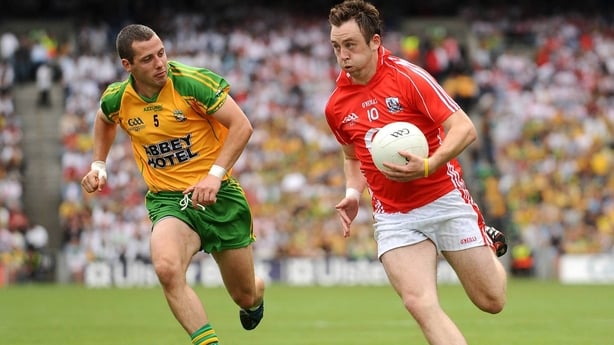
Paul Kerrigan takes on Donegal defender Barry Dunnion. The Nemo Rangers forward ended with a tally of 1-04
John Joe Doherty presided over that sobering defeat, his reign drawn to an inglorious conclusion the following summer after a home defeat to Down after extra-time and the dispiriting display in a nine-point loss to Armagh in Crossmaglen.
McGuinness, the only candidate to succeed Doherty, finally got the job he craved and those insipid displays were a constant reference point as the Glenties man sought to build up Donegal belief.
When he took over, it was Cork that were the standard bearers, with McGuinness full of admiration for what the Rebels brought to the party.
“I remember being in Croke Park watching them lift the Sam Maguire and being struck by their presence – their power, their size at midfield, an array of classy forwards,” he wrote in his book, describing them as an “exceptionally good team”.
The Donegal landscape had shifted somewhat when the sides collided in the 2012 All-Ireland semi-final. McGuinness had annexed Ulster twice, but the spectacularly defensive showing from the previous year’s All-Ireland semi-final defeat to Dublin was still fresh in the mind. The defence remained resolute, could he get more change out of an attack laden with talent?
Cork, whose All-Ireland defence ended at the hands of Mayo in the last eight in 2011, still retained a strong core group and entered the quarter-final weekend as favourites to reclaim Sam Maguire.
The Donegal camp went through the Cork tactical blueprint with a fine toothcomb. The detail-oriented McGuinness noted how, for all Cork’s strength around the middle third, they rarely went right down the middle on their own kickouts. Crucially from his perspective, they had no truck with playing a sweeper.
“We could play Patrick (McBrearty), Michael (Murphy) and Colm (McFadden) up front,” he remarked.
The game was as even as many had predicted, the Ulster champions ultimately winning both halves by a point to continue their journey towards All-Ireland glory.
During his time as an analyst, McGuinness later reflected warmly on that landmark victory.
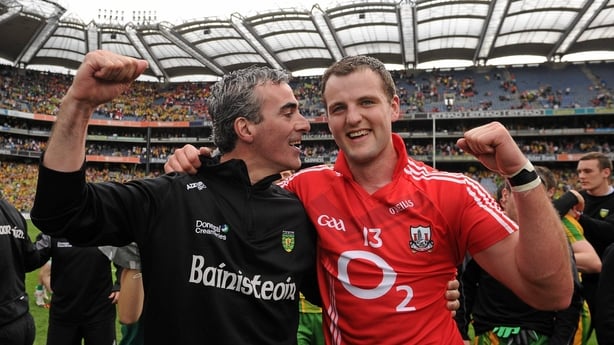
Jim McGuinness celebrates with captain Michael Murphy after the 2012 win over Cork
“It was one of the best games I was ever involved in because they were just a top, top quality team. They were still the benchmark nationally then.”
Four years on and the stock of both sides had dropped considerably. McGuinness was earning his stripes as a coach with the Celtic Under-20s having joined the club initially as a psychologist, while Tyrone had loosened Donegal’s grip on Ulster.
Following their relegation from Division 1, Cork were in something of a transition. Of the starting side that went down 0-21 to 1-15 against a Patrick McBrearty-inspired Donegal, only four had Celtic Cross medals from 2010. Donegal advanced before Jim Gavin’s all-conquering Dublin sent them packing next time out.
The Rebels fell from the highs of the start of the decade, while Donegal were unable to translate provincial success into loftier ambitions under Declan Bonner’s watch.
By the time McGuinness returned to the hotseat, expectations had been ground down. His first competitive game in charge saw rejuvenated followers flock to Ballybofey to see the hosts ease past Cork in their league opener.
Five months later and the fifth and most recent championship tussle took place. Unbeaten through league and championship, Donegal took to the field at a sun-drenched Páirc Uí Rinn in the round-robin fixture as strong favourites to continue that trend.
It wasn’t knockout football, but in front of a packed house, an early summer classic was served up. Though only for those in attendance, as similar to the current scheduling, the game not part of the weekend’s televised line-up.
Donegal’s four-game championship run – including twice going to extra-time in Ulster – was notable in that no opposing side was able to find the back of the net. On Leeside they shipped two in a minute and three overall as the hosts produced a slick attacking display en route to a morale-boosting win.
In the final season before the FRC intervention, Cork’s willingness to go direct and attack both kick-outs caught the eye of McGuinness, and was at odds to much of the fare being served up across the board.
“Cork are a very strong running team and they asked a lot of questions on the transition,” he said afterwards. “Most of their kick-outs go long and they are prepared to go 50-50.”
Today the safety net that the loser will fight another day may diminish the intensity somewhat, though the carrot of a direct route to the quarter-final is an inviting one.
In light of such a tricky draw, the soundings from Cork are that a good performance, with the influential Colm O’Callaghan to return after his suspension this weekend, would stand them in good stead should they fail to turn over the joint-favourites for Sam on their own patch.
Donegal fans will be seeking further evidence that the Down upset was an early campaign blip, the sold out signs going up at the 18,000 capacity MacCumhaill Park within 24 hours of the fixture being confirmed.
Writing in his Irish Times column in 2018 not long after leaving his role as assistant manager at Chinese side Beijing Sinobo Guoan, McGuinness offered his thoughts on the Gaelic football landscape, and Cork’s position within it in order to arrest the negative narrative regarding the provincial championships.
“A revitalised and ambitious Cork team is so important,” he wrote. “Cork and how vital a role they play in football’s eco-system. They may live in the shadow of the hurlers but, nonetheless, they are a big football county.”
He will hope that Cork’s ambitions can be curbed for another day as they plot to go one step further in 2026.
Watch an All-Ireland Football Championship double-header, Louth v Armagh (1pm) and Tyrone v Mayo (3.30pm) on Sunday from 12.30pm on RTÉ2 and RTÉ Player. Follow our live blog on RTÉ.ie/sport and RTÉ News app and listen to commentary on Sunday Sport on RTÉ Radio 1