
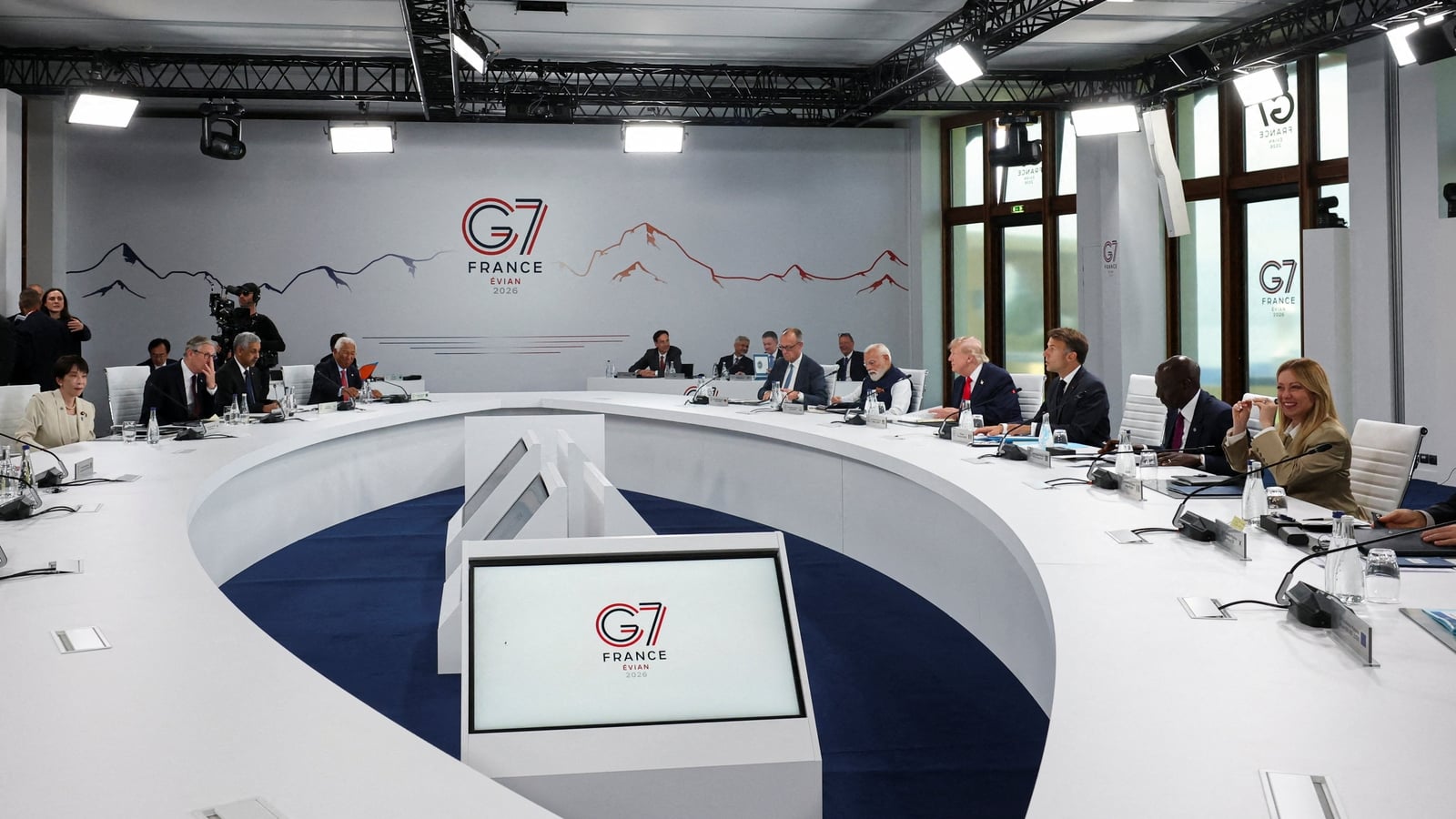
The leaders of the G7 countries said they stand united to support Ukraine, including its territorial integrity, and agreed to increase the pressure on the Russian war economy.
“In this context, we will strengthen our sanctions (against Russia), including those on the oil and gas sectors,” the leaders said in a joint statement.
Separately, the leaders, who are meeting for a summit in the French town of Evian-les-Bains, have also welcomed the deal between the United States and Iran and said they are ready to contribute to its implementation.
They added they will make efforts to diversify energy supply routes and reduce dependence on the Strait of Hormuz and increase energy stocks
G7 leaders are also set to discuss the security risks posed by AI and social media on the last day of a summit dominated by Donald Trump, before host French President Emmanuel Macron dines with his US counterpart at the Palace of Versailles.
Sam Altman, the head of artificial intelligence giant OpenAI, Anthropic chief Dario Amodei and Arthur Mensch of their European rival Mistral AI, will attend lunch with the leaders.
British Prime Minister Keir Starmer announced on Monday that children under-16 will be banned from using social media in the UK, with France also eyeing a similar ban.
The discussion at the G7 will focus on how to “improve cyber security and protect our children and our democracies,” Mr Macron said in an Instagram video ahead of the summit.
‘Real deal’
Mr Trump has been the centre of attention throughout his stay at the summit in the lakeside resort of Evian.
French officials will be satisfied that he has stayed for the entire event – in contrast to the previous gathering in Canada where he left early.
In an unusual gesture, Mr Macron has invited Mr Macron to dinner at the Palace of Versailles outside Paris after the summit winds down this afternoon.
Mr Macron, under pressure to show he is not fawning over Mr Trump, has already insisted the evening at Versailles will not be a “gala” dinner.
Iran remains a key topic at the summit, with allies eager to question Mr Trump over his deal with the Islamic republic to end the Middle East war which is due to be signed in Switzerland on Friday.
Mr Trump said the United States was under “no obligation” to invest in Iran after the deal, adding that its main focus was that Iran would not acquire a nuclear weapon and that “all hell” would “rain down” on the country if it did.
On Ukraine, Mr Trump has moved to a more hostile stance against Moscow, saying Russia should “make a deal” and indicating Washington could re-impose waived sanctions.
He has also adopted a more critical tone against Israeli Prime Minister Benjamin Netanyahu.