
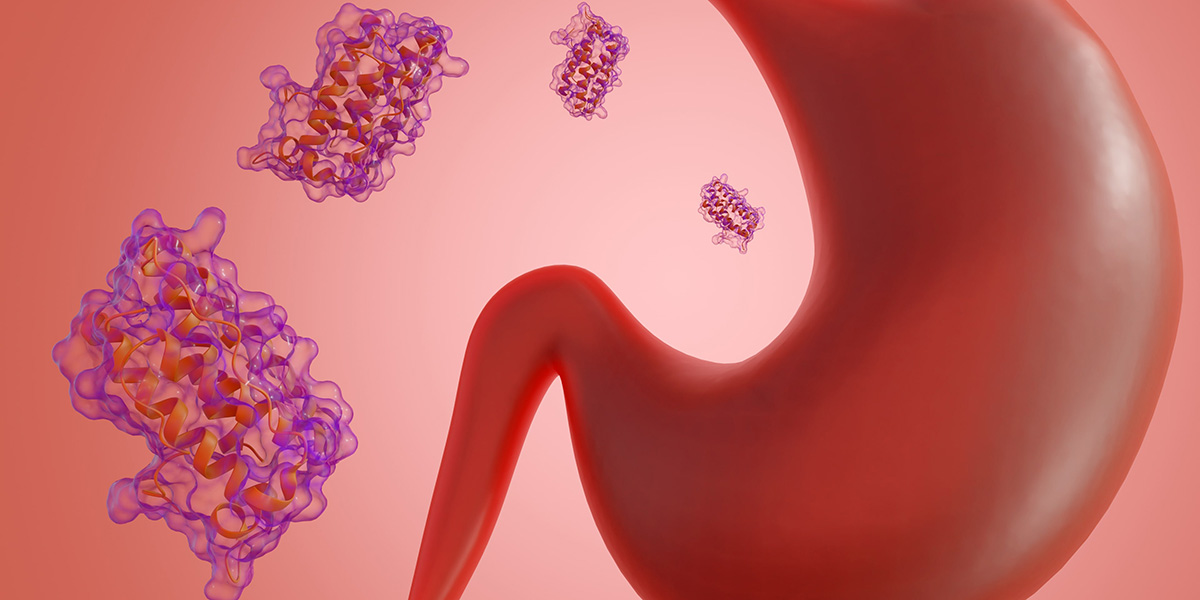
Knowing when to stop eating is as important as knowing when to start. This process, known as satiation, relies on coordinated neural and hormonal signals. In the brain, the paraventricular nucleus of the hypothalamus, or PVN, helps regulate feeding and satiation. Disruptions in PVN signaling may lead to dysfunctional eating patterns and metabolic disorders, including obesity and anorexia nervosa.
Stomach-derived hormones, like lepin shown here, help signal to the brain that the body has had enough to eat.
O-GlcNac transferase, or OGT, is an enzyme that attaches the sugar β-N-acetylglucosamine to proteins and plays a key role in regulating food intake. In a study published in the Journal of Biological Chemistry, Olof Lagerlöf, an assistant professor of psychiatry at Umeå University, and his colleagues found that OGT acts as a caloric “translator,” coupling nutrient status to molecular changes in excitatory neurotransmission in PVN neurons to signal fullness.
“Eating is something we all do. We’re all familiar with it. But how does the body know what, when and how much to eat?” said Lagerlöf, who studies the ability of OGT to integrate metabolic signals with neuronal activity.
Previous work by Lagerlöf showed that OGT regulates food intake and affects excitatory synapses in neurons. However, it remained unclear how the nutritional status could influence OGT’s effect on the neuronal communication that regulates satiation.
Lagerlöf teamed up with Michael Druzin, an associate professor of neuroscience at Umeå University who is also interested in hypothalamic circuits, to explore how OGT integrates nutritional status with synaptic plasticity. To do this, the team used mice lacking OGT in specific PVN neurons that regulate food intake.
Using patch-clamp electrophysiology on brain samples from mutant and control mice, they found that OGT deletion increased neuronal excitability. Recordings from neurons lacking OGT exposed to varying glucose levels showed reduced synaptic transmission. Experiments in fed and fasted mutant and control animals supported these findings: feeding increased excitatory transmission, while loss of OGT suppressed it.
Because excitatory neurotransmission is partly mediated by AMPA receptors, the team assessed expression of AMPA receptor subunits. Neurons lacking OGT showed altered expression of most AMPA receptor subunits, suggesting a molecular basis for the observed electrophysiological changes.
Moving forward, Lagerlöf, Druzin and their teams will continue to investigate how satiation is regulated in the PVN, turning their attention to the input signals that arrive at the PVN and modulate the activity of OGT-expressing neurons.
To Lagerlöf, studies such as this could pave the way for better treatment options for patients affected by eating disorders. “When it comes to the field of eating disorders, there are almost no effective medical treatment for anorexia nervosa or bulimia nervosa,” he said. “For all those disorders, we need to know how the brain processes food. And we’ve identified one mechanism here.”