
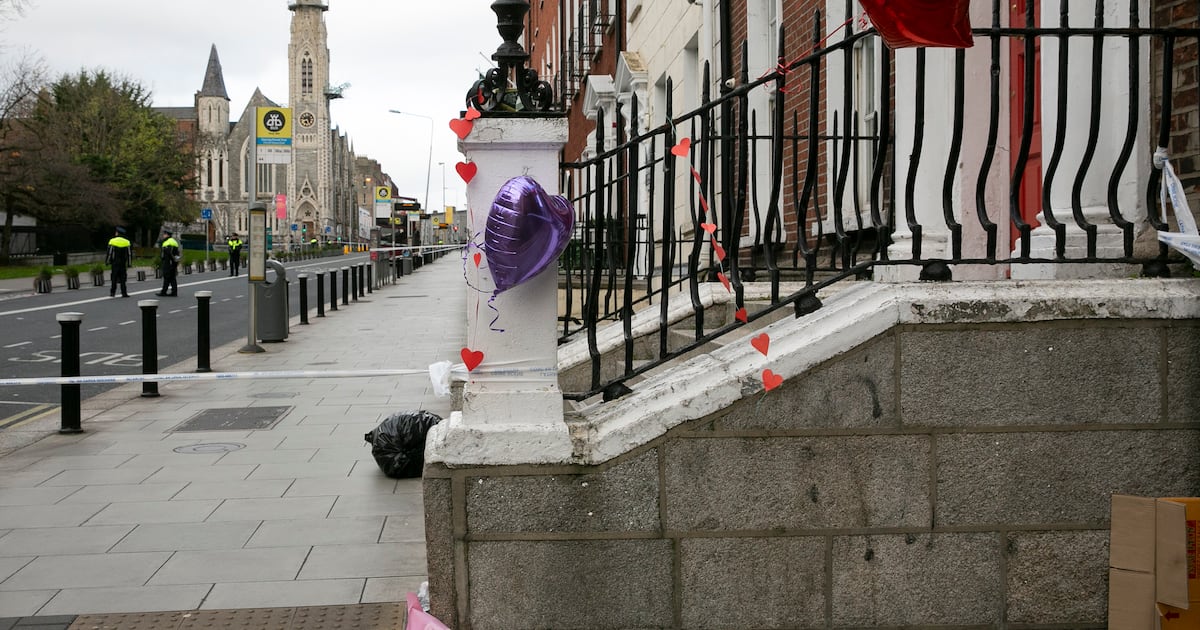
A young girl has a “lifelong and life-limiting” severe disability after being stabbed in the heart during an incident at Parnell Square, a jury at the Central Criminal Court has heard.
The child was aged five when she suffered severe injuries during the incident on Parnell Square East, Dublin, on November 23rd, 2023.
Dr Louise Baker, a neurodisability consultant who treated the girl after her admission to Temple Street hospital that afternoon, said she has a lifelong, life-limiting severe disability.
Now aged seven, the girl will need a wheelchair for the rest of her life, needs to wear splints to stretch her muscles, is at risk of spinal curve and scoliosis and further episodes of gut dystonia and pain, is non-verbal and cannot communicate her wants and needs, she said.
The child is fed through a tube in her stomach, has “no safe swallow” and no selective control over her muscles. She will need 24-hour care for the rest of her life as she has no independent skills.
The girl was a previously healthy five-year-old reaching all her milestones before suffering cardiac arrest following the stabbing injury that led to a severe acquired brain injury.
The child was experiencing seizures and severe and painful muscular dystonia even as medics were trying to treat her in intensive care, she said. The child also suffered gut dystonia to such an extent feeding was stopped for a time because it was so painful.
The child was in Temple Street hospital for nine months, needs 24-hour care, needs to be hoisted, needs a wheelchair and will need a “huge amount” of equipment going forward.
Baker was the last witness for the prosecution on the 12th day of the trial of Riad Bouchaker (52), a native of Algeria of no fixed abode.
Judge Tony Hunt then sent the jury away until Monday to facilitate legal discussions.
Bouchaker denies eight charges; attempting to murder three children on Parnell Square East on November 23rd, 2023; assault causing harm to two other children and a passerby who intervened; assault causing serious harm to Leanne Flynn and producing a 36cm kitchen knife capable of inflicting serious injury.
After two psychiatrists disagreed on his fitness to plead arising from an acquired brain injury, caused by a pre-existing cognitive impairment combined with injuries he suffered during interventions by members of the public at Parnell Square, Judge Tony Hunt ruled he was fit to stand trial with assistance of accommodations.
In evidence on Thursday, Dr Yvonne O’Dowd of Forensic Science Ireland told prosecuting counsel Karl Finnegan she examined clothing removed from Bouchaker in hospital and a knife in relation to the Parnell Square incident.
The knife was a large black-handled Chef Aid knife about 36cm long. The blade was about 24cm long and 2.5cm wide at its widest point.
DNA from the handle of the knife matched the DNA of Bouchaker, she said.
DNA from blood-staining on the blade of the knife matched the DNA of two girls – subject of the attempted murder charges – and the DNA of Flynn, she said. DNA from cellular material on the blade matched that of the seriously injured girl.
Additional DNA elements on the knife were too minor for further interpretation, she said. DNA from blood-staining on clothing taken from Bouchaker matched his DNA.
Under cross-examination, she agreed no match was made with DNA profiles taken from three young children and a teenager who were at Parnell Square on the date of the incident. The charges against Bouchaker include charges relating to the four.
Prof Anne Brannigan, a consultant surgeon, said she provided a report to gardaí regarding childcare worker Leanne Flynn, who was admitted to the Mater hospital on November 23rd with major trauma.
Flynn had a major stab wound on her lower back, her diaphragm had ruptured, her left lung was in her chest, and her spleen was removed because the splenic injury was “not salvageable”. That removal of the spleen was a life-saving procedure to stop bleeding and going into cardiac arrest.
Flynn was discharged on December 20th, she said. She expected she would continue to suffer psychological and other issues. Having no spleen is a significant issue, and Flynn is at more risk of infection, and of hernia.
Dr Aoife Mahony, a consultant paediatrician, told prosecuting counsel Carol Doherty she began treating the severely injured five-year-old girl in November 2025.
The child is fully dependent on her carers for daily living, cannot communicate verbally, can blink yes and no, suffers severe dystonia and is fed through the stomach.
She is on nine regular medications for management of her conditions. She attends a school for children with complex needs and will require lifelong therapies.
Secondary to her brain injury, she has a neurological disability which will be lifelong, she said. She will make gradual gains but, as she grows, that means other difficulties can arise in the future. This was all due to the child undergoing serious harm, she agreed.