
Freshwater mussels don’t look like attentive parents. They wedge themselves into riverbeds and filter water for years, easy to mistake for ordinary stones.
Yet the females shelter their developing young inside their own gills before sending them off.

That kind of care depends on soft tissues, the sort that usually rots away long before an animal can fossilize.
So no one expected to find it locked in stone from the age of dinosaurs. A few mussels from southern England changed that.
Trapped in stone
These mussels turned up on the Isle of Wight, the stretch of coast off southern England famous for its Iguanodon bones and other dinosaur remains.
They lived in shallow rivers during the Early Cretaceous, roughly 125 million years ago. What makes these shells remarkable sits inside them.
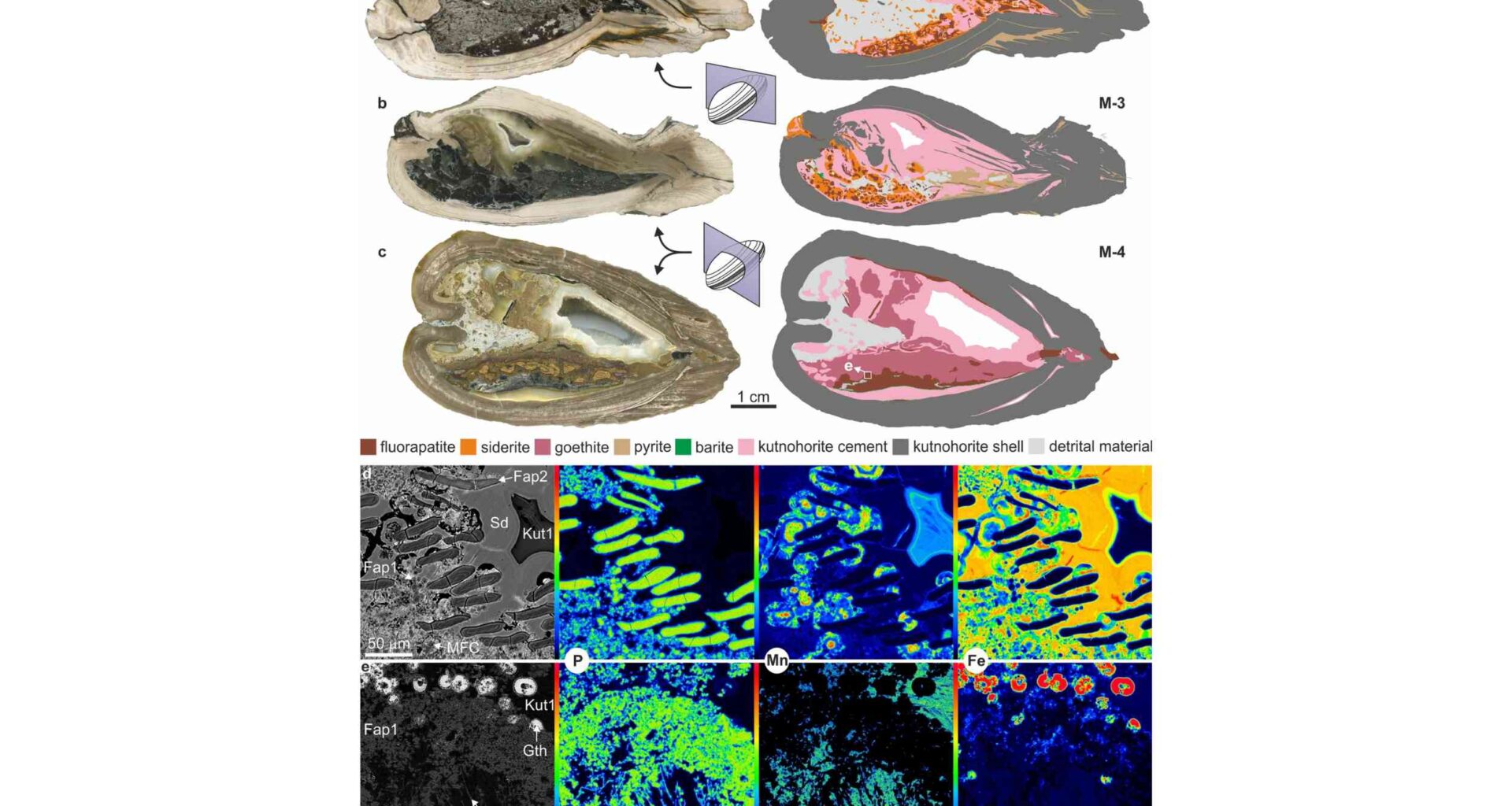
The soft tissue, usually the first to rot, was preserved as hard minerals. Victorian naturalists noticed the dark material almost two centuries ago.
They found it was roughly a third animal carbon and named it “Molluskite” without knowing what it was.
Dr. Graciela Delvene at the Geological and Mining Institute of Spain (IGME) led a research team.
They cut three of the fossils in cross-section and studied the slices under powerful microscopes. The internal details had been preserved, mineral by mineral.
Babies in the gills
Living freshwater mussels raise their young in an unusual way. A female pulls in sperm with the water she filters, fertilizes her eggs inside, then settles the embryos into pockets in her gills.
Until this study, no one had caught that in the fossil record. Stray ancient larvae had turned up before, but never a mother preserved with her brood still in her gills.
These mussels hold just that, larvae at several stages of growth. The most developed larvae, called glochidia, lay with their tiny shells open in what the team calls a butterfly position.
They are the oldest larvae ever found inside a parent still brooding. Decades of study on living mussel gills, including one paper on gill tissue, made the pockets recognizable.
A freshwater problem
Building a shell takes calcium, and freshwater holds far less of it than the sea. For a freshwater mussel, that shortage is constant, least of all with shells of its young to supply.
The animals stockpile calcium ahead of time. They bank the mineral as tiny round grains called mineral concretions, distributed throughout their tissues as a reserve.
When a female starts brooding, that store feeds the shells forming on her embryos. The fossils held these grains in startling numbers near the shell.
What the slices showed for the first time was where those grains ended up. The same calcium was present both outside the embryos and inside them.
So the young, it seems, begin pulling in the stored mineral to build their first shells while still in the gills.
How the calcium crosses into an embryo remains unknown, even in living mussels. But the transfer itself had never appeared in any fossil. Until now.
Telling life from rock
One reasonable question is whether these spheres are just minerals that grew in the rock by chance, with no biology behind them. Delvene’s team tested that, and the evidence ran the other way.
In two of the brooding mussels, the spheres survived in completely different minerals yet matched in size and form.
Random mineral formation would not be expected to produce the same result along two paths.
Each sphere held a hollow where a tiny shell had dissolved, with texture only a living larva would leave.
Their location sealed the case. The spheres sat right where the brood pockets belong, hugging the gill supports and the tissue that braces them.
Stray mineral growth has little reason to trace living anatomy that closely.
The empty mussel
Not every mussel in the set was carrying young. One of the three, alike in most respects, held no embryos or larvae whatsoever.
That gap turned out to be useful. The empty mussel still held loose calcium grains in large numbers, the kind that are used up during brooding.
Its gill bracing tissue was thinner too. In living mussels that tissue thickens to cradle a brood, so the slim version marks an animal that never bred.
The fossils captured separate moments in one reproductive cycle, one mussel before brooding and two in the middle of it. This allowed the team to reconstruct the entire sequence.
What the fossils rewrite
By 125 million years ago, freshwater mussels were already brooding their young in their gills and feeding them stored calcium, the same strategy their descendants use now.
Gill brooding likely helped these animals spread across calcium-poor rivers and lakes through the dinosaur era, an early advantage visible in their long success.
It also hands paleontologists a fresh place to look, since the reproductive record survived in minerals beyond the shell.
The discovery has modern conservation implications. Freshwater mussels are among the most threatened animals alive, and one study warns a large share of species now face extinction.
Knowing how long this reproductive strategy has persisted gives researchers a deeper evolutionary record to draw on as they work to protect modern freshwater mussels.
The study is published in Scientific Reports.
—–
Like what you read? Subscribe to our newsletter for engaging articles, exclusive content, and the latest updates.
Check us out on EarthSnap, a free app brought to you by Eric Ralls and Earth.com.
—–