
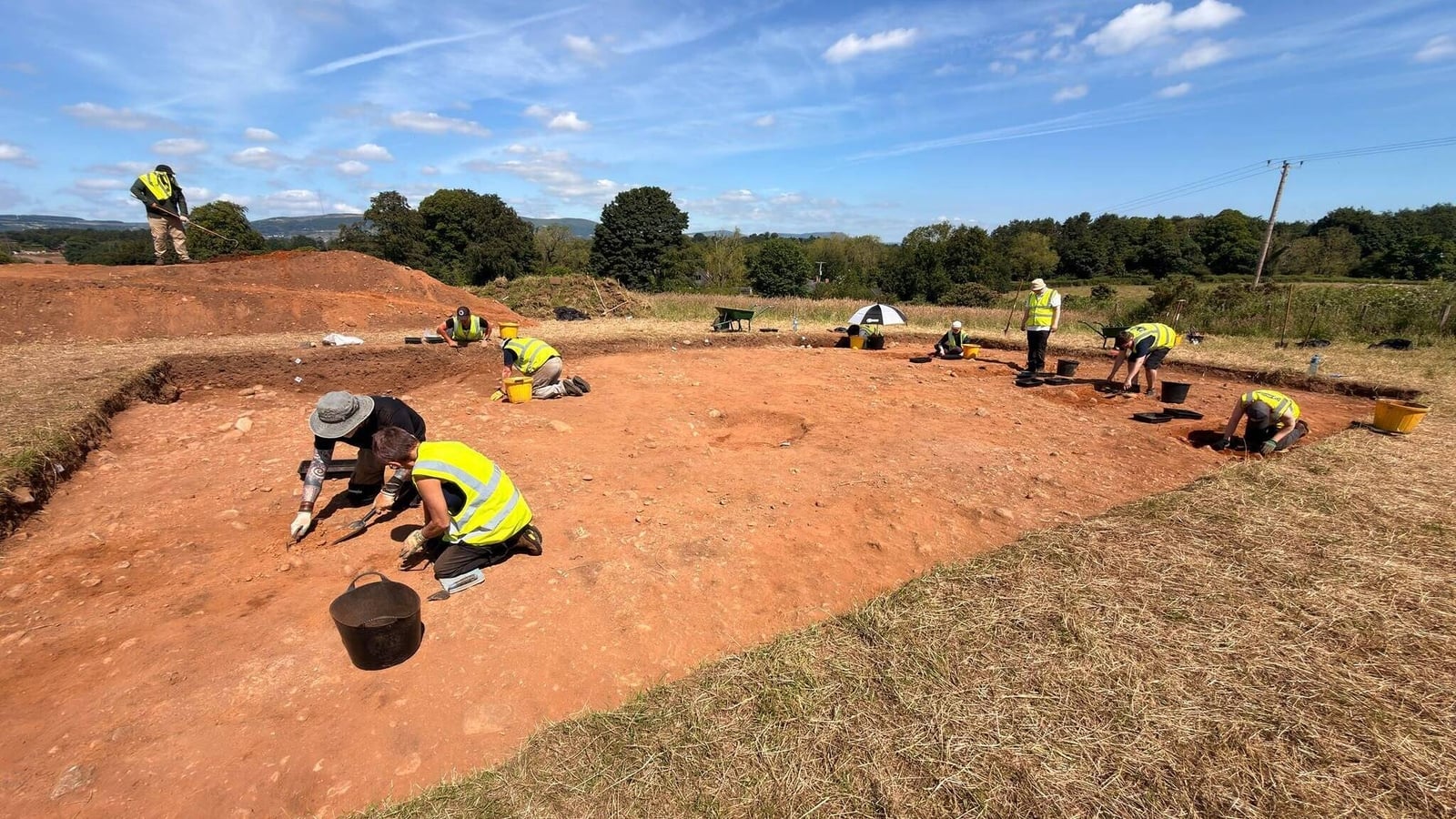
A previously unknown 4,000-year-old stone circle has been discovered by students from Queen’s University working alongside schoolchildren from east Belfast.
A rare bronze arrowhead was also found during the archaeological excavation which took place in Ballynahatty, Co Down.
The discovery was made by students and archaeologogists as part of the Community Archeology Programme.
The site came to the team’s attention after they saw aerial photography highlighting several cropmarks, which extended further than previously thought.
Archaeologist Brian Sloan, who works as Excavation Director with the Centre for Community Archaeology at Queen’s University Belfast, described the find as “fantastic” for the children who were there at the time.
Speaking on RTÉ’s Morning Ireland, he said: “Ballynahatty is known for being a large prehistoric ritual landscape.
“And it’s dominated by a site called the Giant’s Ring, which is one of the largest henge monuments in Ireland.
“And at the centre of that is a passage tomb, kind of like Newgrange in Co Meath, but a lot smaller.
“And we know in prehistory that this whole landscape was absolutely covered in monuments, but the Giant’s Ring is the only kind of upstanding monument that we can see today.”
Mr Sloan said the stone circle was dismantled in the 19th century by local farmers.
“So, they have taken the stones out because they wanted to turn the field into an agricultural field.
“So, they’ve removed the stones, but they’ve left enough evidence there for us to kind of make us pretty confident in what we’re dealing with.”
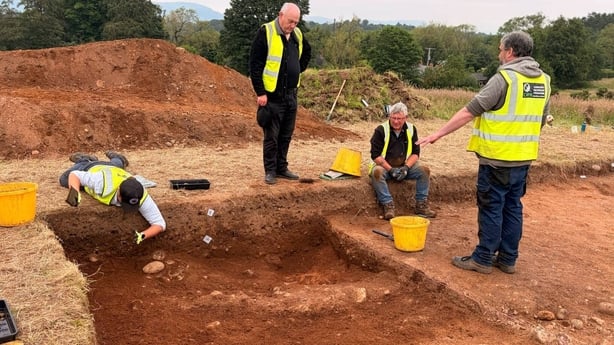
A bronze arrowhead was also discovered during the excavation
Mr Sloan explained how the discovery was made and said that the excavation is ongoing in the area and is twofold.
“It’s acting as the fieldwork component for our undergraduate training excavation for our undergraduate students, but also through the CAP new programme funded by the National Lottery Heritage Fund, Northern Ireland.
“It’s involved in the community aspect as well. So we’re getting primary school kids out, we’re getting local volunteers out to give us a hand to try and unlock the story.
“And we were really looking for a site in Belfast to do over the summer here. And we noticed in the aerial photographs that one of the fields beside the giant shrink is absolutely covered in these circular crop marks.
“So, we picked one of the most obvious ones and put a relatively small trench over it. And that trench is really starting to pay dividends.”
‘Heritage doesn’t belong to one particular side’
In relation to the Bronze Age arrowhead, Mr Sloan said the discovery came to light very late on Friday afternoon.
“I’ve only had the chance to do a wee bit of rudimentary research behind it over the weekend. But it’s made of bronze. It’s a socketed arrowhead.
“It looks like, if you’ve ever been to the National Museum in Dublin, you see these big, massive bronzy spearheads.
“It looks like one of them, but just a lot, lot smaller. And the thing is, we can’t at the minute find an Irish comparison for it.
“There’s comparisons in England and the portable antiquity scheme on their website. There’s about three or four examples.
“But most of these seem to be originated on the continent, in France and Spain, Ukraine, which is odd. There’s a story there, we haven’t been able to untangle just yet.”
He explained that the schoolchildren involved are all part of the Community Archaeology Programme and highlighted the importance of the programme for communities in the north.
“The whole ethos of what we’re trying to do is we’re trying to engage local communities with their local heritage.
“And especially in the north, you’re kind of talking about a contested sort of history in the North.
“It’s great to get kids out and teach them that heritage doesn’t belong to one particular side. It belongs to everybody. And at the end of the day, we all came from the same place.
“So, it’s great to get the kids involved.
“And if we can get just one of those children after site to go home and Google archaeology or talk to the parents, to bring their parents out to see the site and get them engaged with their local heritage as well, I think we’re on a winner.”