
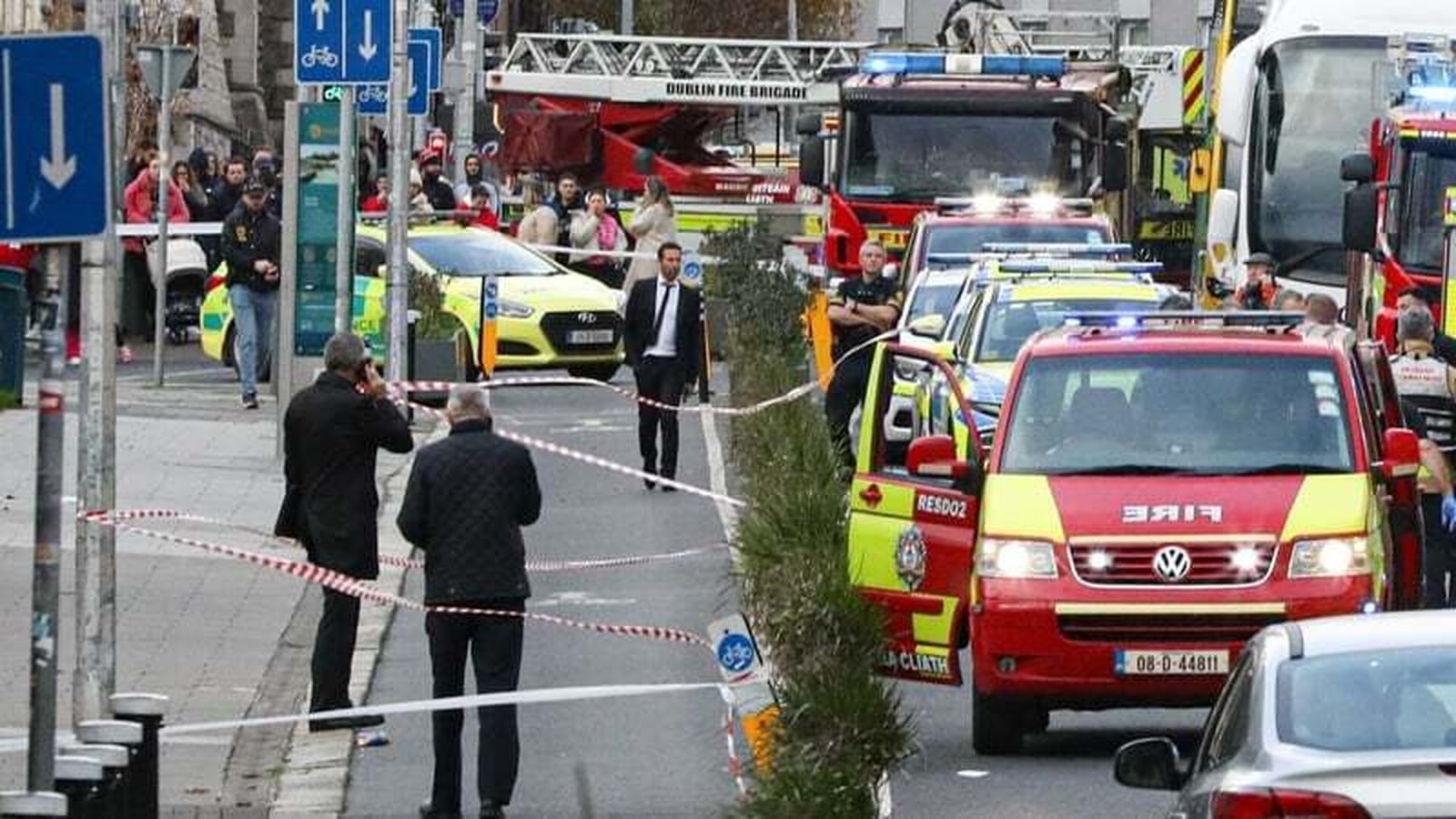
The prosecution has said Riad Bouchaker’s defence that he did not mean to kill anyone during an attack with a knife at Parnell Square in Dublin, lasting just 15 seconds, was “absurd” and a “lame excuse” and he should be judged by his actions not his words.
Defence lawyers have told jurors that Mr Bouchaker’s actions were senseless and did not reach the level of intent necessary for attempted murder.
Closing speeches in the trial of 52-year-old Mr Bouchaker who denies attempting to murder three children and assaulting four other people on 23 November 2023 have now finished.
Mr Justice Tony Hunt will begin his charge to the jury which he said was likely to finish tomorrow.
Earlier, the jurors heard the defence would not be going into evidence and they must consider the case based on the prosecution evidence they have heard during the trial.
As he began his speech, prosecuting counsel Karl Finnegan told the jurors they had heard upsetting evidence in this case but they had also heard that there were “clearly good people out there” – something he said should give everyone comfort.
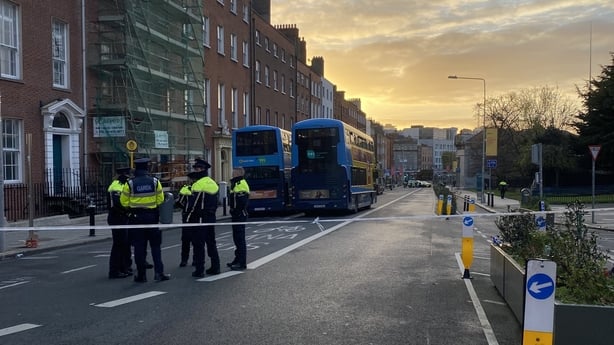
Parnell Square was cordoned off after the incident on 23 November 2023
He said they had heard that there were brave people out there who would go to a person’s assistance “at the drop of a hat” even if it put their own safety at risk.
He said these people could be “Irish, Brazilian, French” – it did not seem to matter.
And he said some people would even protect those who caused the emergency in the first place.
He said they had also heard of the first responders who carried out extraordinary work on a daily basis.
But he said their task was not to recommend any of these people for honours – their task was to see if the prosecution had proved the case against Riad Bouchaker.
Mr Finnegan explained that if the jurors were not satisfied beyond a reasonable doubt on the more serious charges of attempted murder, they could return lesser verdicts of assault causing serious harm or causing harm.
Prosecution case crystal clear
But he said the prosecution case was crystal clear that Mr Bouchaker should be found guilty of the offences he was charged with.
Mr Finnegan said Mr Bouchaker had cognitive issues at the time and had further cognitive issues as a result of what had happened at Parnell Square.
But he said they had heard that the defence of not guilty by reason of insanity was not available to him.
He said Mr Bouchaker’s repeated assertions in garda interviews that he was “not in his right mind” provided no lawful defence.
Mr Finnegan said it was the prosecution case that Mr Bouchaker intended to kill children on 23 November 2023 and it could have been any one or more of the children standing in line outside their school.
He said an intention to kill was rarely announced but he told the jurors they could look at the circumstances and draw inferences of abundant evidence of an attempt to kill.
These included Mr Bouchaker’s annoyance at the letter he received from social welfare, the fact that he then obtained an “inherently lethal” 36 centimetre carving knife, the distance from which he used it, the parts of the body he targeted, the number and severity of the strikes and stabs, his planning and his targeting of school children, and his efforts to prevent crèche worker Leanne Flynn from stopping him.
He said eye witnesses had different memories of the sequence of events in a “fast-moving, chaotic and shocking incident” but the core of the event remained the same.
Mr Finnegan said attempted murder was justified in all three cases.
And he told the jury that the fact that one of the children suffered only superficial injuries did not preclude attempted murder.
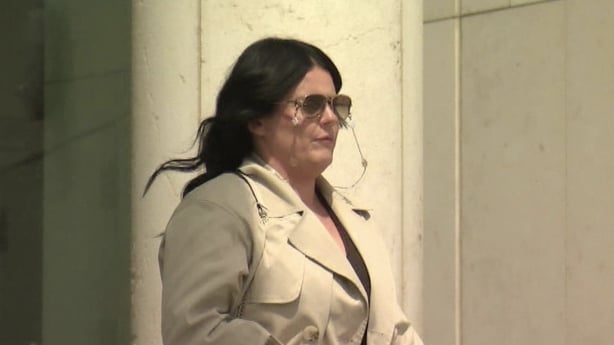
Childcare worker Leanne Flynn leaving court earlier this month
He said the jury had heard the evidence and had seen the “compelling” CCTV footage and there was sufficient evidence that Mr Bouchaker made direct contact with vital parts of their bodies with a knife in a way that could have resulted in their deaths.
Mr Finnegan said there was overwhelming evidence that Mr Bouchaker had caused serious harm to childcare worker Leanne Flynn intentionally or at the very least recklessly.
He said two other children were harmed by Mr Bouchaker either by direct or indirect application of force.
Finally, he submitted that injuries to French man Alan Lorena Guille who grabbed the knife were caused by at least a reckless application of force by Mr Bouchaker as he tried to retain the knife in his hand.
Bouchaker defence inconsistent with CCTV, says Finnegan
Mr Finnegan told the jury they should absolutely reject Mr Bouchaker’s defence that he did not kill anyone, did not intend to harm anyone and was not acting in his right mind.
He said this was inconsistent with the CCTV, the evidence and with the injuries suffered by the victims.
He said it was also inconsistent with Mr Bouchaker’s own interviews and with ordinary common sense.
And he told them it was “absurd” based on the facts of this case.
Mr Finnegan said there was no innocent answer and the only reasonable conclusion was that he intended to kill or cause serious harm.
Mr Finnegan said Mr Bouchaker’s repeated statements in garda interviews that no one died were not to his credit.
He said these words showed that he understood that death was the likely outcome of what he did.
No one died, Mr Finnegan said, because Ms Flynn put herself between the knife and the children, because Warren Donohue punched Mr Bouchaker, Caio Benicio hit him with a motorcycle helmet, Mr Guille grabbed the knife and emergency services fought to keep people alive.
He urged the jury not to let Mr Bouchaker take comfort from the success of people who stopped him and who saved the lives of some victims. He told them they should focus on Mr Bouchaker’s actions until he was stopped by the courage of others.
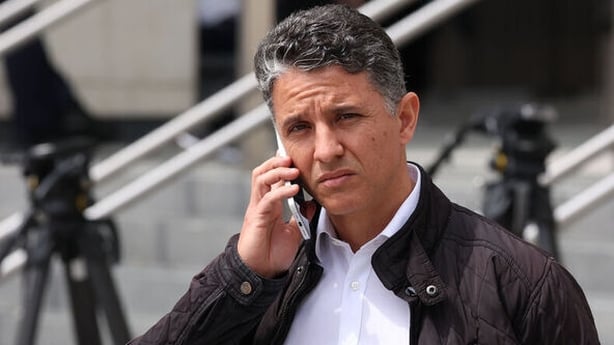
Caio Benicio hit Riad Bouchaker with a motorcycle helmet
He said Mr Bouchaker’s words were a “lame excuse” and they should see it for what it was and return guilty verdicts on all eight counts.
In his speech, Mr Bouchaker’s defence counsel referred to the riots that took place in Dublin after the Parnell Square attack.
He said the city was set on fire by people who would “seek to turn us one against other” and appeal to people’s basest instincts by reducing complex issues to hateful binaries and using the national flag as an instrument of exclusion and hate.
He said whatever toxic blend of banal frustration and inexplicable darkness occupied Mr Bouchaker’s mind was completely and morally abhorrent.
But he urged the jury to resist their critical faculties being overwhelmed by horror, even though that would be a natural and normal response.
The Senior Counsel said the most difficult work for the jury in the case would be deciding on Mr Bouchaker’s intention to kill. He said the offence of attempted murder required an intent to kill and a clear attempt to carry out the act of killing.
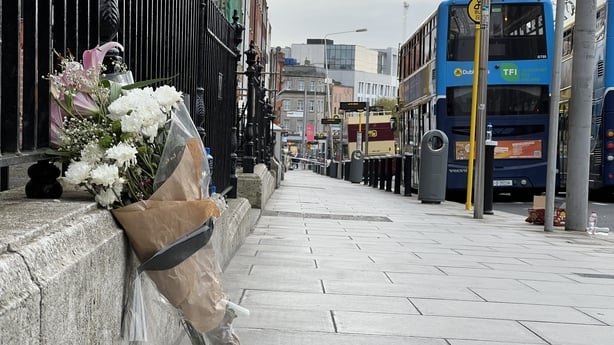
A bouquet of flowers left at the scene
He said that even in the case of the most seriously injured child who the jury have heard was left with “life-long, life-limiting” injuries he was asking them to conclude that in Mr Bouchaker’s case, his actions were senseless in every way.
He said his actions were “deeply irrational and abhorrent” but did not reach the level of intent necessary to sustain the charges of attempted murder.
The jurors were told by the defence that there was nothing to stop Mr Bouchaker killing or causing devastating injuries to other children after he had stabbed the first child and stabbed Ms Flynn but that had not happened.
He said the positive intent to kill was not there and suggested there was no evidence that a small laceration to one child’s neck had been caused by a knife.
He said the jury was being asked to join speculative dots and convict Mr Bouchaker of attempted murders without evidence.
He added there was no evidence of a deliberate infliction of an assault on Mr Guille.
Inconsistencies in eyewitness evidence, says defence counsel
Mr Bouchaker’s defence counsel pointed out the inconsistencies in eyewitness evidence pointing out that “15 different people see 15 different things”.
He also referred to Mr Bouchaker’s interviews with gardaí, saying his answers were “incoherent” and strayed regularly into gibberish.
He said his client had “no guile or sophistication” and stated repeatedly that he did not intend to kill anyone despite failing to appreciate the enormity of his position and the “violent disconnect” between what had happened and “trifling” difficulties in his own life.
The jury was told this was a case like no other and would live with the children and their families for the rest of their lives.
Mr Bouchaker’s lawyer asked the jurors not to approach him as a “monster” but to consider how they would want the case to be judged if someone they loved was similarly impaired and in a similar position.
He said their work would give a profound answer to the “people out there” who wanted “rage and hate” and were shrieking for vengeance or “perhaps worse”.
He told the jurors vengeance had no place in the court.
Earlier, Mr Justice Hunt told the jurors they should not draw any adverse inference from the fact that Mr Bouchaker was not calling evidence.
He said it was the right of every accused person not to give evidence and everything must be proved by the prosecution.