

More than 60% of people do not believe that the Government will ensure fair and unbiased treatment of all citizens when using AI, new figures show.
This is significantly higher than the OECD average of 39%.
The findings, which were part of the OECD’s Trust Survey 2025 conducted by the CSO, also revealed 72% of people do not have confidence that the Government can protect personal information from unauthorised access or misuse in its future use of AI, compared to an OECD average of 44%.
Some 49.8% of respondents were not confident in the Government’s ability to use AI to reduce costs while 30% people said they were confident that the Government could maintain human oversight and final decision-making authority in critical areas in its use of AI.
Overall, people in Ireland are less positive about the potential use of AI by government agencies than the OECD average.
The questions on artificial intelligence formed a new part of the trust survey which is in its third edition.
Respondents were also asked to rate their familiarity with the term AI, with 56% saying they understood it well and could explain it to others.
When broken down by gender, 63.7% of men said they could explain it well compared with 49.1% of women.
There was also a disparity in age groups, with 37.8% of those 50 years and older responding that they understood AI well compared with 81.7% of 18 to 29 year olds.
We need your consent to load this flourish contentWe use flourish to manage extra content that can set cookies on your device and collect data about your activity. Please review their details and accept them to load the content.Manage Preferences
The online questionnaire was conducted by the CSO between 29 September and 15 November last year and involved 2,197 respondents.
Regarding the addition of the new questions on AI, CSO statistician Sarah Crilly said: “The AI questions were added in 2025 with a recognition that expectations and perceptions of the role of artificial intelligence in the public sector is of interest with respect to trust in institutions.”
Trust levels between people down
The survey’s topline figures showed a decrease in the proportion of respondents who “trusted most people”.
In 2025, 78.7% of people said they had trust in most people, down from 82.5% in 2023.
Only 8.4% of people said they did not trust most people, with fewer men (7.3%) saying they did not trust most people compared with women (9.4%).
The percentage of women who did not trust most people increased from 6.3% in 2023.
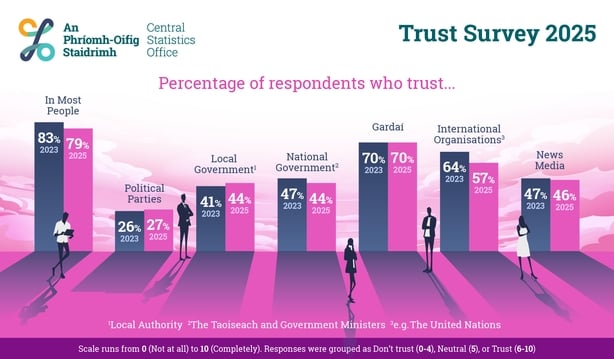
Meanwhile, 43.8% of people said they trusted national government, down from 46.6% in 2023.
This is slightly higher than the OECD average of 40% who expressed high or moderate trust in national government.
Trust in political parties stood at 27.4% in 2025 showing similar levels to 2023 (26.4%).
Some 57.4% of people trusted international organisations in 2025, a decrease from 63.7% in 2023.
Trust in news media showed a slight drop, decreasing from 47.1% in 2023 to 46% in 2025.
Responding to the trust figures, Ms Crilly said: “Overall, when it comes to trust, our analysis shows that a higher percentage of respondents had trust in most people when compared with trust in other institutions that were included in the survey, such as political parties, the civil service, or the news media.”
The survey also showed a stark disparity between the public’s satisfaction with both education services and healthcare services in Ireland.
Some 69.2% of respondents said they were satisfied with the education system in Ireland, while just 32.3% said they were satisfied with the healthcare system.
When broken down by age group, 75.4% of 18 to 29 year olds said they were satisfied with the education system.
However, in this same group, only 25.2% said they were satisfied with the healthcare system.
Satisfaction with the healthcare system was higher among those over 50 at 39.8%.
There was also a gender disparity in satisfaction with the healthcare system with 37.2% of men expressing satisfaction compared with 27.4% of women.
The survey also asked a number of specific scenario-based questions, such as: “That a senior politician would refuse the prospect of a well-paid job in the private sector in exchange for a political favour.”
Some 59.1% of respondents said that such a refusal was unlikely compared to 23.8% who believed a senior politician would refuse such an offer.
Meanwhile, 39% of respondents felt that the national government would provide appropriate support to affected people in the event of an economic crisis.