
Space agencies want to explore places that current rovers simply cannot reach. Steep slopes, rocky ridges, loose soil, and long travel distances remain major obstacles on the Moon and Mars.
To solve that problem, NASA engineers have been testing a new rover that can think more independently and move across difficult ground in ways existing planetary vehicles cannot.

The rover recently completed a demanding field test in Southern California’s Colorado Desert. Over seven days of intermittent testing, it traveled about 16 miles with very little help from the engineers following behind.
That may not sound like much by Earth standards, but for a planetary rover, it marks a significant step toward covering much greater distances while handling challenging landscapes on its own.
ERNEST Rover built for tough terrain
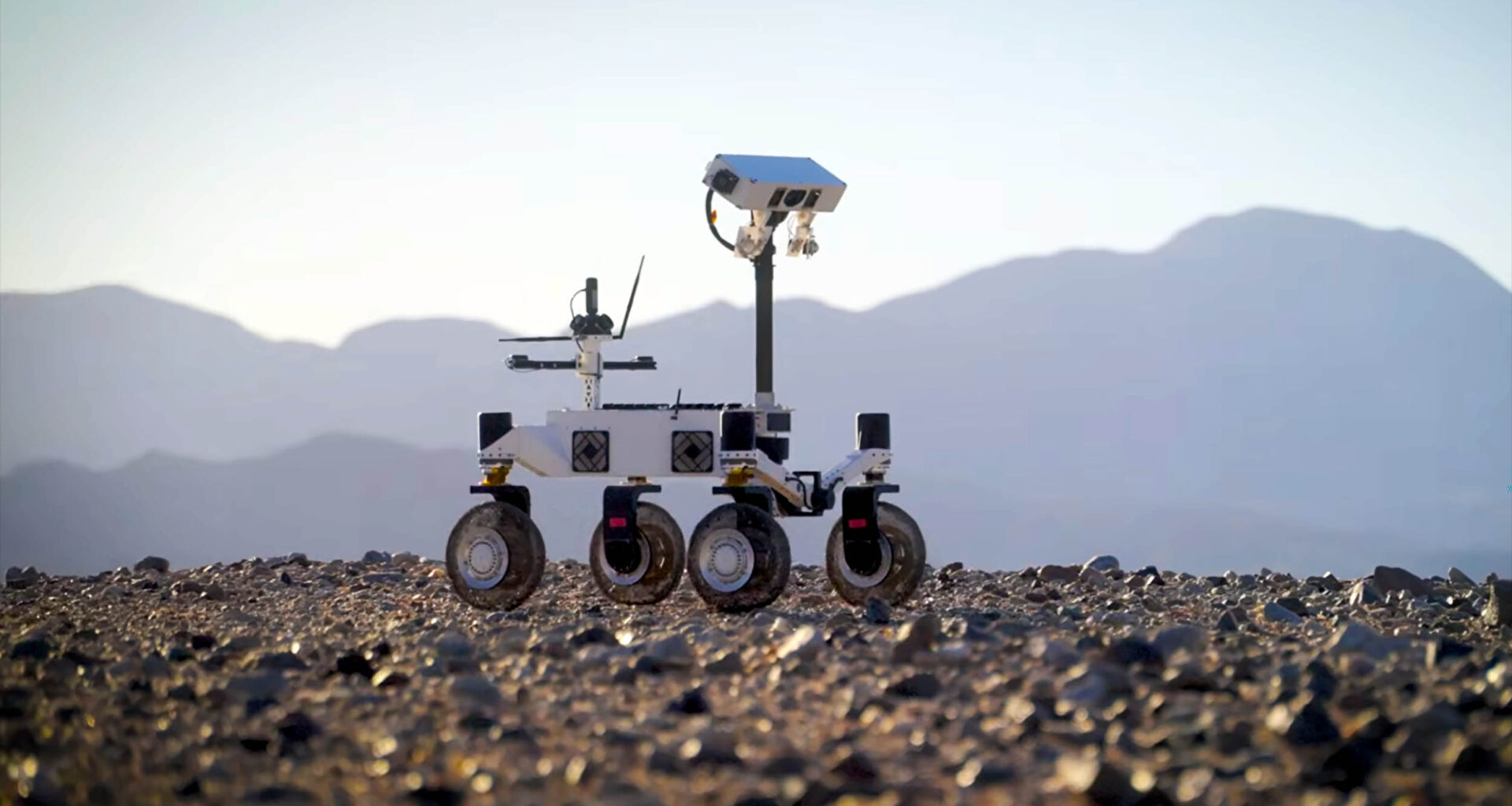
The experimental vehicle is called ERNEST, short for Exploration Rover for Navigating Extreme Sloped Terrain.
Developed at NASA’s Jet Propulsion Laboratory (JPL) in Southern California, the compact rover measures about 4 feet long and was created to test new ideas in mobility and autonomous navigation.
Unlike NASA’s current Mars rovers, Curiosity and Perseverance, ERNEST can lift each of its mesh wheels individually to get over obstacles that would stop many traditional rover designs.
Its four-wheel system also allows it to move in multiple directions, including sideways, giving it more flexibility when navigating rough ground.
The project is aimed at helping future missions reach places that have remained out of reach. Those locations could include rugged lunar regions, steep Martian terrain, or other difficult environments across the solar system.
Faster travel for future exploration
One of the biggest goals behind ERNEST is distance. Future lunar missions may need vehicles capable of traveling much farther and faster than current rovers.
During the recent testing campaign, ERNEST reached speeds of up to 0.6 miles per hour while driving for a total of 37 hours. That is roughly ten times faster than the top operating speeds of Curiosity and Perseverance.
“This testing is helping us refine the mobility hardware and autonomy software to navigate extreme distances across a wide range of terrain and lighting conditions anticipated on the Moon,” said Issa Nesnas, a principal technologist at JPL who led the recent testing.
Nesnas and his team are using the prototype to show that a larger rover, about twice ERNEST’s size, could eventually support long-distance exploration missions on the Moon.
“You could do a science road trip across the Moon – or Mars – with this vehicle,” said James Keane, a JPL planetary scientist working on lunar missions.
ERNEST goes beyond trusted designs
NASA’s rovers have relied on a suspension system known as rocker-bogie since the Sojourner rover landed on Mars in 1997. The design has proven extremely reliable, helping rovers maintain stability across uneven surfaces.
ERNEST builds on that foundation while adding new capabilities. Its active suspension system can shift weight between wheels and change how the rover moves depending on the terrain.
Engineers designed it to perform several different movement styles, including wheel-walking, obstacle-climbing, and squirming motions.
A clutch mechanism allows the rover to switch between active suspension and a simpler passive mode. The passive setting uses less energy, while the active mode offers greater terrain-handling ability when conditions become difficult.
“We started by postulating that we could do better in designing a planetary surface robotic mobility system,” said Hari Nayar, a JPL principal technologist leading the ERNEST team.
“While the rocker-bogie system has been very successful over the past 30 years, there’s been a lot of research in that time on mobility and understanding terrain interaction.”
Rover makes its own decisions
The hardware was only part of the challenge. Engineers also wanted ERNEST to make more of its own decisions instead of relying on constant human instructions.
To accomplish that, the team used reinforcement learning, a form of artificial intelligence that allows a machine to learn through interaction with its environment.
Before allowing the rover to operate on its own, engineers trained it extensively in a virtual testing system developed by JPL’s Dynamics and Real-Time Simulation Laboratory.
The simulator recreated the rover’s behavior using real-world data collected from physical tests. Engineers then ran thousands of hours of simulations on high-performance computers, sometimes completing an enormous amount of testing in a single weekend.
After months of training, the rover faced obstacle courses filled with sand ripples, rubble piles, steps, and steep slopes inside JPL’s Mars Yard testing facility.
ERNEST successfully navigated the terrain without human guidance and has since completed many similar courses.
Preparing for future missions
The team is now working on making the rover even smarter. Future upgrades will allow ERNEST to decide not only how to use its suspension system but also how to plan efficient routes over long distances.
That means identifying obstacles it can safely cross while steering around hazards that could threaten the mission.
These abilities could help future rovers reach scientifically valuable locations that are currently considered too difficult or risky to explore.
As space agencies look toward longer lunar missions and deeper exploration of Mars, vehicles like ERNEST could play a key role.
The farther a rover can travel and the more independently it can operate, the more of another world scientists can study.
—–
Like what you read? Subscribe to our newsletter for engaging articles, exclusive content, and the latest updates.
Check us out on EarthSnap, a free app brought to you by Eric Ralls and Earth.com.
—–