
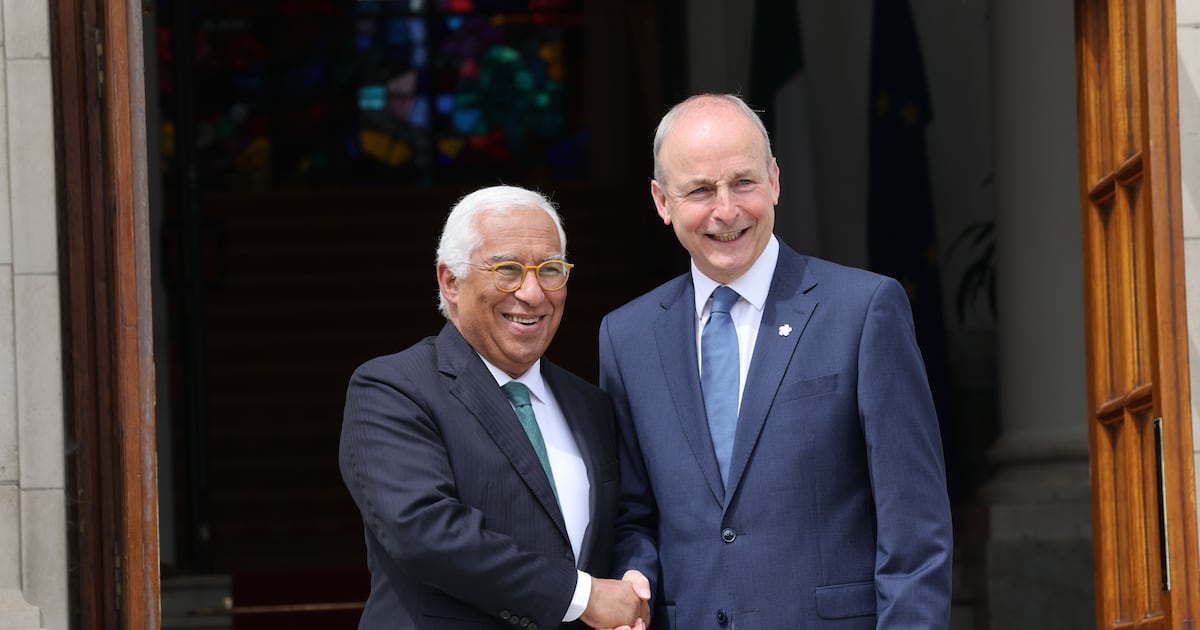
“Now that the starting whistle has blown, we are ready to give it our all,” Taoiseach Micheál Martin has said welcoming European Council president Antonio Costa to Government Buildings at the first official engagement of Ireland’s six month EU presidency.
Martin pledged to work to make Europe more secure and competitive, while promoting the EU’s values, enhancing its competitiveness and working to accelerate the enlargement of the union. He also said that Ireland would seek to conclude the EU’s next budget settlement by the end of the year.
Costa, the former prime minister of Portugal who heads the European Council, the group of heads of government which is the EU’s most important decision-making body, said Ireland was “the right presidency in the right time”.
In response to questions, Martin played down concerns that Ireland as a neutral country and one with “low defence spending” could promote the strengthening of the EU’s defence during its presidency.
He said countries on the EU’s “eastern flank … see an existential threat to their way of life, from the threatening behaviour of Russia, the invasion of Ukraine … which many people in this part of the world wouldn’t have that same experience. And it’s important that we communicate that to our own people, that is how Baltics and indeed Poland and others see this. So we’re very conscious of that.”
He said Ireland was “constructive at all times” on European security.
Costa said that, “Of course, Nato is the key element of European security and defence. But European security and defence goes beyond Nato.”
Both men pointed to the negotiation of the next EU budget as a key priority for the Irish presidency. While hopes are high the presidency can conclude an agreement on the next budget, Martin struck a cautious note, saying only that the Government would work “to advance negotiations on the next multiannual budget, ideally, to secure agreement by the end of the year”.
In his prepared remarks, Costa said: “I left what is, perhaps, our main common challenge to last – the next multiannual financial framework. We need to reach an agreement on our next long term budget by the end of this year. Not just any budget, but one that has the resources it needs to deliver on what our citizens expect from us.”