
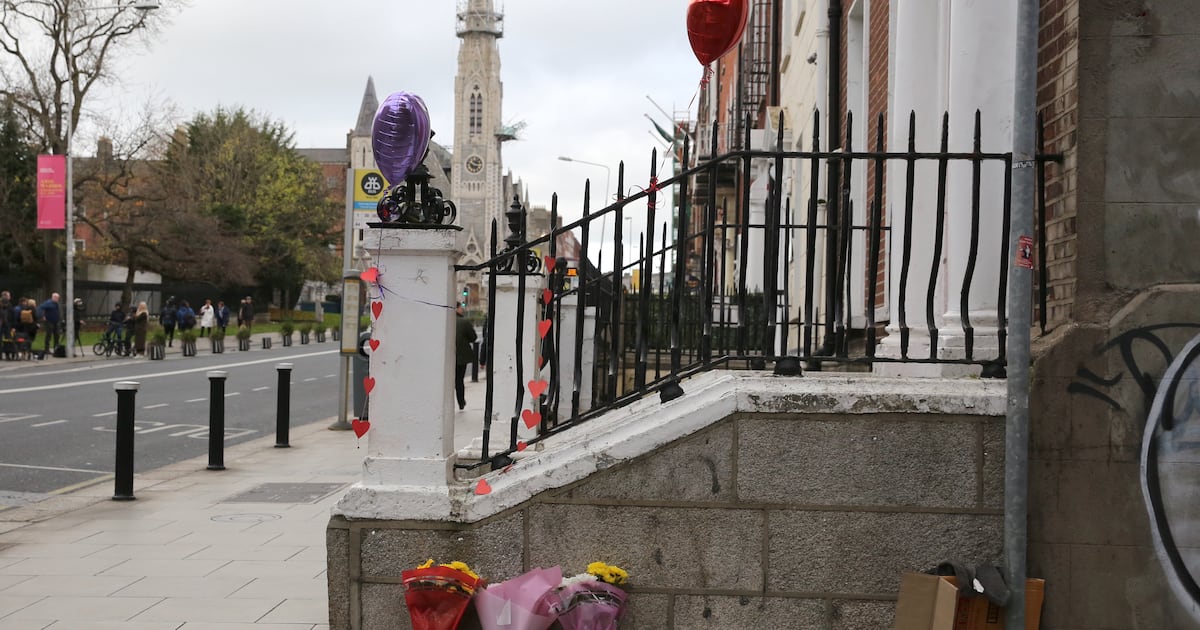
It took just five seconds for a large man with a carving knife to leave a bubbly five-year-old girl “clinically dead” at Parnell Square.
While feverish work by medics managed to avert her death, the girl, who went to school in pink runners on what should have been an ordinary November day, can no longer walk and her brain and other injuries are so severe that she will need 24-hour care for life.
This week, Riad Bouchaker (52), a native of Algeria of no fixed abode, was found guilty of attempted murder of the girl and two other children; assault causing serious harm to childcare worker Leanne Flynn, and assault causing harm to two other children and a trainee chef who intervened, at Parnell Square East on November 23rd, 2023.
He was also convicted of producing a knife capable of inflicting serious harm.
His attack came out of the blue that afternoon as about 13 children stood in a line outside their school, waiting to be taken to their nearby creche.
It was over within 15 seconds. In the first five seconds, Bouchaker lunged towards the children with a new 36cm Chef Aid carving knife and stabbed the five-year-old in the heart.
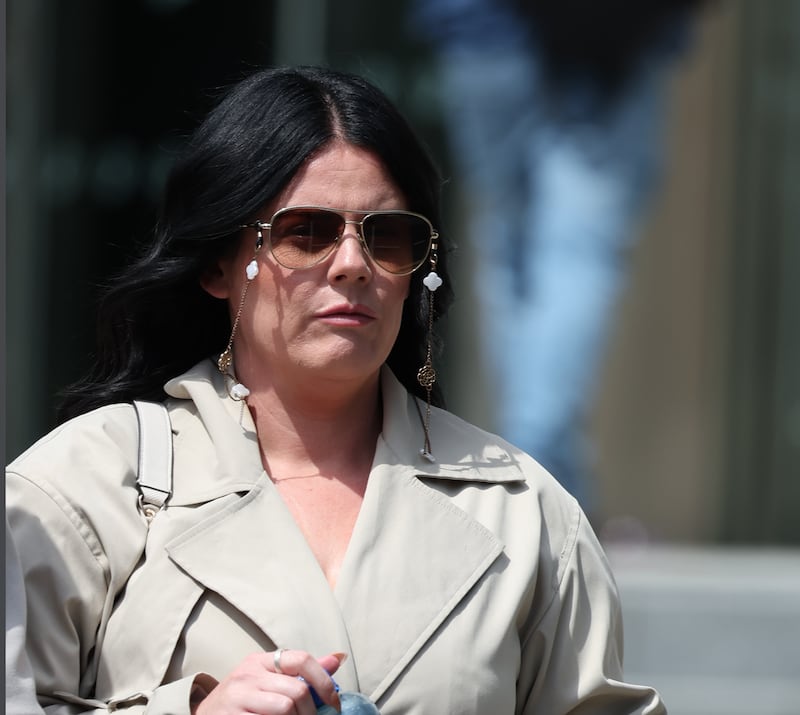 Leanne Flynn, the childcare worker stabbed by Riad Bouchaker. Photograph: Collins Courts
It took him another three seconds to stab childcare worker Leanne Flynn in the back when, showing immense courage, she tried to stop him after she saw him lunge forward suddenly and start “ferociously stabbing” the girl.
Having cast the seriously injured Flynn aside, she said Bouchaker turned back towards the children, “swinging the knife”.
Shouting, “Somebody help me, he has a knife!” Flynn urged the children to run and tried to pull some to safety even as she became lightheaded due to blood loss.
Amid chaos and confusion, and within what trial Judge Tony Hunt estimated as another seven seconds, Bouchaker was disarmed and brought to the ground by the combined brave actions of horrified passersby from Ireland, France and Brazil.
Trainee chef Alan Lorena Guille, then aged 17, wrenched the knife from Bouchaker’s hand. In his evidence, he was dismissive of minor scratches to his hand and face sustained during the encounter.
Delivery driver Caio Benicio hit Bouchaker on the head with his bike helmet while Warren Donohue, who had been celebrating his daughter’s 11th birthday in Burger King, punched him in the face and kicked him on the ground “to make sure he stayed down”.
Siobhán Kearney was about to go back into the nearby Rotunda Pillar Room for the inquest into the Stardust fire that had killed her brother Liam when she heard Flynn scream. She raced across the road and jumped on Bouchaker’s back.
Cyclist Oisín Murphy hit Bouchaker on the head with his bike lock. Eder Nascimento Dos Santos saw the knife on the ground and took it away to prevent other people from getting hurt.
While waiting for gardaí to arrive, Kearney, declaring “we’re not f***ing savages”, formed a protective cordon with another woman to prevent further injuries to Bouchaker as he lay on the ground. Her human decency was not replicated by those who rioted in Dublin later that evening, seeking, as defence counsel put it, to “turn us one against the other”.
The trial heard poignant evidence from the mother of the seriously injured girl. In a phone call at 1.45pm on November 23rd, a sobbing creche worker gave the woman the shocking news that her daughter had been stabbed.
The mother became tearful when telling of her race across the city to the scene to see emergency responders working on her daughter as she lay on the ground. Other parents spoke of panic and fear upon learning of the attack and rushing to their children.
Parnell Square’s central location and proximity to hospitals meant medics and other first responders were quickly on the scene and 16 eyewitnesses came forward.
Due to the speed at which the attack unfolded and concluded, the chaos surrounding it, and the recognised frailty and fallibility of human memory and the impact of witnessing traumatic scenes, it is unsurprising that the eyewitness accounts did not always tally with each other or with CCTV.
Some spoke of children being “swivelled around” by the attacker so their backpacks would not be an obstacle. Several denied suggestions their accounts may have been influenced by what they might have seen in media reports.
The CCTV was described by Hunt as an objective “yardstick” against which to assess the eyewitness evidence. He also considered that Flynn probably had the clearest view of the incident as it unfolded.
It was only towards the end of the prosecution case, during the seventh and final recorded Garda interview with Bouchaker on December 21st, 2023, carried out after he had spent three weeks in hospital, that the burning question was asked.
“Why? Why children?” asked Det Garda Gary Moran.
Bouchaker repeatedly said, via a French-Arabic interpreter, he was “sick”, often gesticulating towards his head and referring to pain in his shoulder.
When shown CCTV of the attack, he said: “Someone who is not in the right state of his mind and the families of the children when they see this, they are free to do what they want. I am sick, for 140 years, I did not have a cent, how am I supposed to live? I’m sick.”
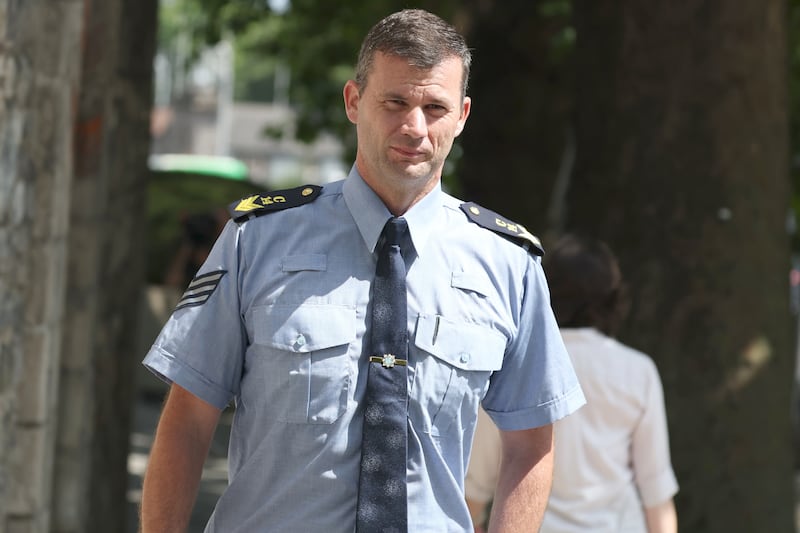 Garda Gary Moran, who gave evidence in the trial of 52-year-old Riad Bouchaker.
Photograph: Collins Courts
He insisted, several times, he had no intent to do harm and thanked God no one died. “Do to me whatever you want” was a frequent mantra.
The interviews showed incoherent answers and “gibberish” with “no guile or sophistication”, said his lawyer. They demonstrated Bouchaker failed to appreciate the enormity of his situation and the “violent disconnect” between the event and “trifling” difficulties in his life.
Moran had a different theory. He suggested to Bouchaker that he had his “full mind” with him and had waited for 37 minutes on Parnell Square and “weighed up your options”. Bouchaker, he suggested, intended to find the school, decided against attacking bigger children and waited until pedestrians moved farther up the street before putting down his backpack and moving quickly, knife in hand, towards the group of children.
Stop thanking God no one died, Moran told him. “Don’t thank God, thank Leanne, and you stabbed Leanne as well.”
In earlier interviews, it emerged Bouchaker’s brother had explained to him on November 23rd that a letter from the Department of Social Protection had required him to provide, by November 22nd, documents for his application for supplementary welfare allowance.
Bouchaker told gardaí the letter “made me go into blackout” and CCTV showed him ripping it up and dropping pieces of paper at the Ilac Centre Christmas tree.
He went back to his hostel on Little Britain Street and said he packed a suitcase with clothes and his Irish and Algerian passports, left that in a mosque on Talbot Street and went “wandering”.
Bouchaker went towards Parnell Square, where he previously stayed in emergency accommodation near the children’s school. He had a backpack in which gardaí later found packaging for a knife.
“All the damage was done in about 13 seconds,” the trial judge observed last Friday when refusing a defence application, heard in the absence of the jury, for a direction aimed at having the attempted murder charges relating to the two children with lesser injuries withdrawn.
The two were a boy aged five who had a laceration to his neck, treated with paper stitches, and whose jacket hood had three holes in it; and a six-year-old girl who was discharged a day after undergoing surgery to repair a non-penetrating laceration to her head and loss of a skull fragment.
During that application, when defence counsel said he faced a difficult task, the judge told him: “You’re a very capable lawyer, not a magician”.
In his ruling, Hunt said the jury was entitled to take “a broader view” in assessing whether Bouchaker’s actions amounted to an attempt to kill.
Hunt agreed with the prosecution that there was evidence from which the jury could infer intent to kill in relation to all three children.
He also rejected defence arguments of insufficient evidence to support verdicts of assault causing harm to two other children and to Guille. One child, a six-year-old girl, had a bump on her head, a nick behind her right ear, a clump of cut hair on her shoulder and had wet herself. The second, a five-year-old boy, was unaware he had a small cut near his nipple and a graze under his arm until his father, having noted minute slashes in his coat, removed it and all his upper clothing with similar slashes.
In his charge this week, the judge directed the jury that verdicts of attempted murder, intentionally or recklessly causing serious harm, and “theoretically”, not guilty, were options in relation to the seriously injured girl. Attempted murder, assault causing harm, and “theoretically”, not guilty were optional verdicts in relation to the two other children.
Before the trial, the judge heard conflicting psychiatric evidence about whether Bouchaker was fit to plead and stand trial. It was agreed that a defence of not guilty by reason of insanity was not available to him.
The defence psychiatrist said Bouchaker told her he was born in Algiers and gave confused accounts of his family and personal history. He spoke of memory issues from childhood, not doing well in school, financial difficulties at home, working as a butcher and selling women’s clothes at markets. He came to Ireland 25 years ago and is a naturalised Irish citizen. The defence psychiatrist considered he confabulated, filling in gaps in his memory rather than saying he did not know or was unsure.
Her view was that he lacked the capacity to understand the serious nature of the charges and was unfit to stand trial. She said he had moderate dementia due to a combination of a brain injury, sustained at Parnell Square, and a brain tumour. Surgical treatment was carried out for that benign tumour in 2021, he developed epilepsy, and his left temporal lobe was affected before the Parnell Square incident.
His brother had said the family were concerned about his mental health for about five years before the 2021 surgery.
Hunt preferred the evidence of an expert psychiatric witness for the prosecution that Bouchaker was fit to stand trial with accommodations, including an interpreter, an intermediary and simplified questions. That psychiatrist said Bouchaker had an acquired brain injury secondary to neurosurgery in 2021 and suffered a head injury at Parnell Square, but was fit to stand trial with accommodations.
During the fitness to plead hearing, Bouchaker sat in court muttering words including: “Is a shit country, no respect, nobody respect you”; “three years, no payment, nothing”; and “let me go home. Your future is shit for you”. At one point, he said: “Kill me.”
Bouchaker’s lawyer described his horrific actions at Parnell Square as “undeniably senseless”. They were life-altering, most grimly for the girl in the pink runners and for Leanne Flynn, whose heroic efforts to save children’s lives almost cost her own.
After almost three weeks, Bouchaker’s trial has ended. He will be sentenced on October 12th. There is still no answer to Det Garda Moran’s question: “Why? Why children?”