
The first and best way to lower emissions, cut energy bills, and build resilience is to make it so our buildings don’t need so much energy to stay warm or cool. Harold Orr, acclaimed energy engineer and inventor of the blower door test, believes the most high-impact work begins with simply fixing the air leaks in our homes — that is, preventing heated or cooled air from slipping through the gaps — and reducing the amount of heating and cooling our buildings need in the first place.
Prudence Ferreira, a building science expert, echoed this sentiment, telling Jacobin, “In many climates, air sealing and ERVs are two of the most impactful measures you can implement.” ERVs are short for “energy recovery ventilators,” a device that brings fresh air into buildings without losing temperatures inside — unlike opening a window. A Canadian engineer named Anthony Douglas calculated that in colder climates, installing ERVs delivers ten times the return on investment of an equivalent solar installation.
New window-unit ERVs are relatively low cost and take just minutes to install, making them accessible and affordable for homes and apartment units everywhere. Fixing air leaks, insulating roofs and basements, and installing ERVs are a way to significantly lower home emissions and energy bills without any electricity or critical minerals — by simply eliminating energy needs at the source.
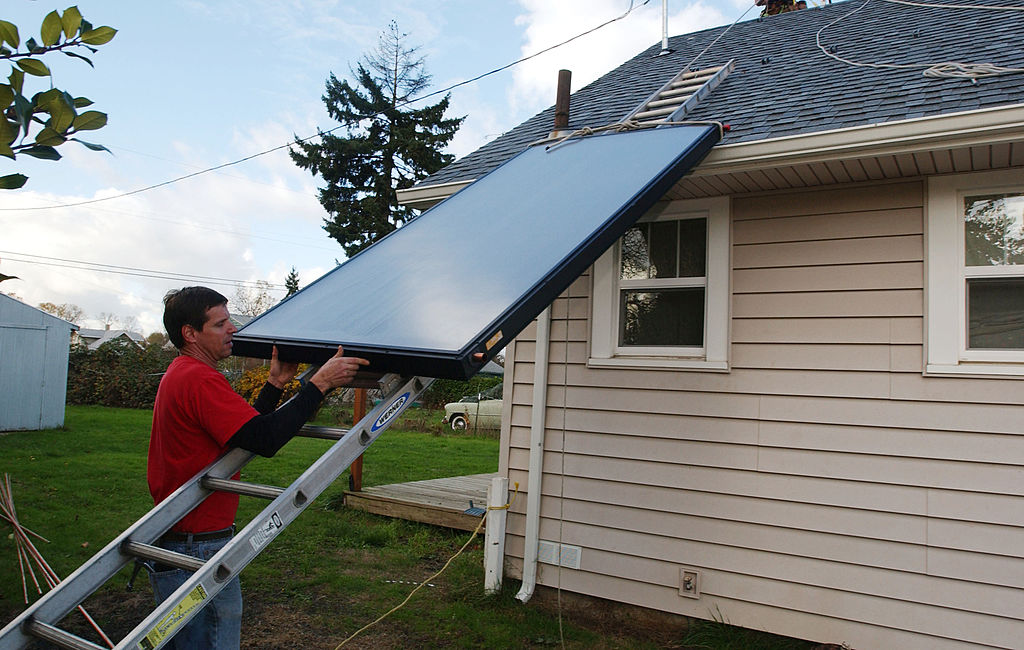
When it comes to the energy we do need, we can get that at the source as well. President Jimmy Carter put solar panels on the White House back in 1978. But these panels didn’t generate electricity — they made heat. The panels heated water behind glass and distributed it to kitchens and buildings around the White House complex, a technology known as solar thermal. With 70 percent of our home energy use for heating and hot water, solar thermal is a critical technology, and it’s already in use worldwide.
Solar water heaters used to be commonplace in America, only falling out of favor around 2010 as solar electric panels started getting significantly cheaper. But more recently, as utilities have begun facing higher costs due to increased electrification, and as states like California have ended net metering incentives, we’ve seen a renewed demand for solar heat that doesn’t depend on grid power or battery storage. Since 2009, every new home in Hawaii has been built with a solar water heater, eliminating pollution and reducing grid strain while ensuring the availability of hot water during outages.
Living Energy Farm, a sustainable technology research center in central Virginia, has heated multiple off-grid buildings with solar thermal — without electricity or gas — for over ten years. “There’s a lot of solar collection going on here, but the bulk of it is not actually creating electricity,” Debbie Piesen, cofounder of Living Energy Farm, told Jacobin. “It’s storing solar energy as heat.”
Arctica Solar, a California-based company, makes solar thermal products that enable you to harvest heat from your exterior walls. Originally designed to heat camps in Antarctica, Arctica’s “solar air heaters” simply draw cold air into a glass panel, use the sun’s heat to warm it, and send the heated air back into living spaces. Five of these panels, costing a total of $6,000, can provide 30,000 BTUs of heat per hour — almost the average amount of heat used by an American home. These solar thermal systems don’t depend on electricity, fuel, or hardly any moving parts. That means they take heat off your energy bill permanently, and ensure it’s always there.
In 2021, a winter storm swept across Texas, leaving 4.5 million homes and buildings without power and causing up to seven hundred deaths in the freezing temperatures. Solar thermal energy can prevent those disasters. One homeowner who installed Arctica’s panels in Billings, Montana, reported that when outside temperatures were 3 degrees Fahrenheit with eight inches of snow, Arctica’s panels kept indoor temperatures at 61 degrees Fahrenheit — higher than the average indoor temperature for Montana in that time of year.
Big picture, solar thermal has a number of benefits over electric-based heating. Solutions like Arctica’s solar air heaters are easy for general contractors to install. Perhaps more importantly, solar thermal is simple to produce. Unlike electric panels, which rely on complex circuitry and manufacturing, solar thermal primarily relies on glass and heat. Many people even make solar thermal panels themselves at home with off-the-shelf parts.
Solar thermal can be manufactured by any country, regardless of technological capacity. Many countries are already using it for heating and hot water needs.
In terms of global decarbonization and transitions away from fossil fuels, solar thermal can be manufactured by any country, regardless of technological capacity. Many countries are already using it for heating and hot water needs. EU energy policy officer Jamie Kern reported seeing solar water heaters throughout Morocco — even connected to temporary structures such as tents.
Scott Sklar, director of the George Washington Solar Institute at The George Washington University, believes America should scale up solar thermal again as well. “This solar thermal panel added $5.40 to my renovation mortgage per month and saved me back then $20 per month,” Sklar said, on a tour of his net-zero home in the suburbs of Washington, DC “It’s absolutely cost-effective.”
As for our remaining electrical needs, we can meet them at lower cost and with materials right from home, too. Unlike typical rooftop solar installations, plug-in solar panels — rapidly rising in popularity — don’t feed power into the grid (which requires batteries to store that electricity) or into home batteries. Instead, they send power directly into your home’s circuits. Your appliances draw power from plug-in panels when the sun is shining and fall back to the grid when sunlight at your home isn’t enough. This simple solution is the cheapest, fastest, and most resilient way to get electricity to our homes — especially with more outages ahead due to extreme weather, rising power demand, and the advent of data centers.