
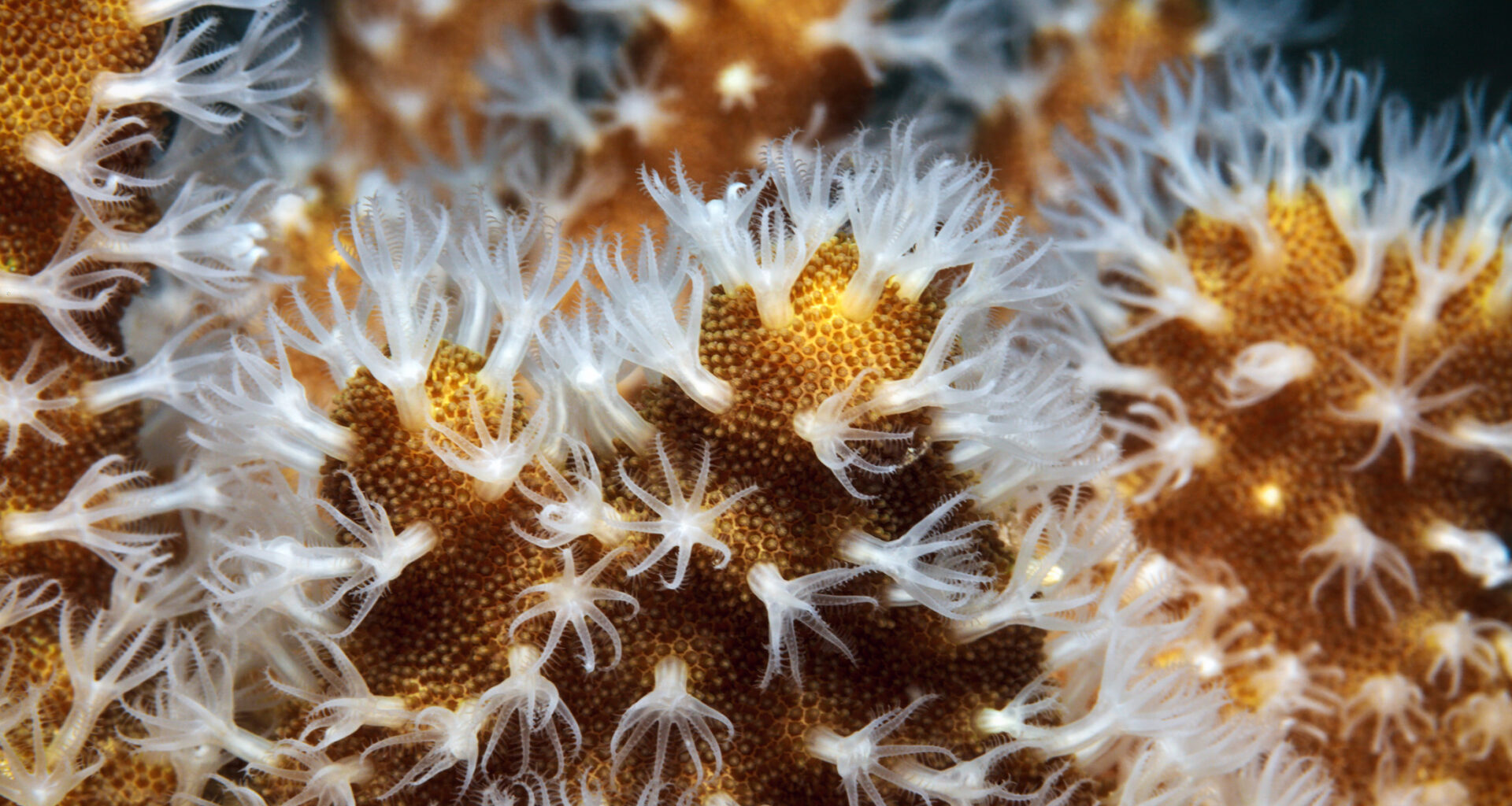
The algae that power the world’s coral reefs survive inside coral cells by hijacking the very compartment built to destroy invaders, a new study has found. Rather than being digested, the algae move into the cell’s disposal unit and turn it into a permanent home.
The finding rewrites a decades-old assumption about how corals and algae came to rely on each other. It suggests their partnership began less as a friendly merger and more as a hostile takeover, and it hands scientists a new molecular handle on coral bleaching, the breakdown now hollowing out reefs around the globe.
Inside the coral cell

Corals get most of their food from single-celled algae that live packed inside the coral’s own cells. Each alga sits in a pouch called the symbiosome, a membrane the animal builds around its tenant to hold it in place.
For years, biologists treated that pouch as a permanent fixture, in the same category as the mitochondria and chloroplasts that living cells absorbed eons ago. That view is now in doubt.
Phillip Cleves, an assistant professor of molecular and cell biology at the University of California, Berkeley (UC Berkeley), and his team now argue for a very different origin.
To find out what actually lines that pouch, first author Shumpei Maruyama, a postdoctoral researcher, and doctoral student Catherine Henderson worked out how to pull symbiosomes out of the sea anemone Aiptasia and identify their proteins. They catalogued roughly 200 proteins.
Most were not proteins dedicated to symbiosis. They were the ordinary equipment of the lysosome, the acidic compartment a cell uses to recycle and destroy material, including proteins that fuse membranes together and enzymes that shred what comes in.
Finding that machinery on the symbiosome was itself surprising. In a conversation with Earth.com, Cleves, who led the study, said, “The most surprising part of finding that the symbiosomes were lysosomal is that for decades, the field had hypothesized that symbiosomes were explicitly formed by preventing lysosomal fusion.”
A home in acid
Lysosomes are hostile places. They are highly acidic, near a pH of four, and brim with enzymes that break proteins, fats, and sugars into reusable scraps. The team watched these compartments fuse onto the symbiosome inside living anemone cells and confirmed the pouch itself is acidic.
By this account, the alga is not resting in a neutral bubble. It is living inside a working stomach and somehow avoiding digestion.
“The algae are hijacking the nutrient centers of the cells and acting like food that just never gets digested,” Cleves said.
The borrowed parts are not decorative. The researchers dialed down two lysosomal proteins on the symbiosome, including part of the acid pump. As a result, far fewer anemone larvae took in algae at all. Strip out the digestive hardware and the partnership fails to form.
Elsewhere in the animal kingdom, the same challenge has come up. Certain sea slugs steal chloroplasts from the algae they eat and keep them photosynthesizing for months inside a special pouch of their own.
A 2025 paper found those slugs manage the trick the opposite way, blocking lysosomes from fusing with the pouch so their stolen cargo stays intact.
Feeding the algae
Among the 200 proteins, one stood out. It explained how an alga trapped inside an animal cell gets enough carbon dioxide to carry out photosynthesis. The protein carries bicarbonate, a dissolved form of carbon, across the symbiosome membrane.
An earlier study had shown the pouch is acidic enough to turn bicarbonate into carbon dioxide, the raw material photosynthesis runs on. The researchers propose that the transporter delivers the carbon while the acid converts it into fuel the alga can use.
To test whether the transporter was doing real work, the team disabled its gene using the gene-editing tool CRISPR. In Aiptasia, the edited anemones developed patchy tentacles, with pale areas low in algae beside dark, densely colonized ones.
The pale patches carried far more mutations in the gene than the dark ones, which tied the missing transporter directly to the vanished algae.
The same edit in a reef-building coral, Galaxea fascicularis, produced the same collapse. The most heavily mutated corals ended up far paler than untreated ones.
The coral experiment did something no one had managed before. Speaking with Earth.com, Cleves said, “This is the first time we’ve been able to disrupt the function of a single gene to break symbiosis in a coral.”
An evolutionary shortcut
Corals and anemones evolved their algal partnerships independently, yet both rely on the same borrowed transporter. The same solution turned up twice.
That repetition suggests reusing lysosomal parts is an easy evolutionary road into symbiosis. It could explain why these dinoflagellate algae have paired up with hosts as different as jellyfish, giant clams, and flatworms.
“If evolving a new symbiosis is as simple as resisting lysosomal digestion, we should be able to have the algae persist inside lysosomes in other organisms,” Cleves said.
Much of that cellular machinery is shared across the animal kingdom, which would give the algae many possible doorways.
Clues to coral bleaching
The same protein catalog could reveal what goes wrong when reefs bleach. As ocean temperatures climb, corals cast out their algae and slowly starve.
A prior study from the group traced hundreds of genes that turn on within hours of heat stress. The team is now watching how that protein lineup changes under heat.
The researchers want to catch the moment the partnership breaks down.
When asked by Earth.com how the discovery could change efforts against bleaching, Cleves said, “Understanding that algae hijack the coral cell’s digestive machinery brings to light the idea that coral bleaching may occur when the algae fail to cloak themselves as a food particle that keeps on giving.”
The decades-old debate over the symbiosome’s true nature now has an answer. It is a repurposed digestive compartment, and a single borrowed transporter keeps the whole arrangement running.
Knowing which proteins hold the partnership together gives researchers concrete targets to watch as corals bleach and, perhaps in time, levers to help reefs keep their algae as the oceans warm.
The study is published in Cell.
—–
Like what you read? Subscribe to our newsletter for engaging articles, exclusive content, and the latest updates.
Check us out on EarthSnap, a free app brought to you by Eric Ralls and Earth.com.
—–