
46:18: Tony Carmody puts Clare six points ahead of Cork in the 2005 All-Ireland semi-final.
46:20: Gavin Lee puts Galway six points ahead of Cork in the 2026 All-Ireland semi-final.
Just two seconds difference on the clock leaving the Rebels in almost identically precarious positions, but the contrast in response couldn’t be more different.
Back in 2005, a Ben O’Connor-inspired Cork side said ‘no more’. That six-point deficit heading towards the final quarter ended up in a one-point win and Cork went on to claim a 30th All-Ireland title. With their season on the line, they out-scored their opponents 0-09 to 0-02 with O’Connor landing three late points and twin Jerry nabbing the winner.
On Saturday after Lee put the Tribe County six up, a Ben O’Connor-managed Cork found no such durability. They managed only four points from there, Galway tagging on 1-06 as the underdogs eased their way into a final meeting with Limerick.
By 19 July that final pairing will have lifted the Liam MacCarthy seven times since Seán Óg Ó hAilpín did in ‘05, the last Cork captain to do so.
O’Connor led that semi-final fightback in ‘05, he was player of the match in the final win over Galway too. His character unquestionable, his steeliness desirable.
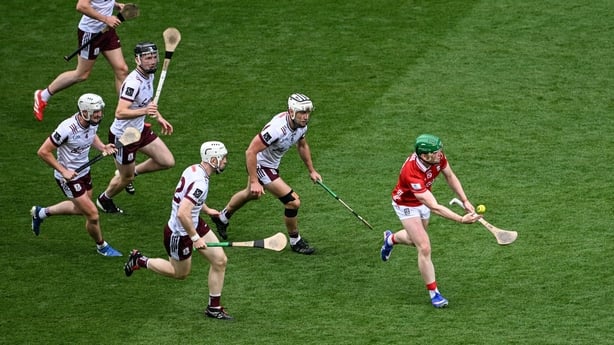
Cork players were swarmed constantly against Galway
That’s why his appointment as Cork manager last August felt like the perfect antidote to the ills of last year’s sensational second-half collapse to Tipperary in the All-Ireland final.
That it could happen again, so soon, and under O’Connor’s watch, feels unfathomable.
That it happened on their first return to Croke Park provides piercing ammunition to the critics.
Against Tipp, they lost the second half 3-14 to 0-02. At the weekend, they lost the second half 1-14 to 0-05. Not quite as bad in raw data, but equally as damaging in terms of impact.
Now the question is ‘why?’
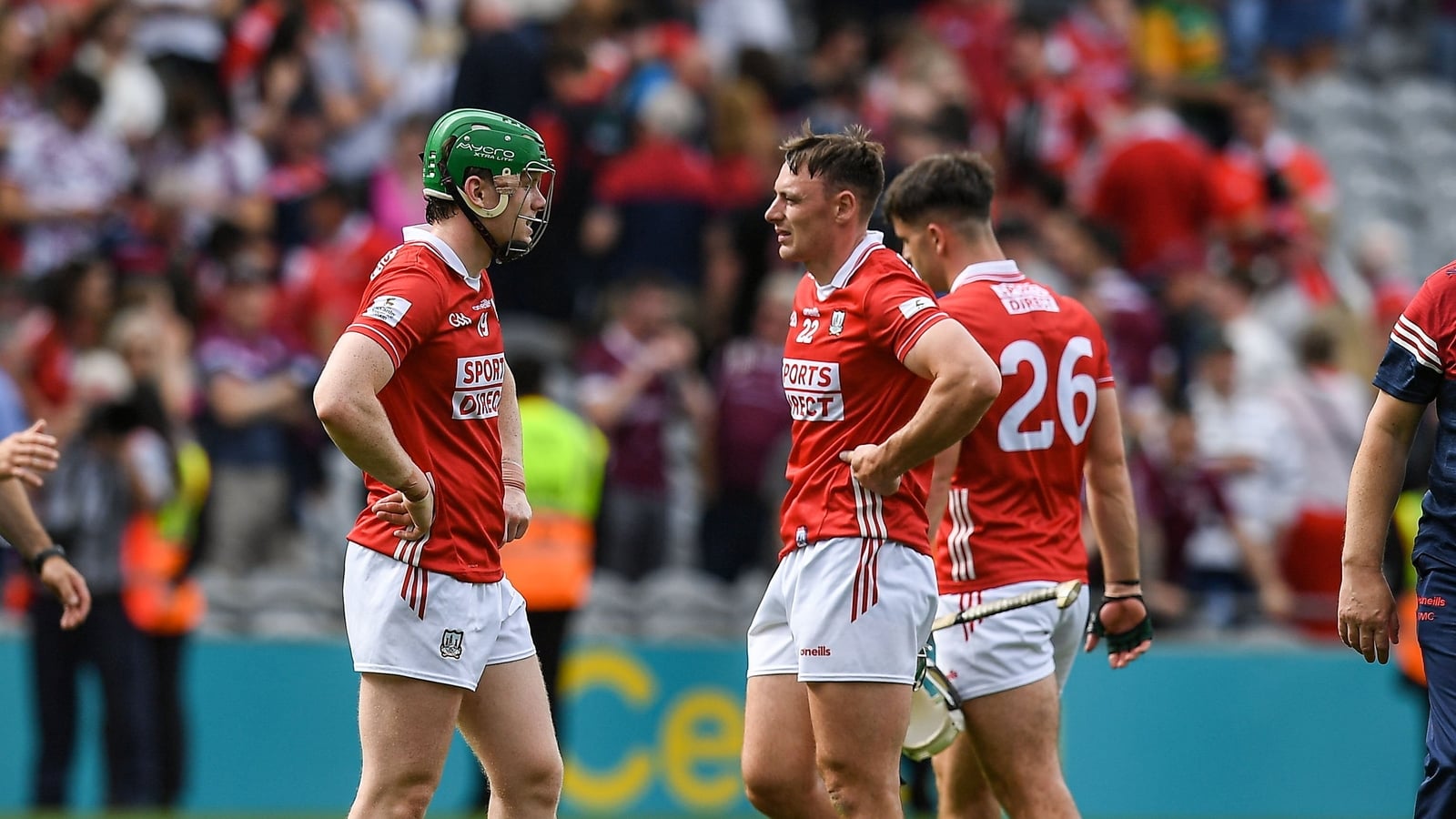
Darragh Fitzgibbon’s 55th-minute red card came at the first spark of second-half life, back-to-back points after 16 minutes without a score, but Cork had taken on serious water by that stage and it would be unfair to suggest that the tide was truly turning.
Galway were crunching the Cork puck-out, getting overloads around the breaks and suffocating space to cut off route to simple shots.
And overloads and shots is where O’Connor’s coaching team will probably land on when the dust has settled. Those two heavily connected areas are where they fell down spectacularly.
On the former, some may find it a criminal offence to borrow from soccer when discussing an All-Ireland hurling semi-final, but Jurgen Klopp’s Gengenpressing philosophy is something that can pollinate other sports.
While on the surface, its successful application at Liverpool and, firstly, Borussia Dortmund, looks like a simple energetic high press to win the ball back as quickly as possible, the depth of such a style is about much more than that.
It requires a shared mentality, incredible trust and concentration and no shortage of good decision-making. It is an emotional investment as much as a physical one, and Galway’s commitment to swarms and quick transitions left Cork floundering.
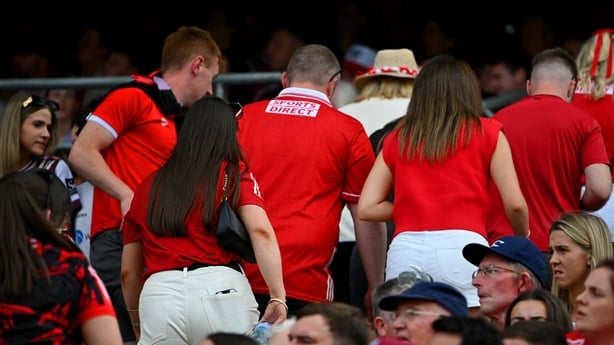
Many Rebel fans headed for the exits long before full-time
“We didn’t want them to get their heads up,” Galway’s Darren Morrissey said afterwards, in the most telling post-match quote of the lot when it comes to their defensive modus operandi.
Of Cork’s 13 points from play, seven were scored with only one Galway jersey in close proximity. Six of those seven, however, came from Brain Hayes who took a clearly unfit Daithí Burke to the cleaners, in what was the weak link in Galway’s defensive chain due to those fitness problems. Outside of that and a Fitzgibbon effort, they were clamped in white packs.
It was more Gengen-depressing for Cork, who were unable to match such intensity in the tackle, unable to get players to push and press in sync to cut out the gaps and create two-on-ones or three-on-ones in defensive situations.
Then to shots, or the lack thereof.
Cork famously only had 12 in the second half of last year’s All-Ireland final and a conversion rate of just over 16%.
On Saturday, they had 29 shots over the entire game. Even with a much healthier conversion rate of 66%, that’s startingly low. In their 14 games this season across league and championship, their average score count – let alone shot count – sits at just under 25 scores per game.
Not your usual handover but a handover nonetheless as Damian speaks to Cork Manager Ben O’Connor pic.twitter.com/zRYOVtcBcn
— The Sunday Game (@TheSundayGame) July 4, 2026
Away from the numbers game, Cork now have a long wait to prove to internal and external critics that more indeterminable factors have not seeped into the camp. The sort of manna for social media critics to latch on to [Cork restricted replies on their social media channels when posting the full-time result].
Such buzzwords as ‘bottle’ and ‘balls’ are cheap tat in this age of bait, but questions about the side’s character are now simply unavoidable.
On their last two visits to Croke Park the side have been presented with sink or swim situations and have attached cinder blocks to their boots. No league successes or Munster titles will atone for those, there’s only one place that can be achieved – and they’re a year away from even possibly having that opportunity.
“There’ll be a lot of fellas who’ll have all the answers,” O’Connor said after the game.
“We’ll get that. We’ll get a few letters during the week telling us where it all went wrong. A few phone calls, a few messages. We’ll take that and we’ll drive on.”
O’Connor is talking the talk after walking the walk. Just ask Tony Carmody and Clare 21 years ago.
Everyone expected Cork to have the answers this year to last year’s capitulation; they didn’t. A dark winter awaits to restart the search. For now, it can only be questions.