
How well do planetary surface image AI catalogs hold up to being scientifically-ready databases? This is what a recent study published in The Planetary Science Journal hopes to address as a team of scientists investigated the accuracy of AI planetary surface catalogs compared to human standards. This study has the potential to help scientists better understand the shortcomings of using AI for planetary science and the steps that can be taken to address them.
For the study, the researchers compared eight databases of lunar impact craters with those that were generated by AI. The primary motivation behind the study was to fill existing knowledge gaps regarding how AI can be used for planetary science, specifically regarding whether it can be used to speed up planetary science without sacrificing scientific data. Studying impact craters to ascertain a planetary surface’s age, a practice that is also called crater counting, has increased the use of computer-generated databases to speed up this traditionally manual, visual inspection practice.
In the end, the researchers found that almost all the AI-generated databases had worse data than previously reported when compared to traditional methods. However, the researchers emphasized that the purpose of this study was not to begin a debate about not using AI, just that certain precautions needed to be addressed going forward.
“A crater catalog is not just a random list of circles,” said Dr. Stuart J. Robbins, who is a research scientist at the Southwest Research Institute and lead author of the study. “If a crater is shifted, duplicated or improperly sized, that can affect the science that depends on those metrics. For instance, if a surface with a model age of 1 million years requires x number of craters and AI accidentally duplicates those craters, suddenly the model would double the surface’s projected age.”
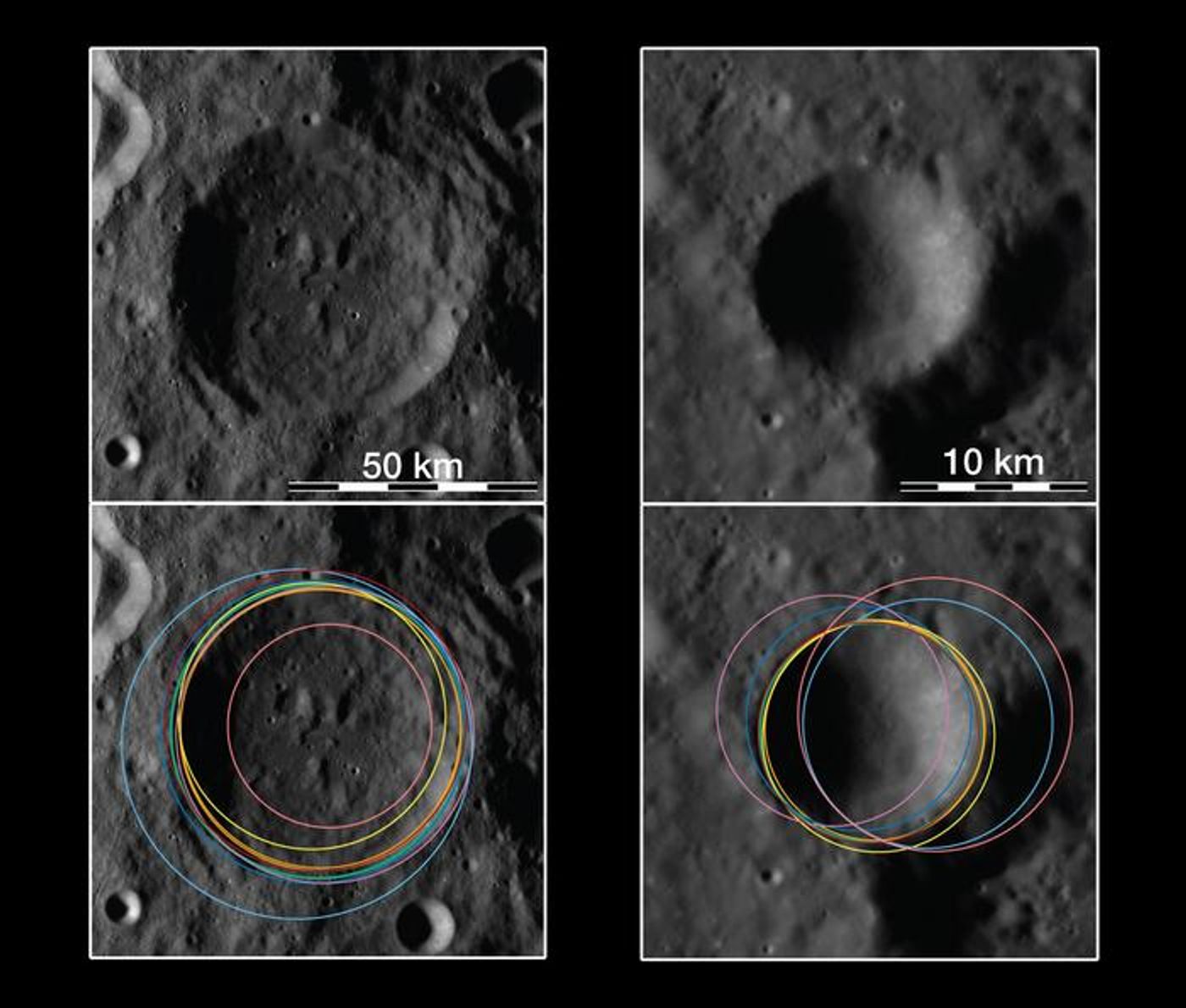
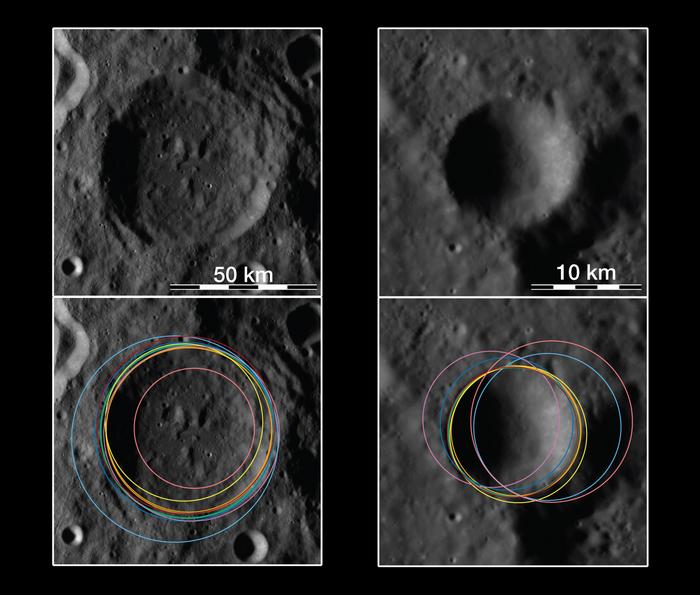
Image showing how different datasets compare to each other, including AI-derived datasets. The rings depict the inaccuracies between each dataset. (Credit: NASA/GSFC/Arizona State University/SwRI)
What new insights into AI and planetary images will researchers make in the coming years and decades? Only time will tell, and this is why we science!
As always, keep doing science & keep looking up!
Sources: The Planetary Science Journal, EurekAlert!