
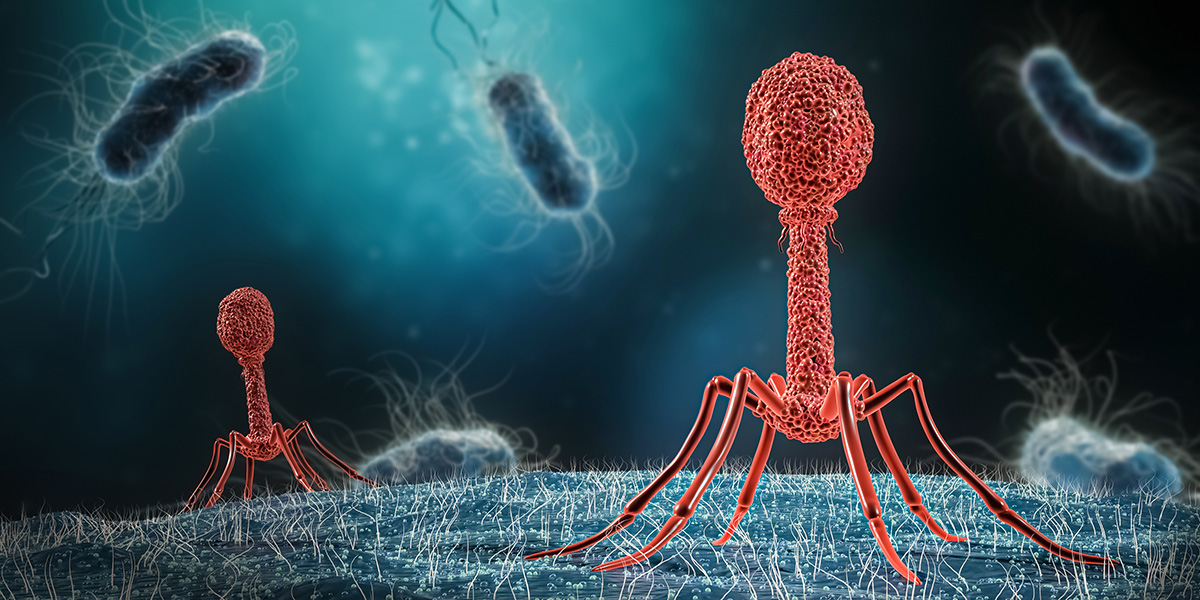
Bacteriophages, viruses that infect bacteria, coexist in an evolutionary arms race with their bacterial hosts on Earth. But what happens when that arms race moves into orbit?
In a recent study, researchers from the University of Wisconsin sent bacteria and phages to the International Space Station, or ISS, to test how microgravity reshapes host–pathogen interactions. The results suggest that space not only alters infection dynamics but also serves as an evolution accelerator, driving new mutations that could be harnessed to develop improved antibacterial therapies on Earth.
Sending experiments to space
Courtesy of Srivatsan Raman
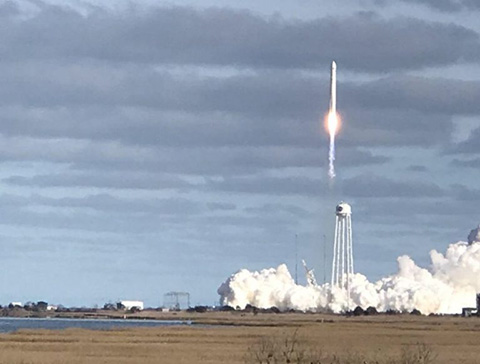
The resupply mission with the team’s research onboard after launch at NASA’s Wallops Flight Facility in Virginia in 2023.
Srivatsan Raman, an associate professor of biochemistry at UW and corresponding author on the article, studies phage–host interactions in the human microbiome and wanted to understand how microgravity might impact these interactions.
“The microbiome is linked to all kinds of human wellness conditions,” Raman said. “Understanding how it changes in space is critical for thinking about human health during long-term space travel.”
Raman’s team is also interested in engineering phages as treatments for bacterial infections and has hypothesized that microgravity could accelerate phage evolution in ways with translational potential.
“We wanted to know what mutations the bacteria and phages acquire under microgravity conditions, and what these mutations mean in terms of how these might be able to infect bacteria on Earth,” Raman said.
Working with a company specializing in space research, Raman’s team proposed to the Department of Defense to study interactions between phage T7 and its host, E. coli, and was selected. Phage T7 and E. coli are both easy to work with and well-characterized, making the pair a good model to study virus-host interactions.
They then worked with NASA to design experiments that astronauts could perform within ISS constraints, including limited equipment, space and crew time.
Raman said extensive preparation was required on Earth. They developed a compact experimental system, essentially a small, enclosed unit, to meet biosafety requirements. They conducted control experiments to ensure feasibility and data quality.
In the end, there were approximately 30 cryovials spanning a range of experimental conditions, controls and biological replicates. The experiment was designed to be simple for astronauts. All samples were prepared and frozen on Earth, and astronauts would only have to thaw them, incubate them for designated time periods, then refreeze them.
Approximately eight months later, the experiment was launched to the ISS. They were onboard a Northrop Grumman Cygnus resupply mission. Raman and his students traveled to NASA’s Wallops Flight Facility in Virginia to watch the launch.
“What struck me most was the realization that the experiments would soon be taking place in an environment that very few scientists have ever had access to,” Raman said. “It felt remarkable to know that a project that started in our lab would be contributing, in a small way, to advancing our understanding of how life behaves in space and expanding the frontiers of human knowledge.”
How microgravity reshapes infection

Courtesy of Srivatsan Raman
Associate Professor Srivatsan Raman with lab members Phil Huss, a graduate student, and Chutikarn Chitboonthavisuk, a postdoctoral scholar, wait to watch their science experience launched into space outside NASA’s Wallops Flight Facility in Virginia in 2023.
On Earth, phages and bacteria encounter each other partly through fluid mixing. In microgravity, that mixing is reduced.
“Because the churn in the system is different, we thought the infection dynamics may be different,” Raman said.
The team expected infection to take longer in space but did not know to what extent. On Earth, the infection cycle takes about 20 minutes. In space, samples were incubated for short periods of 1, 2 and 4 hours or one long period of 23 days. Samples at each time point were frozen and brought back to Earth for phage and bacterial counting in Raman’s lab. They found that the infection cycle was significantly delayed, occurring after the four-hour time point.
Using whole-genome sequencing, the team also observed that both bacteria and phages accumulated new mutations in space.
“Microgravity acts as a stressor,” Raman said. “Bacteria and phages adapt by picking up mutations that help them handle these stresses better.”
Most phage mutations occurred in structural genes, which may affect the virus’s ability to infect hosts. These mutations may expand host range or improve binding, key properties for phage therapy.
In bacteria, the team found mutations in genes related to outer membrane structure, stress response and nutrient management. These mutations may improve bacterial fitness by reducing susceptibility to phage infection.
Once the samples returned to Earth, the team also tested some of the space-evolved phages against pathogenic strains of E. coli that cause urinary tract infections and are normally resistant to T7 phage infection. The results were surprising: space-evolved T7 phages could kill pathogenic E. coli.
“I thought this was remarkable,” Raman said. “There’s a big push toward developing alternative treatments for bacterial diseases, including phage therapies. It was interesting to see that the phages might pick up mutations in space that make them more effective at killing pathogens on Earth.”
Raman said the findings are preliminary but lay the groundwork for future research. Understanding how microgravity alters microbial interactions could help scientists better predict how the human microbiome responds during extended space missions. At the same time, space-driven evolution may uncover viral mutations that expand host range or enhance the ability of phages to target hard-to-treat bacterial pathogens on Earth.