
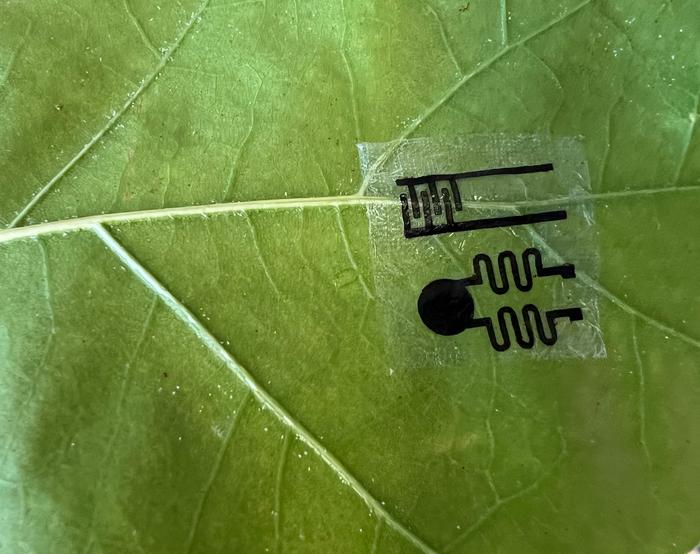
What new methods can be used for plants to monitor their health? This is what a recent study published in ACS Applied Materials & Interfaces hopes to address as a team of researchers investigated using “wearable” technology for plants to monitor their health. This study has the potential to develop new technologies to monitor plant health like humans wearing smartwatches for their own health.
For the study, the researchers introduced tiny tattoo-like sensors that can be attached to leaf surfaces and monitor health metrics, specifically leaf subsurface temperature and humidity. The primary motivation behind the study was to develop new methods for crop monitoring technology, as existing technologies involve satellites, drones, and ground stations, but lack the ability to provide immediate feedback on plant health. As a result, planet damage is only identified when it’s too late. In the end, the researchers for this study found that not only did the wearable sensor successfully remain attached to the leaf without harming it, but it successfully tracked health metrics for a period of 20 days.
“The larger promise is not merely that one plant can wear one sensor,” said Dr. Sameer Sonkusale, who is a professor of electrical and computer engineering at Tufts University and a co-author on the study. “It is that fields could one day contain networks of plant-level monitors, each reporting early signs of thirst, salt stress, disease or nutrient imbalance. Satellites and drones already give farmers a bird’s-eye view. Plant wearables could provide something more intimate: the plant’s-eye view.”
This study comes as climate change continues to ravage the planet, bringing more extreme weather events that could harm plants. Therefore, studies like this demonstrate how new technologies could help monitor plant health before the environmental damage becomes too severe.
How will this new wearable technology help monitor plant health in the coming years and decades? Only time will tell, and this is why we science!
As always, keep doing science & keep looking up!
Sources: ACS Applied Materials & Interfaces, EurekAlert!
Featured Image Credit: Nafize Hossain