
In the cold, wet days of early January, we decided the family holiday this summer would be in the south of France.
June seemed like a good month to go, as temperatures in the area where we were staying, Montauroux, near Nice, averaged 26C. Note: we were not expecting a heatwave.
We had never ‘taken the car to France’ but with a dog and two teenagers, this year we would give it a go.
We realised that our 14-year-old Qashqai with broken air conditioning was probably not the best vehicle to drive through France, so we traded in for a fully electric second-hand Volkswagen ID4 with a range of approximately 450-500 kilometres.
In advance of the trip, we researched charging EVs in France. The prevailing advice was that you would probably get by using two well-known charging apps – Ionity and Total Energies. This, however, proved not to be as straightforward as billed.
Charging Network – France
The journey from Cherbourg to Montauroux is 1,250km, a gruelling estimated 12 hours of straight driving, so we decided to break up the journey by staying overnight along the way.
We would have to stop to charge every 300 to 350km anyway, and the onset of range anxiety saw us decide in advance not to let the battery fall below any less than 100km.
Mercifully, as it turned out, we did not need to worry about charging.
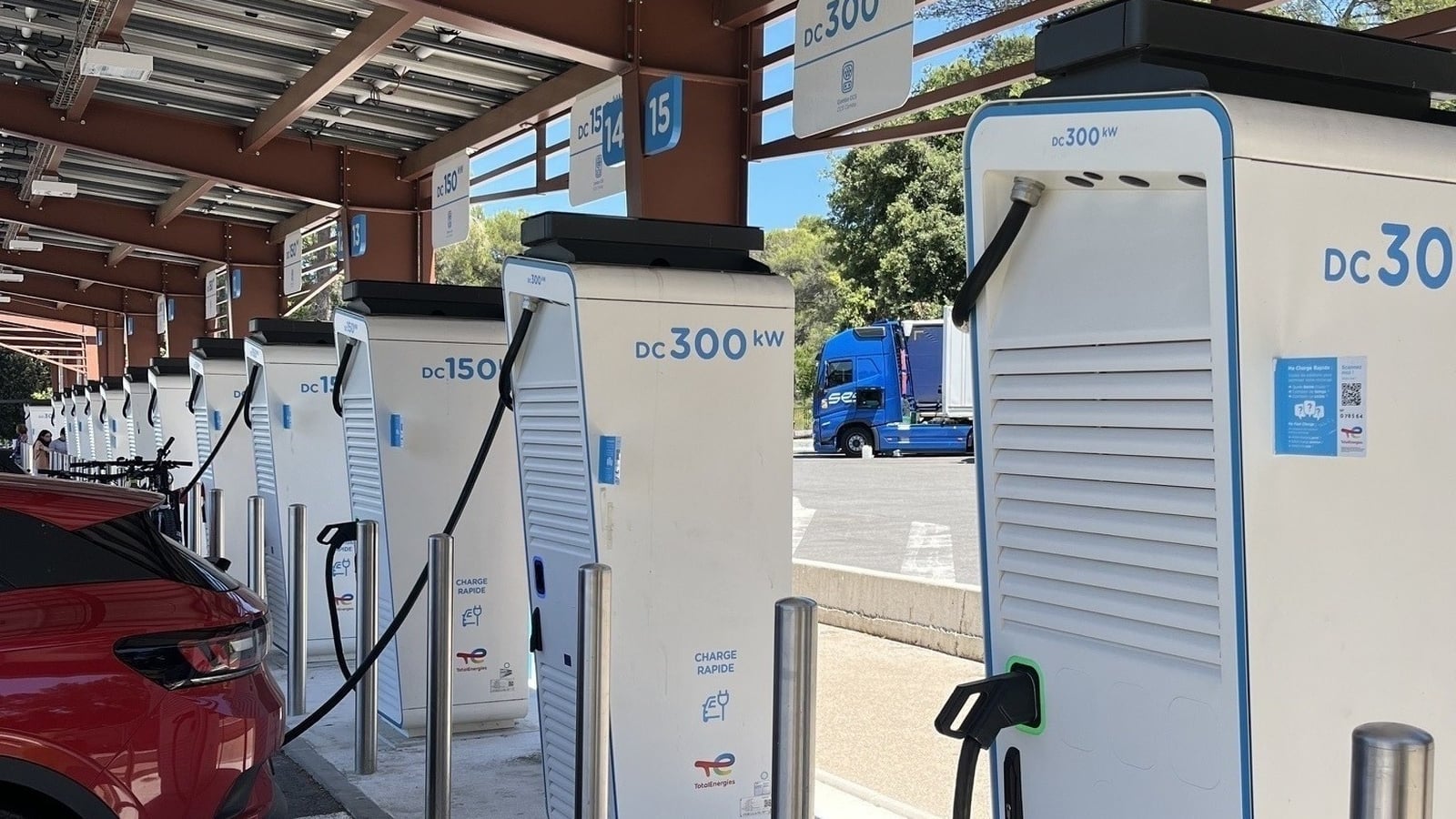
That is because the French charging network is excellent and there is generally a large EV charging station every 75km to 100km along the motorways to the south.
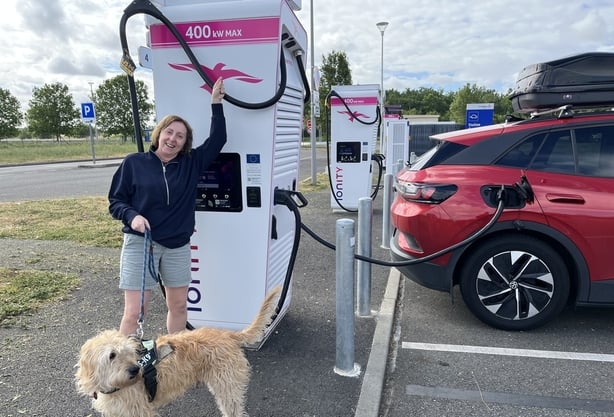
Elayne Devlin with the family dog while they recharged the car
These welcome stop-offs are well marked on the route, and we didn’t have to queue for a charger at any point.
With most points equipped with powerful 400kWh, chargers, the car would be good to go in around 30 to 40 minutes. This obviously adds to the journey time.
Large supermarkets also have chargers, although these tend to be smaller [50 kWz], but some went up to 150 kWz.
Charging costs
Perhaps the most frustrating aspect of charging the car was the need to have several different apps. We used six apps (see below).
Some offered better rates if you subscribed to the app, which you can cancel later.
They all require your home address/bank details, which speeds up payment if you set them up in advance.
We found Ionity (who are also in Ireland) were the cheapest with a monthly subscription of €5.99 and charged 0.44 euro per kWz on average, but most other companies were charging between 50 cent and 58 cent per kHz for high-speed chargers.

The family had no option but to leave the air con on in the car all the time to keep them, and the dog, cool
For comparison, this is cheaper than Ireland. The ESB recently announced price increases – slow chargers pay as you go to 64-66 cents and the faster chargers to 73 cent per kWh.
At one point, we plugged the car in and it failed to charge, we were unable to disconnect the cable, we rang the helpline on the charging station and within minutes, someone answered.
They located us through the charger and were able to disconnect the car remotely.
There was one area where there seemed to be less chargers and that was the roads around Cherbourg itself.
Admittedly, there were supermarket chargers but the bigger, faster chargers were on the motorways and larger national roads.
Heatwave and hills
So, what are the drawbacks? As EV drivers know, driving at around 100km per hour is better on motorways as it uses less power, but obviously your journey takes longer.
In addition, hills are not your friend as more power is needed to climb, so in the middle of France, you have to charge up more.
The other challenge was the return journey, we had planned to leave two days to drive back but with the heatwave raging in France and the highest red alert in the centre and northwest where we were driving, we left a day early to allow extra time for any issues.
Average temperatures on our drive back were between a sweltering 38 to 42C, leaving no option but to leave the air con on in the car all the time to keep us, and the dog, cool. This inevitably placed a further drain on the battery and, yes, more charging.
The other unexpected issue driving in a heatwave is the drain on battery power – not the car but actually your mobile phone.
We found our phones lost power more quickly in high temperatures at the same time as you need the apps on the phone to charge the car.
We therefore spent some time fretting over mobile phone battery power as well as our vehicles.
Tolls
In advance, we were warned about the cost of tolls in France, they are eye-watering. There is no discount for driving an EV, so whether you drive a petrol, diesel or EV car, tolls apply.
Cost
So, what did all cost to drive an EV to the South of France?
Return journey Cherbourg to Montauroux – charging costs: €269
[For comparison, a fuel cost calculator estimates petrol would cost €308]
Return journey for Tolls: €257
In conclusion, while we had a lovely holiday and it was certainly very doable to drive an EV in France, we will try and avoid driving through a heatwave in the future.
Apps used:
Ionity
Total Energies
Zunder