
NASA Picks 37 Companies to Provide Power on the Moon
NASA Pursues Advanced Nuclear Thermal Propulsion For Faster Rockets
GridMarket and Deployable Energy Partner to Power Data Centers
Rockwell Automation Selected by Aalo Atomics for Reactor Control Systems
CEZ and Rolls-Royce SMR Sign Temelín SMR Agreement
India Opens RFP to Build Four 700 MW PHWRs
Bangladesh Bets on SMRs for Future Nuclear Power
Rosatom Budget Cuts Curb Central Asia Nuclear Project Plans
NASA Picks 37 Companies to Provide Power on the Moon
 Image: U.S. Department of Energy
(Tech Times) NASA has selected 37 American companies for its 2025 Announcement of Collaboration Opportunity (ACO) program to help build the technology required for a permanent human presence on the Moon.
Rather than issuing traditional cash grants, NASA’s “in-kind” partnership model trades access to world-class government facilities, specialized software, and expert engineers in exchange for corporate matching funds. Under this setup, NASA provides approximately $30 million in testing and technical resources, while the selected companies contribute $32 million of their own capital.
This collaborative arrangement helps bridge the gap between initial commercial design and flight-ready space technology. NASA’s ultimate goal is to equip upcoming Artemis missions, including the first planned crewed landing target in early 2028, with reliable tools capable of enduring the harsh lunar environment.
Overcoming Key Engineering Challenges
The program focuses on solving immediate, practical hurdles associated with operating on the Moon. The lunar surface presents extreme operational hazards, particularly near the lunar south pole where NASA plans to establish its base.
Surviving the Lunar Night: A single night on the Moon lasts two Earth weeks, with temperatures dropping to -246C in shadowed craters. In deep craters near the Moon’s poles, permanent shadows keep the surface even colder — NASA’s Lunar Reconnaissance Orbiter has measured temperatures lower than -410°F (-246°C).
Because standard solar-powered landers and rovers freeze and die without sunlight, Zeno Power is developing a nuclear battery. The system uses a high-efficiency Stirling engine to convert heat from decaying radioisotopes (americium-241) into continuous electricity, allowing hardware to operate in total darkness for years.
Wireless Power Distribution: Running physical copper cables across the abrasive, crater-scarred lunar dust is impractical. To solve this, Lockheed Martin is building a power-beaming system that converts electricity into optical laser beams. These lasers transfer power line-of-sight from solar panels on sunlit crater rims to specialized receivers inside dark craters miles away.
Next-Generation Reusable Rockets: Stoke Space is collaborating with NASA to test an actively cooled metallic heat shield for its reusable Nova rocket. By circulating liquid hydrogen fuel through the heat shield during atmospheric reentry, the design protects the vehicle without requiring heavy, single-use ceramic tiles—drastically lowering the cost of resupply missions.
Dust Protection and Orbital Maintenance: Lunar dust consists of sharp, electrostatically charged particles that foul mechanical joints and solar panels. Moonprint Solutions is designing flexible protective covers to seal moving robotic parts. Meanwhile, Kall Morris Inc. is advancing targeted adhesive docking tools that allow service spacecraft to capture and repair satellites without needing pre-installed handles.
Building a Long-Term Pipeline
The ACO program serves as a proven stepping stone for aerospace startups and defense contractors alike. Previous participants, including SpaceX, Blue Origin, and Intuitive Machine, utilized NASA testing facilities under early ACO agreements to refine landers and fuel-transfer methods before securing multi-billion-dollar flights.
& & &
NASA Pursues Advanced Nuclear Thermal Propulsion For Faster Rockets
Planned systems could be capable of dramatically reducing travel times and expanding range of missions
(NucNet) The University of Alabama in Huntsville (UAH) has signed a partnership agreement with NASA’s Marshall Space Flight Center (MSFC) to further research into nuclear thermal propulsion (NTP) that could expand the capabilities of space travel. Earlier this year, NASA announced plans for a series of initiatives including launching a nuclear-powered spacecraft to Mars by the end of 2028.
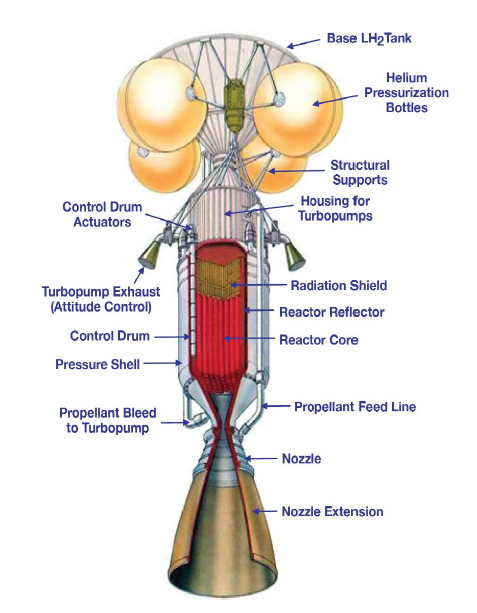 Image: NASA
Dr. Dale Thomas, deputy director of the UAH Propulsion Research Center, said that work done in previous decades gave “the designs and a treasure trove of ground-test data. We’re not starting from zero.”
Aiming For Mars And Beyond
Thomas said that the use of NTP systems could help reduce missions to Mars from six months to two to three months, which would make an enormous difference to crew safety.
“With advanced nuclear propulsion, we’re looking at (science) mission profiles that could reach Jupiter in about five years, Saturn in six, Uranus in eight and Neptune in nine. Those missions suddenly move from the ‘can’t do’ category into the realm of possibility.”
The university said it was also looking into digital engineering efforts using digital twins to help NASA evaluate propulsion systems before any hardware was built.
“The real bottleneck for nuclear thermal propulsion is ground testing infrastructure. Modern nuclear thermal testing would require exhaust capture and specialised facilities.”
He said advances could be made quickly, and that if the testing infrastructure was in place, that an engine could be ready within a year.
Looking forward, Thomas said the UAH is leading in the development of the centrifugal nuclear thermal rocket, or CNTR, a “revolutionary” propulsion concept. Unlike traditional solid-core nuclear thermal engines, CNTR uses molten uranium contained within a rapidly spinning centrifuge, allowing hydrogen propellant to bubble directly through the liquid fuel and absorb extreme heat before being expelled as thrust.
& & &
GridMarket and Deployable Energy Partner to Power Data Centers
The partnership includes a committed pilot project and commercial deployments with priority access to future capacity for GridMarket’s pipeline of C&I, data center and hyperscaler customers
GridMarket, a leading energy and infrastructure project facilitator, announced a strategic partnership with Deployable Energy, a microreactor developer whose Unity Nuclear Battery achieved criticality in June. The agreement represents an estimated lifetime energy contract value of approximately $145 billion over a 40-year operational horizon, underpinned by over 3 GW of cumulative clean nuclear deployments through 2035 across GridMarket’s hyperscaler, industrial, and commercial customer base.
Through the partnership, GridMarket will leverage its existing funnel of qualified customers and deployment-ready sites to support the commercialization of Deployable Energy’s Unity Nuclear Battery. The companies will work together to advance customer engagements, develop an initial pilot installation, and expand commercial deployment opportunities as the technology progresses toward market availability.
As artificial intelligence, cloud computing, and advanced manufacturing drive unprecedented demand for electricity, access to firm, scalable power has become one of the most significant challenges for infrastructure development. Through this collaboration, GridMarket will connect development-ready customers with Deployable’s emerging nuclear technology. Deployable Energy expects to provide priority access to Unity Nuclear Battery deployments, helping position GridMarket customers among the earliest commercial adopters of the technology. The partnership is targeting 500MW of capacity each year starting in 2030 through 2035.
Deployable Energy is developing compact, deployable nuclear power systems designed to provide resilient, zero-emission electricity for critical infrastructure applications. Unlike the power and cooling systems running today’s data centers, the Unity Nuclear Battery delivers electricity, heat, and cooling in a single system – dramatically reducing the water intensity that has strained local communities hosting large-scale compute infrastructure.
The companies expect to announce additional details regarding pilot host selection, customer engagements, and broader commercial opportunities as Deployable advances its development program and the parties progress toward initial Unity Nuclear Battery deployments.
& & &
Rockwell Automation Selected by Aalo Atomics for Reactor Control Systems
Rockwell Automation, Inc. (NYSE:ROK), announced Aalo Atomics,has selected Rockwell as the control platform provider for its Aalo-X test reactor.
The collaboration supports Aalo’s participation in the U.S. Department of Energy Reactor Pilot Program, an initiative to accelerate the development, authorization and validation of advanced nuclear technologies. Aalo reached criticality on its pilot reactor two weeks ago, ahead of its July 4th, 2026, deadline, marking a significant milestone for next-generation nuclear deployment in the United States.
Rockwell Automation provides integrated control and information solutions, including its ControlLogix platform, to support reactor operations, system reliability and accelerated development timelines. The platform is designed to deliver safe, scalable control for a first-of-its-kind reactor system across the full lifecycle, from design to operation.
Aalo’s Aalo-X test reactor serves as a testbed for rapid innovation in modular reactor technology, allowing real-world validation of system performance and operational readiness. Through the DOE pilot program, Aalo has demonstrated a streamlined pathway to advance next-generation nuclear capabilities in a live environment.
The project positions Rockwell as a key enabler of emerging nuclear technologies and reinforces its role in supporting energy transition efforts through advanced automation and digital solutions. The companies will continue to collaborate as the program advances, with the Aalo-X test reactor serving as a foundation for future commercial deployments
& & &
CEZ and Rolls-Royce SMR Sign Temelín SMR Agreement
(WNN) The Czech Republic’s CEZ and UK-based Rolls-Royce SMR have signed an Early Works Agreement to start site-specific work for potential small modular reactors (SMRs) at the Temelin nuclear power plant.
Rolls-Royce SMR was selected as technology partner by CEZ last year for the proposed installation of up to 3 GW of capacity from small modular reactors (SMRs). It also acquired a 20% equity stake in Rolls-Royce SMR.
The aim is to build the first SMR in the Czech Republic near the existing Temelin nuclear power plant in the mid-2030s. There are also plans being developed for their deployment at the location of current coal-fired power plants.
The early works will include regulatory approvals and licensing, an environmental impact assessment and preparatory site work, as well as detailed planning and regulatory engagement.
The Rolls-Royce SMR is a 470 MWe design based on a small pressurized water reactor. It will provide consistent baseload generation for at least 60 years. 90% of the SMR – measuring about 16 meters by 4 meters – will be built in factory conditions, limiting on-site activity primarily to assembly of pre-fabricated, pre-tested, modules which significantly reduces project risk and has the potential to drastically shorten build schedules.
Earlier this week the Czech and UK prime ministers signed a memorandum of cooperation on nuclear energy which included expanding business and industrial collaboration between the two countries.
& & &
India Opens RFP to Build Four 700 MW PHWRs
(WNN) Anushakti Vidhyut Nigam Limited – the joint venture between Nuclear Power Corporation of India Ltd and National Thermal Power Corporation – will soon launch a tender for the nuclear island EPC package for units 1 to 4 of the Mahi Banswara Rajasthan Atomic Nuclear Power Project
This is the largest Nuclear Island EPC package ever floated for India’s indigenous Pressurized Heavy Water Reactor (PHWR) program. The comprehensive package covers engineering, manufacturing, supply, civil construction, installation, testing and commissioning assistance of critical nuclear island systems for four PHWR units of 700 MWe capacity each.
Anushakti Vidhyut Nigam Ltd (Ashvini) is a joint venture between NPCIL (51%) and National Thermal Power Corporation (NTPC) (49%) formed in 2024 to construct, own and operate nuclear power plants in India. The Mahi Banswara project, in the Banswara district of Rajasthan, is the first project to be implemented through the joint venture model. Excavation work for the first two Indian-designed 700 MWe PHWRs at the site began in late March this year.
The project is part of India’s fleet mode initiative to build ten identical 700 MWe reactors at various locations across India under uniform design and procurement plans, an approach the Indian government says will bring in cost efficiencies and speed deployment, while consolidating operational expertise.
The other reactors that make up the ten planned units are Kaiga units 5 and 6 (in Karnataka), Gorakhpur units 3 and 4 (Haryana), and Chutka units 1 and 2 (Madhyar Pradesh). Two 700 MWe PHWR units at Kakrapar, in Gujurat, are already in commercial operation. Rajasthan units 7 and 8 are currently in the commissioning process.
& & &
Bangladesh to Bet on SMRs for Future Nuclear Power
(Wire services) Bangladesh partnered with the Russian state-owned company Rosatom to build the Rooppur nuclear power plant. It consists of two 1,200 MW VVER reactors. Expected to be completed by 2028, the plant will eventually supply up to 15% of Bangladesh’s electricity, with the first reactor expected to be fully operational by 2027. Rosatom will supply the nuclear fuel for the plants and will take back all spent fuel once it has cooled off to be shipped in dry casks.
However, this ambitious infrastructure project carries a steep price tag of approximately $12.65 billion. The financial burden has become increasingly problematic because the value of the Bangladeshi currency has dropped significantly since the project was initially approved a decade ago. The project is being financed mainly through a Russian export credit amounting to $11.38 billion. The loan will be paid off over 20 years in equal installments.
While the plant’s operators argue that low long-term operational costs will ultimately justify the massive initial expense, the financial strain has prompted a change in strategy. Bangladeshi officials have indicated they will not pursue further large-scale nuclear plants after Rooppur. Instead, the nation plans to pivot toward small modular reactors (SMRs), which promise lower costs and faster construction timelines. The government did not specify a timeline for consideration of SMRs.
Ultimately, Bangladesh is serving as a critical test case for the developing world. As the Rooppur plant prepares to connect its first reactor to the grid, other emerging economies are watching closely to see if Bangladesh will successfully reap the rewards of clean energy or serve as a cautionary tale.
& & &
Rosatom Budget Cuts Curb Central Asia Nuclear Project Plans
Budget cuts call projects in Kazakhstan, Uzbekistan into question.
(Eurasisnet) Kazakhstan and Uzbekistan may have to rethink their plans to develop nuclear energy. Rosatom, the Russian nuclear entity that has agreements to build nuclear plants in both Central Asian nations, is experiencing major financial difficulties.
Alexei Likhachev, Rosatom’s CEO, announced the entity is cutting its investment program by nearly 50 percent this year due to “poor economic conditions.” Likhachev also said Rosatom would strive to slash operating costs by 10 percent within the next 18 months.
“We immediately abandoned a number of projects or shifted the deadlines for their implementation to a later date, guided by several criteria, the main of which is efficiency in the horizon until 2030, that is, more profit and revenue per ruble of investment,” Likhachev was quoted as saying by the Reuters news agency. World Nuclear News also reported budget cutting for Rosatom export-related projects while the state-owned enterprise is continuing investment in new domestic nuclear reactors.
Rosatom did not comment on the reason for the budget cuts, but Russian government finances have reportedly taken a hit from western sanctions that forced Russia to sell its oil & gas, the primary source of funds for the government, at steep discounts. The cost of the ongoing war in Ukraine has also reportedly diverted governmemnt export funding to military spending.
Likhachev did not specify which projects are being slashed or delayed. Kazakhstan awarded Rosatom a contract in 2025 to build the Central Asian state’s first nuclear power plant on the shores of Lake Balkhash. Since then, the project has been hit by delays in obtaining financing. Likhachev’s announcement increase concerns that the project can meet a tentative completion deadline in the mid-2030s.
Rosatom also has a preliminary agreement in place to build small-scale nuclear plants in Uzbekistan. Company officials in early 2026. This project has not moved beyond the planning stage.
Both Kazakhstan and Uzbekistan have alternatives to Rosatom. Astana already has an agreement in place for a Chinese company to build two nuclear plants in the country. And both Kazakhstan and Uzbekistan have expressed interest in working with the United States to develop small modular nuclear plants.
Discover more from Neutron Bytes
Subscribe to get the latest posts sent to your email.