
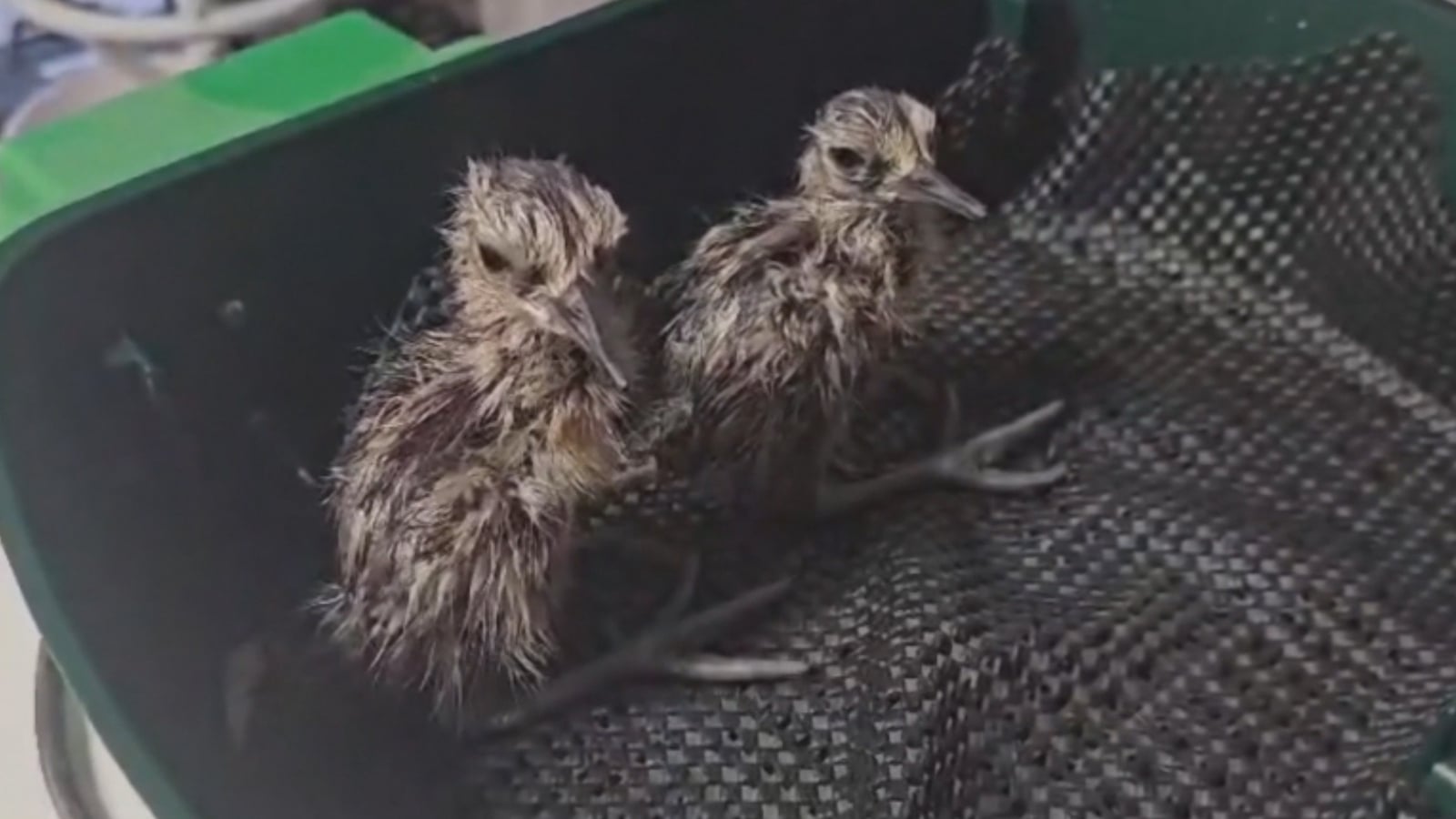
Four endangered curlew chicks have been released into the wild after their eggs were rescued from a wildfire on Slieve Beagh in Co Fermanagh.
The eggs were saved on 30 April after a wildfire broke out on the mountain, one of the few remaining breeding areas for the critically endangered bird on the island of Ireland.
At its height, 85 firefighters were involved in tackling the blaze, which spread across the breeding territory of a well-established curlew pair.
Slieve Beagh straddles counties Fermanagh, Tyrone and Monaghan, where a cross-border conservation project protects breeding pairs that remain.
While the curlew’s call was once synonymous with the landscape, population numbers have declined by 97% since the 1980s, leaving the species on the brink.
Dónal Beagan, Headstarting and Nest Protection Manager with the Breeding Waders EIP project, was in Dublin when he received a message about the wildfire in the Slieve Beagh area last April.
Mr Beagan contacted local Royal Society for the Protection of Birds (RSPB) Conservation Advisor Róisín Normanly, who was nearby at the time.
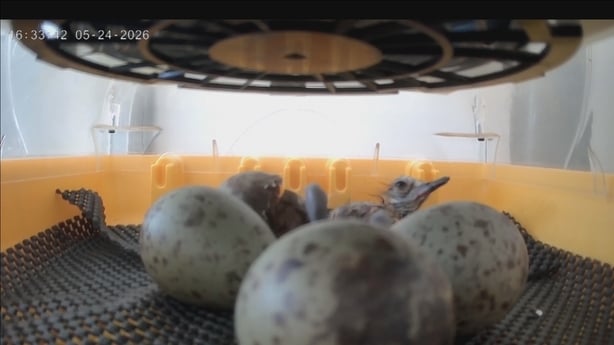
Th curlew eggs were placed in an incubator to regulate temperature and humidity
‘A daunting prospect’
Ms Normanly said they found the curlew’s nest the previous morning and had fenced it for protection from predators. It was the first nest found in that area this year.
“There was a plume of smoke rising. My heart was sinking as I drove towards it because I could see it was that bog. I could see our little fence and the fire moving towards it,” she said.
“These birds are one of the highest conservation concerns in Northern Ireland. There are about 150 pairs. Each one is vital and important. To lose one, we had just found and we’re doing our best to protect was a daunting prospect.
“We got emergency permission from the Northern Ireland Environment Agency to lift the eggs, if needed. They [firefighters] were on the other side of the bog and came around when they heard about the curlew.
“While the firefighters were putting out the fire, the parents were circling overhead, fending off crows and whatever else, but it was still ongoing three hours afterward,” she said.
Ms Normanly said they had to make the decision to lift the eggs, given the time they were without incubation and the level of destruction and disturbance caused by the fire.
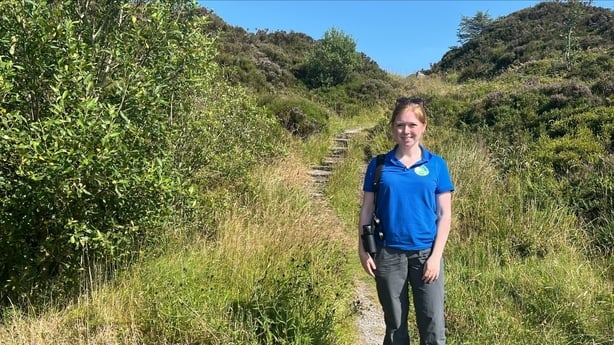
RSPB Conservation Advisor Róisín Normanly
Assisted by Vincent Campbell from the Sliabh Beagh Curlew Conservation Trust, Ms Normanly collected the eggs and packed them carefully into a lunchbox.
The eggs were transported to an incubation facility, where they were held in a small incubator.
“We were able to save the curlew in this case, but there were other meadow pipits and skylarks nesting on that bog that we couldn’t save,” she said.
Approximately 50 days from hatch to release
Mr Beagan, who is also a member of the Slieve Beagh Conservation Trust, works in hatching and rearing curlews in captivity, a process that takes about 50 days after eggs hatch.
Mr Beagan said the incubator, which regulates temperature and humidity, turned the eggs automatically when needed.
“On a daily basis, you’re weighing eggs throughout the incubation period. They’re turned automatically in the incubator. When it’s time for hatching, it’s a matter of recalibrating settings and increasing the humidity to allow for a successful hatch.
“We put them under a brooding lamp for the first couple of hours, and then they start to fluff up, move around and feed.
“They feed themselves, which is the beauty of trying to rear a curlew. After two weeks, they are not reliant on heat. They’re hardened enough to stay outside all night,” Mr Beagan said.
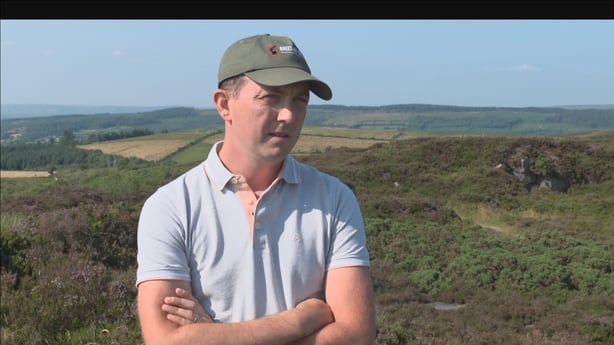
Headstarting and Nest Protection Manager Dónal Beagan
A delicate process
The newborn chicks were placed in a brooding tub to replicate an adult curlew’s brooding patch. After a week, they were moved into a small outdoor aviary.
After a fortnight in the small outdoor aviary, the chicks were moved to a larger enclosed aviary on Slieve Beagh before release.
Curlew chicks cannot fly for around six weeks, leaving them vulnerable to predators. Their behaviour was monitored until they were capable of controlled flights.
“We’re looking for controlled flights and manoeuvres around in the pen. You’re looking at 50 days of rearing before that can happen,” Mr Beagan said.
He said they were delighted they could release the chicks into the wild after the fire. Prior to release, they were fitted with GPS tags and coloured identification rings.
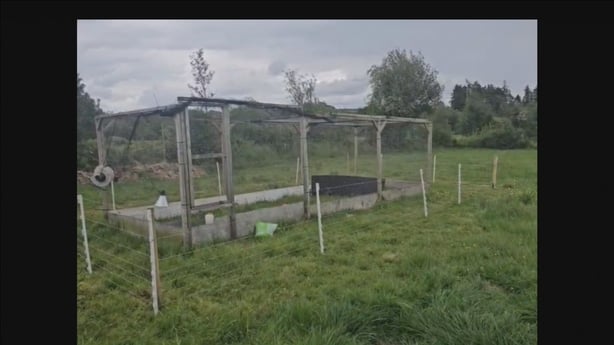
The curlew chicks were placed in an outdoor aviary
“It was a rescue operation. We’re just lucky that we have the people involved. We’re delighted to release them into the wild. Hopefully some good will come from it,” he said.
Mr Beagan said such cross-border collaborations are important in areas like Sliabh Beagh as he thanked Breeding Wader EIP for providing equipment, resources and technical advice on the hatching and rearing of the chicks.
‘A silver lining’
Dr John Cusack of the Conservation Trust said the release of the four fledglings went “fantastically well”, with one bird flying away and the others walking off “nonchalantly” into the surrounding habitat.
He described it as “a bit of a silver lining,” adding that its “nice to salvage something when we could have lost everything”.
The curlew population has declined sharply since the 1980s. Conservationists estimate there are fewer than 100 breeding pairs in the Republic of Ireland and around 150 pairs in Northern Ireland.
The decline has been linked to changes in land use, habitat loss, and predation pressures. On Slieve Beagh, about six breeding pairs remain.
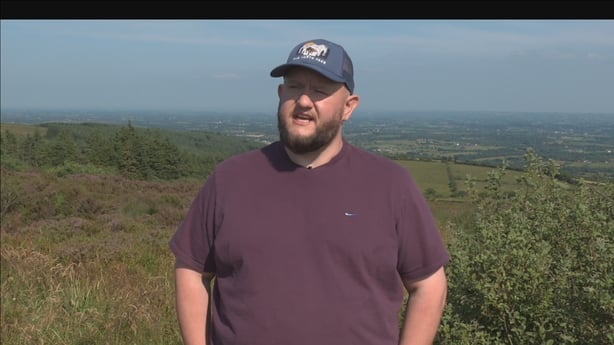
Dr John Cusack of the Conservation Trust
Uplands like ‘tinderboxes’
Dr Cusack said wildfires in upland areas are a major threat to ground-nesting birds and other wildlife and urged the public to be cautious.
“Uplands at present are tinderboxes and when a fire goes through these places, there’s absolutely nothing left,” he said.
“With the low numbers of curlew that we have now, every pair, every chick and every egg matters.”
Ms Normanly said the curlew nest had been saved, but other birds nesting on the bog could not be protected from the fire.
“We were able to save the curlew in this case, but there were other meadow pipits and skylarks nesting on that bog that we couldn’t save.
“These bog fires can wipe out breeding birds if they happen at the wrong time of year. It takes quite a long time for those habitats to recover,” she concluded.
Slieve Beagh pioneering conservation measures
In recent years, conservation measures have been introduced through the Breeding Waders European Innovation Partnership – a project funded by the National Parks and Wildlife Service and the Department of Agriculture, Food and the Marine.
Earlier this year, what is believed to be Ireland’s first known case of a headstarted curlew returning to establish a breeding territory was recorded on Slieve Beagh.
One of the breeding pair had coloured rings which identified it as a curlew released two years ago less than 50km away in Co Leitrim.
Headstarting is recognised as an emergency measure to support the endangered species, where curlew eggs are taken from the wild, and reared in a safe environment until the fledglings are ready to be released into the wild.
As with many wading birds, curlews nest on the ground, leaving eggs and young chicks vulnerable to predators.
Dr Cusack noted that the Trust, a voluntary organisation, hopes to address some of the challenges caused by the risk of high predation on Slieve Beagh in the time ahead.