
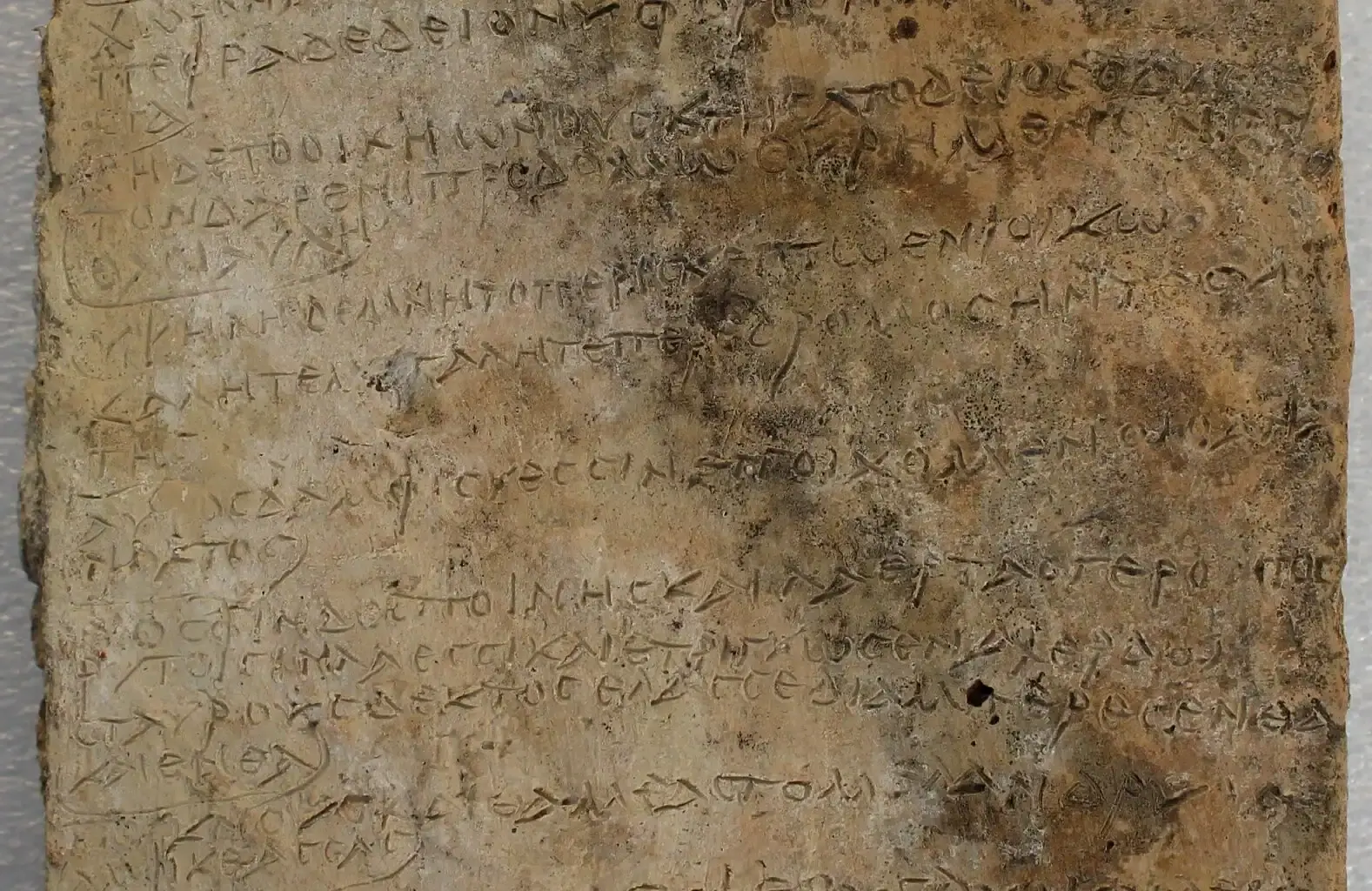
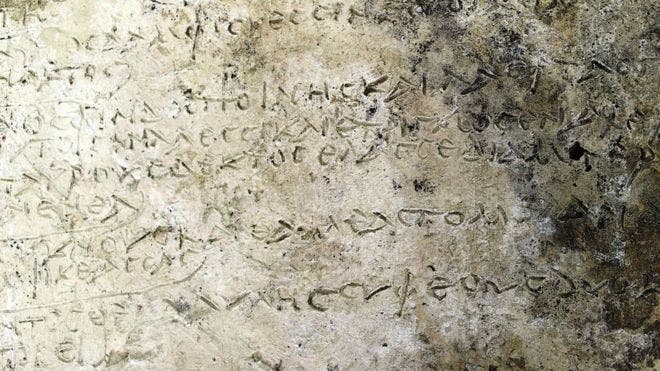
 Picture released by the Greek Culture Ministry depicting 13 verses from the Odyssey.
Nearly 1,800 years ago, someone in the Olympia region picked up a stylus and began scratching poetry into a still-unfired wall brick.
The writer chose 13 lines from Book 14 of Homer’s Odyssey. By that point, the epic was already roughly nine centuries old. Homer’s poems had become pillars of education and culture across the Greek-speaking Roman world, yet this passage was not copied into an expensive book. It was carved into ordinary construction material.
The inscription is not the oldest surviving copy of the epic, but it is the earliest known record of these particular verses. It also shows how deeply Homer’s poetry had entered daily life, far beyond libraries, schools and expensive manuscripts.
An unexpected find
Legend has it that after the fall of Troy, the Greek hero and king of Ithaca Odysseus (known as Ulysses in Roman mythology) wandered for 10 years as he tried to return home and reclaim his throne.
The Odyssey, named after the hero, tells this extraordinary story, intertwining myth, adventure and echoes of the ancient Mediterranean world. Christopher Nolan’s 2026 movie is just the latest retelling of this story, which has been told in various forms for dozens of centuries.
Scholars believe Homer, the author traditionally associated with both the Odyssey and the Iliad, developed these works sometime around the late eighth or early seventh century BC. The stories were likely shaped through a long oral tradition before being written down, although researchers still debate when this happened and whether the poems were primarily the work of one poet or several generations of performers.
However, this recently studied inscription wasn’t part of that early transition from oral poetry to writing. It was created roughly 800 to 1,000 years later, when Homer’s works were already central to education and culture across the Greek and Roman worlds.
A window into the past
 Picture released by the Greek Culture Ministry.
Researchers initially announced the discovery in 2018, before the object had been thoroughly dated and studied. A full scholarly analysis published in 2022 concluded that the inscription was made no earlier than the middle of the second century CE, most probably during the late second or early third century CE.
×
Thank you! One more thing…
Please check your inbox and confirm your subscription.
The 13 verses were scratched into a Roman wall brick before it was fired. Archaeologists found the brick in the Roman necropolis of Frangonissi, around 1.9 kilometres east of the sanctuary at Ancient Olympia in the Peloponnese. It had been reused as construction material in a tomb and still carried traces of plaster.
The brick preserves the opening 13 lines of the Odyssey’s 14th book. Rather than a dialogue between Odysseus and Eumaeus, the passage describes Odysseus approaching the home of Eumaeus, the loyal swineherd who continued to serve him during his long absence. It also describes the pens Eumaeus had constructed for the animals under his care.
Early reports described the object as potentially the oldest written record of Homer’s work ever discovered in Greece. That claim has since been narrowed. Much older fragments and quotations from Homer survive elsewhere, so the brick is not the oldest known copy of the Odyssey.
It is, however, the earliest surviving witness to these particular 13 verses. Researchers also describe it as one of the longest continuous passages from Homer known from an ancient inscription and a rare example found on the Greek mainland. Many early copies of Homer survive on papyrus from Egypt, where the dry climate preserved fragile writing materials far more effectively.
Homer was already very popular
The inscription also contains ten differences from the text found in standard modern editions of the Odyssey. Five are mostly spelling variations, while the others involve missing, altered or misplaced words. Researchers found no evidence that the brick preserves a lost version of the poem. Instead, the differences were probably mistakes made while copying or recalling the lines.
But there is one curious finding.
The person who wrote the inscription appears to have known Homer reasonably well. He wasn’t a professional scribe. The verses may have been written from memory in or near the workshop where the brick was produced. Its original purpose remains unclear: it could have been a writing exercise, a personal display of literary knowledge or something created for a context that has since been lost.
That shows that Homer’s poetry circulated outside formal manuscripts and libraries. Someone in Roman Greece knew these lines well enough to scratch them into an ordinary building material, preserving a small trace of how ancient people read, memorized and repeated the Odyssey.
Homer remains one of the most intriguing authors in history, so much so that many historians even question wether he was a single person. The ancient Greeks held that Homer was a blind poet from Chios or Smyrna, but there’s no way to be absolutely certain of this. Both of his two monumental works have been preserved orally throughout several centuries, so it’s very likely that the works we know today were quite different from the originals — and there were several “Homers” over the years, as each storyteller forgot, added, and improved upon the original work (a universal occurence in oral tradition).
Modern scholars generally agree that the epics emerged from a sophisticated oral tradition in which poets composed and performed stories using inherited phrases, themes and narrative structures. The surviving poems may therefore reflect both the work of an exceptional poet and the accumulated influence of generations of performers.
The Odyssey spans some 12,000 lines and is considered to be one of the most influential works of literature in the Western World. It was written in Homeric, or Epic Greek — a mixture of several dialects from different centuries. You can read a free English translation here.
After conservation and further study, the inscribed brick was placed on display at the Archaeological Museum of Olympia in 2022.
This article was originally published in 2018 and has been edited with subsequent information.