

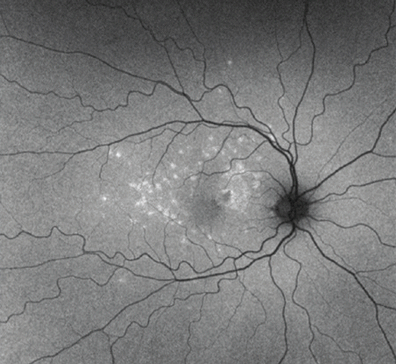
Greater recognition of the psychological burden of uveitis is recommended, as it can help doctors initiate counseling and other interventions in a timely manner. Photo: Rami Aboumourad, OD. Click image to enlarge.
It’s been shown that patients with uveitis are at a higher risk of depression and anxiety. In a recent study, researchers provided an overview regarding the association between uveitis and psychiatric comorbidities and found an increased prevalence of anxiety and depression in these patients, especially Black individuals. The findings were reported in American Journal of Ophthalmology.
Researchers used the “All of Us” database to compare 3,266 uveitis patients against 9,798 matched controls, adjusting for demographics and systemic comorbidities.
Uveitis patients demonstrated a statistically significantly higher frequency of various psychiatric conditions compared to controls, including mood disorders, depressive disorders, anxiety, personality disorders, insomnia, substance/opioid abuse, schizophrenia and bipolar disorder.
Black participants with uveitis exhibited a higher frequency of depression, anxiety, substance abuse and opioid abuse compared to white participants with uveitis. “This highlights epidemiologic as well as racial discrepancies within the healthcare field suggesting that Black patients may face a greater burden and worse outcomes from mental illness,” the authors wrote in their paper. The US Department of Health and Human Services also reported that psychological symptoms tend to be more severe and disabling in Black patients, which may be explained by reduced access to healthcare services.
The majority of psychiatric comorbidities were diagnosed one year or more after the initial uveitis diagnosis, suggesting potential underdiagnosis or delayed identification. This may be explained by psychiatric diagnoses going unnoticed for years. “These findings are supported by a case control study analyzing psychological stress, which revealed that depression and anxiety are severely underdiagnosed in uveitis patients,” the authors wrote. “This may be due to the mental burden that accompanies the pathology of uveitis and may be alleviated with comprehensive treatment of not only the ocular condition, but the mental implications it can have on the patient.”
Patients with uveitis showed increased visual function impairment across all analyzed psychiatric comorbidities, which may reflect a bidirectional relationship between mental health and eye disease severity. Bipolar disorder, personality disorder, and depressive disorder had the largest associations with visual function impairment in patients with uveitis in comparison to control patients.
The use of patient health questionnaire (PHQ) screening tools among uveitis patients was found to be low, at 4.8% and 1.4% respectively. “This may be explained by the reduced administration of PHQ questionnaires by primary care physicians, which can impede identification of psychiatric symptoms and subsequent referral and treatment for these diagnoses,” the authors wrote in their paper. “There is also a risk of inaccurate self-reporting by patients with diagnoses such as schizophrenia which can prevent its use in these patients.”
The study recommends that eye care and primary care providers increase the use of two specific questionnaires—PHQ-2 and PHQ-9—to facilitate earlier detection of mental health conditions and improve patient quality of life, especially in medically underserved populations.
Click here for the journal source.
This article was developed by the editorial staff in conjunction with experts in the field. In the process, AI may have been among the editorial tools used to meet the goals of human editors, who approved all content.